This article's table of contents introduction:
- Table of Contents (目录导读)
- Introduction: The Demand for Silent Airflow
- Defining Low-Noise Centrifugal Fans
- The Physics of Fan Noise: Sources and Reduction Strategies
- Key Engineering Features for Noise Reduction
- Real-World Applications and Case Studies
- Selection Guide: How to Choose a Low-Noise Centrifugal Fan
- Frequently Asked Questions (FAQ)
- Conclusion: The Future of Quiet Air Movement
Optimizing Ventilation: The Engineering and Application of Low-Noise Centrifugal Fans
Table of Contents (目录导读)
- Introduction: The Demand for Silent Airflow
- Defining Low-Noise Centrifugal Fans
- 1 How They Differ from Axial Fans
- 2 Core Acoustic Metrics (dB(A), Sones)
- The Physics of Fan Noise: Sources and Reduction Strategies
- 1 Aerodynamic Noise (Turbulence & Vortex Shedding)
- 2 Mechanical Noise (Vibration & Bearing Quality)
- 3 Electrical Noise (Motor Design)
- Key Engineering Features for Noise Reduction
- 1 Blade Geometry: Backward-Curved vs. Airfoil
- 2 Housing Design: Scroll Casing and Sound Dampening
- 3 Variable Speed Control (EC Technology)
- Real-World Applications and Case Studies
- 1 HVAC in Office Buildings
- 2 Laboratory Fume Hoods
- 3 Wind Turbine Cooling Systems
- Selection Guide: How to Choose a Low-Noise Centrifugal Fan
- 1 Performance Curve Analysis
- 2 Noise Level vs. Static Pressure Trade-off
- Frequently Asked Questions (FAQ)
- Conclusion: The Future of Quiet Air Movement
Introduction: The Demand for Silent Airflow
In modern engineering, the demand for silent airflow has moved from a luxury to a regulatory necessity. From data centers to office ventilation, the hum of moving air is a constant challenge. Low-noise centrifugal fans have become the preferred solution for applications requiring high static pressure with minimal acoustic disturbance. Unlike their axial counterparts, centrifugal fans can move air against significant resistance (ductwork, filters) while maintaining a more focused and quieter operation profile. According to industry standards (ISO 13347), a well-designed low-noise centrifugal fan can achieve sound levels below 55 dB(A) at the point of use—equivalent to a quiet office environment.
Defining Low-Noise Centrifugal Fans
1 How They Differ from Axial Fans
The fundamental difference lies in airflow direction. Axial fans move air parallel to the motor shaft, creating a broad, high-volume airflow at low pressure. Centrifugal fans, in contrast, draw air into the center and exhaust it radially (perpendicular to the shaft). This design inherently creates a more stable, laminar flow pattern, which is less prone to the turbulent noise characteristic of axial fans.
2 Core Acoustic Metrics (dB(A), Sones)
When evaluating these fans, two metrics dominate:
- dB(A): A-weighted decibels, which filter sound to mirror human ear sensitivity. Low-noise centrifugal fans typically range from 30 dB(A) (whisper-like) to 65 dB(A) (normal conversation).
- Sones: A linear scale of loudness. 1 sone is roughly the sound of a refrigerator. A premium fan can operate at 0.5 sones.
The Physics of Fan Noise: Sources and Reduction Strategies
Understanding noise sources is critical for selection and troubleshooting.
1 Aerodynamic Noise (Turbulence & Vortex Shedding)
This is the primary contributor. As air passes over the blade tips and through the volute casing, turbulent boundary layers generate broadband noise. Low-noise designs use airfoil-shaped blades (curved backward) to minimize flow separation. Computational Fluid Dynamics (CFD) modeling now allows manufacturers to predict and reduce vortex shedding at the blade trailing edge by optimizing the blade pitch angle.
2 Mechanical Noise (Vibration & Bearing Quality)
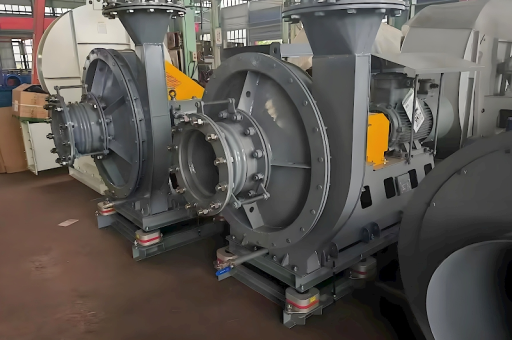
Mechanical noise originates from bearing wear, impeller imbalance, and structural resonance. High-quality fans use precision-grade ball bearings (with low radial play) or sleeve bearings for lower acoustic output. Rubber vibration isolators between the fan housing and the ductwork are essential to prevent structure-borne noise.
3 Electrical Noise (Motor Design)
Motor whine, often at multiples of the mains frequency (e.g., 60 Hz or 120 Hz harmonics), is a known issue. Electronically Commutated (EC) motors with sinusoidal drive reduce these harmonics significantly, producing a quieter audible profile.
Key Engineering Features for Noise Reduction
1 Blade Geometry: Backward-Curved vs. Airfoil
- Backward-Curved (BC) Blades: Exhibit a non-overloading power characteristic, meaning they draw less power at higher flows. This self-limiting feature reduces aerodynamic noise at high static pressure.
- Airfoil Blades: Hollow, aerodynamic shapes that create the highest efficiency (up to 85% static efficiency). They are significantly quieter than forward-curved blades because they minimize turbulence.
- Tip Clearance: A critical factor. Maintaining a tip clearance of less than 1% of the impeller diameter cuts noise by up to 3 dB.
2 Housing Design: Scroll Casing and Sound Dampening
The housing, or volute, must be aerodynamically optimized. A proper scroll shape (logarithmic spiral) collects the high-velocity air leaving the impeller and converts it to static pressure smoothly. Internal acoustic liners (closed-cell foam or fiberglass) can absorb mid-to-high frequency noise. External insulation cladding further reduces radiated noise.
3 Variable Speed Control (EC Technology)
Electronic Commutation allows precise RPM control. Running a fan at 80% speed instead of 100% reduces noise by approximately 6 dB(A) (a perceived halving of loudness) while only reducing airflow by about 20%. This is a hallmark of modern low-noise systems.
Real-World Applications and Case Studies
1 HVAC in Office Buildings
Modern LEED-certified buildings specify low-noise centrifugal fans for rooftop air handlers. In one case study, replacing standard forward-curved fans with backward-curved, airfoil-type units reduced the plenum noise from 62 dB(A) to 48 dB(A), satisfying stringent workplace noise norms.
2 Laboratory Fume Hoods
Biological safety cabinets require constant exhaust rates but demand near-silent operation to avoid disturbing sensitive experiments. Sophisticated centrifugal fans with variable-speed EC drives and soft-start circuits are now standard.
3 Wind Turbine Cooling Systems
This is a critical and often overlooked niche. Inside a wind turbine nacelle, the gearbox and generator generate substantial heat. The cooling fan must operate under high static pressure (due to the long, narrow duct paths) but cannot produce noise that would trigger community complaints or interfere with offshore vibration monitoring. Specialized low-noise centrifugal fans for wind turbine applications use corrosion-resistant aluminum impellers and acoustic baffles to maintain internal cooling without exceeding 60 dB(A) external noise at the nacelle wall. This design balances thermal management with silent operation, ensuring the wind turbine meets local noise regulations and extends component life.
Selection Guide: How to Choose a Low-Noise Centrifugal Fan
1 Performance Curve Analysis
Always request the manufacturer’s performance curve. Look for the "sound power level" (Lw) at the specific operating point, not just at free delivery. A fan that is too large will operate far from its BEP (Best Efficiency Point), creating more noise than a properly sized smaller fan running at medium speed.
2 Noise Level vs. Static Pressure Trade-off
There is no free lunch. A fan designed for ultra-low noise will often have a lower peak static pressure capability. If your system requires high pressure (e.g., a long duct with HEPA filters), you may need a slightly larger impeller running at lower RPM to meet both static pressure and noise targets.
Frequently Asked Questions (FAQ)
Q1: What is the quietest type of centrifugal fan blade? A: Airfoil-shaped, backward-curved blades are the quietest because they create the least aerodynamic turbulence. They are standard in premium low-noise models.
Q2: Can I make my existing centrifugal fan quieter? A: Yes. First, check for imbalance (clean the blades). Second, add rubber isolation mounts. Third, install variable speed controller to run it at lower RPM. Finally, consider an acoustic enclosure or duct silencer.
Q3: How does a low-noise centrifugal fan compare to an EC axial fan for a data center? A: For high-density server racks needing airflow through tight spaces and across heat sinks, the centrifugal fan’s higher static pressure capability typically wins. However, if the goal is pure cubic feet per minute (CFM) in an open environment, an EC axial fan is quieter at high flow.
Q4: Are low-noise centrifugal fans suitable for wind turbine nacelles? A: Absolutely. They handle the restricted, high-pressure duct paths typical in a wind turbine gearbox cooler. Their low acoustic signature is essential to comply with site noise limits and avoid disturbing wildlife or nearby infrastructure.
Q5: What is the typical life expectancy of a low-noise centrifugal fan? A: With regular maintenance (bearing greasing and cleaning), a quality unit can last 10 to 15 years in continuous operation. EC motor models often have a longer lifespan due to reduced thermal stress.
Conclusion: The Future of Quiet Air Movement
Low-noise centrifugal fans represent a convergence of aerodynamics, material science, and electrical engineering. As building energy codes tighten and community noise sensitivity increases, these fans will continue to evolve. Future innovations may include active noise cancellation (ANC) built into the housing and advanced composite blades that dampen vibration naturally. For specifiers, selecting a fan is no longer just about airflow—it is about creating a comfortable, quiet environment without sacrificing performance. Whether for a cleanroom, a commercial HVAC system, or a wind turbine gearbox cooler, the low-noise centrifugal fan is the unsung hero of silent, efficient ventilation.