This article's table of contents introduction:
- Article Directory
- Introduction: Why Mine Ventilation is Non-Negotiable
- What is a Mine Centrifugal Fan? Principle of Operation
- Types of Mine Centrifugal Fans: Forward-Curved vs. Backward-Curved
- Key Performance Metrics: Airflow, Pressure, and Efficiency
- Design Features for Harsh Mining Environments
- Comparison: Centrifugal Fans vs. Axial Fans for Mining
- Common Operational Challenges and Maintenance Solutions
- Smart Monitoring and VFD Integration for Energy Savings
- Frequently Asked Questions (FAQ)
- Conclusion: Future Trends in Mine Ventilation Technology
The Critical Role of Mine Centrifugal Fans in Underground Ventilation: Efficiency, Safety, and Optimization
Article Directory
- Introduction: Why Mine Ventilation is Non-Negotiable
- What is a Mine Centrifugal Fan? Principle of Operation
- Types of Mine Centrifugal Fans: Forward-Curved vs. Backward-Curved
- Key Performance Metrics: Airflow, Pressure, and Efficiency
- Design Features for Harsh Mining Environments
- Comparison: Centrifugal Fans vs. Axial Fans for Mining
- Common Operational Challenges and Maintenance Solutions
- Smart Monitoring and VFD Integration for Energy Savings
- Frequently Asked Questions (FAQ)
- Conclusion: Future Trends in Mine Ventilation Technology
Introduction: Why Mine Ventilation is Non-Negotiable
Underground mining poses significant environmental hazards, including the accumulation of toxic gases (methane, CO, H₂S), dust, and heat. Without a reliable ventilation system, these conditions can lead to explosions, respiratory diseases, or fatal asphyxiation. The mine centrifugal fan is the heart of any primary or auxiliary underground ventilation system. Unlike simple household fans, these heavy-duty machines must deliver high static pressure to overcome the resistance of long, narrow, and roughened underground tunnels.
Modern mining regulations (e.g., MSHA in the US, DGMS in India) mandate minimum airflow velocities to dilute contaminants. The centrifugal fan remains the preferred choice for main mine fans (MMF) due to its robust pressure-generating capability and stable performance under fluctuating underground conditions.
What is a Mine Centrifugal Fan? Principle of Operation
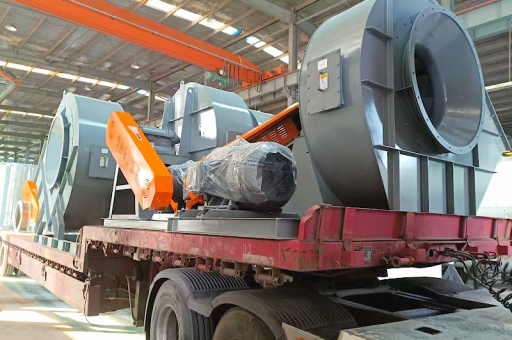
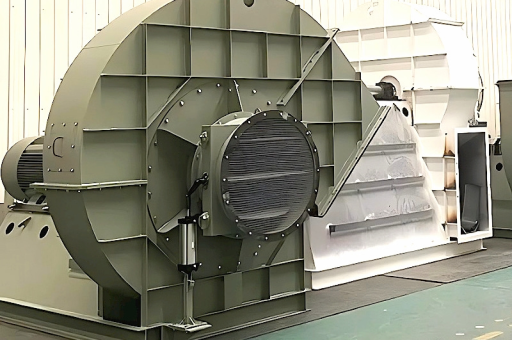
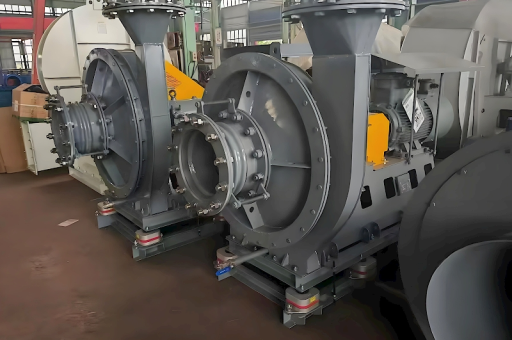
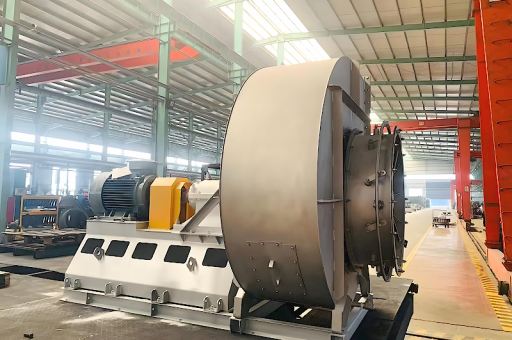
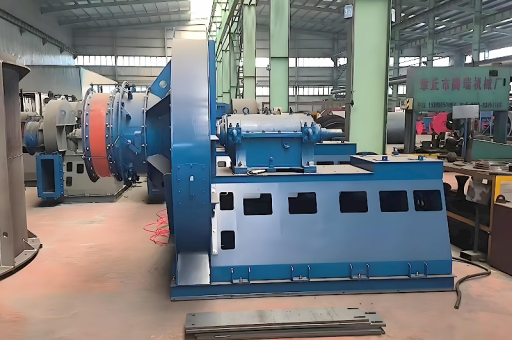
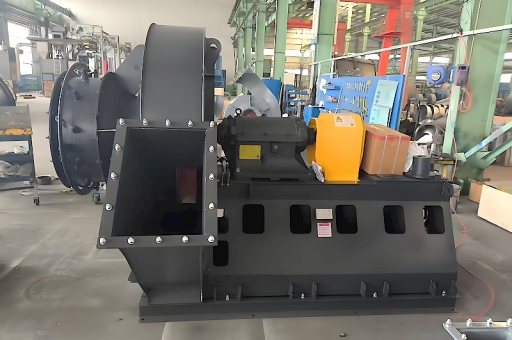
A mine centrifugal fan uses a rotating impeller to increase the velocity of air. Air enters the fan axially (parallel to the shaft), is caught by the rotating blades, and is flung outward radially by centrifugal force. This action increases both the kinetic energy and the static pressure of the air.
Key components include:
- Impeller: The rotating wheel with blades.
- Housing (Scroll): A spiral-shaped casing that converts velocity into pressure.
- Inlet box & Evase: Inlet guides streamline air; evase outlets recover kinetic energy.
The fundamental physics relies on Euler’s pump equation: The pressure rise is proportional to the square of the impeller tip speed. Therefore, mine centrifugal fans are often directly coupled to high-power motors (up to several megawatts) to achieve the necessary pressure (often 2,000–8,000 Pa) for deep or extended tunnels.
Types of Mine Centrifugal Fans: Forward-Curved vs. Backward-Curved
The blade geometry defines the fan’s performance curve:
-
Forward-Curved Blades (Squirrel Cage):
- Pros: Higher airflow for a given impeller diameter at low speed. Lower initial cost.
- Cons: Steep power curve; motor overload is possible if system resistance decreases. Lower efficiency (70–75%).
- Use Case: Auxiliary ventilation or shallow mines.
-
Backward-Curved Blades (Airfoil or Plate):
- Pros: Non-overloading power characteristic (safe if duct opens). Higher efficiency (85–90%). Quieter operation.
- Cons: Higher tip speed required for same pressure; more expensive.
- Use Case: Main mine fans (MMF), especially for deep or high-resistance mines.
Selection tip: For new installations, backward-curved airfoil fans are strongly recommended for their energy savings over the 20–30 year mine life.
Key Performance Metrics: Airflow, Pressure, and Efficiency
When specifying a mine centrifugal fan, engineers evaluate:
- Volume Flow Rate (Q): Measured in m³/s. Regulation requires at least 6 m³/s per MW of diesel equipment underground.
- Total Pressure (Pt): The sum of static pressure (overcome duct resistance) and velocity pressure. Mine fans typically operate at 1,500–6,000 Pa static pressure.
- Fan Efficiency (η): For lifecycle cost, efficiency is critical. A 5% efficiency gain can save tens of thousands of dollars annually in electricity for a 500 kW fan.
- System Resistance Curve: The fan must be selected to operate at its Best Efficiency Point (BEP) on the system curve. Off-peak operation causes vibration and energy waste.
Calculation example: To move 100 m³/s against 3,000 Pa resistance, the air power is 300 kW. At 85% efficiency, fan shaft power ~353 kW.
Design Features for Harsh Mining Environments
Mine centrifugal fans face corrosive gases, dust, high humidity, and sometimes explosive atmospheres. Key engineering adaptations include:
- Flameproof (Exd) Motors: In gassy coal mines, the motor is enclosed to contain any internal spark.
- Wear-Resistant Liners: Impeller blades and housing walls are clad with abrasion-resistant materials (e.g., Hardox or ceramic tiles) to extend life.
- Anti-Sparking Construction: Impellers made from aluminum bronze or stainless steel to prevent friction sparks.
- Variable Inlet Vanes (VIV): Allow airflow modulation without changing motor speed, improving part-load efficiency.
Comparison: Centrifugal Fans vs. Axial Fans for Mining
| Parameter | Centrifugal Fan | Axial Fan |
|---|---|---|
| Pressure Capability | Higher (up to 10,000 Pa) | Lower (typically < 2,500 Pa) |
| Efficiency at High Pressure | 80-90% | 70-80% |
| Size (for same flow) | Smaller diameter, larger width | Larger diameter, shorter width |
| Sound Level | Lower (blade pass frequency) | Higher (tonal noise) |
| Mine Type | Deep shaft, long tunnels | Short headings, face ventilation |
Conclusion: For mainstream mining duties with high resistance, centrifugal fans dominate. Axial fans are used for flexible, low-pressure booster applications.
Common Operational Challenges and Maintenance Solutions
- Vibration & Imbalance: Caused by dust buildup on blades. Solution: Periodic cleaning using compressed air or water wash systems (with fan offline).
- Bearing Failure: High loads from heavy impeller. Solution: Vibration monitoring (ISO 10816-3) with alarm thresholds; use of grease-lubricated spherical roller bearings.
- Performance Degradation: Due to internal wear. Solution: Annual performance testing with a pitot traverse; compare to factory curve; repair if deviation > 5%.
- Surge: At low flow, the fan can enter stall. Solution: Avoid running below minimum flow (typically 40% of design volume) or install anti-surge recirculation ducts.
Smart Monitoring and VFD Integration for Energy Savings
Modern best practice integrates Variable Frequency Drives (VFDs) with mine centrifugal fans. A VFD adjusts motor speed to match real-time ventilation demand. Energy savings of 30–50% are common because fan power is proportional to the cube of speed (P ∝ N³).
Additionally, Internet of Things (IoT) sensors on the fan measure:
- Motor winding temperature
- Vibration spectrum
- Static pressure differential This data feeds into a SCADA system (Supervisory Control and Data Acquisition) and enables predictive maintenance. For example, a mining operation implementing a wind turbine-themed energy recovery system can further offset electricity costs by using regenerative braking on downhill conveyor belts to power VFDs.
Frequently Asked Questions (FAQ)
Q1: How often should a mine centrifugal fan be inspected? A: A visual inspection is recommended weekly. A detailed inspection (including bearing temperature, vibration, and airflow verification) is required monthly per ISO 17359. Full strip-down overhaul every 5–10 years, depending on environment.
Q2: What is the typical lifespan of a mine centrifugal fan? A: With proper maintenance, 20–30 years is common. The housing can last 40+ years, while the impeller may need replacement every 10–15 years due to erosion or corrosion.
Q3: How do I increase airflow without changing the fan? A: Check for obstructions in the intake or duct. Cleaning screens and removing debris can raise flow by 5–10%. Alternatively, increase the fan speed via VFD. Caution: Never overspeed above the motor nameplate rating or the fan structural limit.
Q4: Are mine centrifugal fans explosion-proof? A: Many are, but certification is required (ATEX, IECEx for methane zones). The designation typically requires non-sparking materials, flameproof enclosure, and temperature control to prevent ignition.
Q5: Can a mine centrifugal fan be used for a wind turbine application? A: No, the aerodynamic design is opposite. A wind turbine extracts kinetic energy from wind to turn a generator, while a fan uses power to move air. Some hybrid mines use a wind turbine for power and then a centrifugal fan for ventilation, but they are distinct devices.
Conclusion: Future Trends in Mine Ventilation Technology
The mine centrifugal fan remains indispensable for underground safety. However, the industry is shifting toward “smart ventilation” – using real-time gas monitoring to modulate fan speed automatically. Combined with wind turbine-generated power on the mine site, these fans can operate with near-zero carbon emissions. Advancements in computational fluid dynamics (CFD) are also enabling more efficient impeller designs that reduce noise and extend component life.
Final thought: A well-engineered and well-maintained mine centrifugal fan is not just a piece of equipment—it is a life-saving asset. Investing in higher efficiency, monitoring, and variable-speed control pays back in reduced downtime, lower energy bills, and enhanced miner safety.