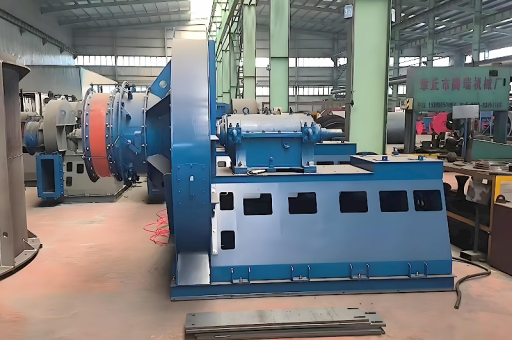
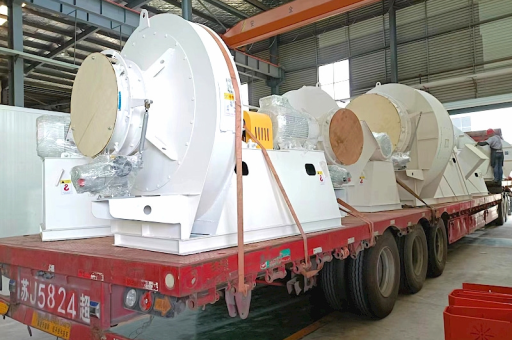
This article's table of contents introduction:
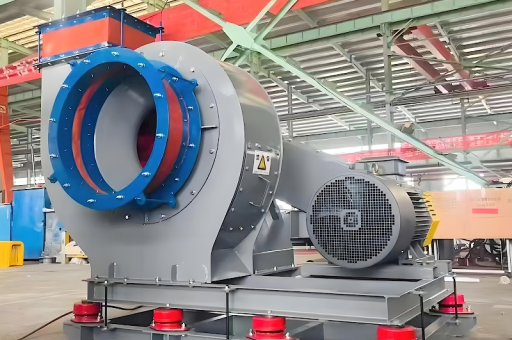
- What is a Centrifugal Induced Draft Fan?
- How It Works (Step-by-Step)
- Key Difference: Induced Draft vs. Forced Draft
- Types of Centrifugal Impellers Used for ID Fans
- Common Applications
- Common Problems & Maintenance
- Summary
Here is a comprehensive explanation of a Centrifugal Induced Draft (ID) Fan, covering its definition, working principle, key differences from forced draft fans, applications, and common issues.
What is a Centrifugal Induced Draft Fan?
A Centrifugal Induced Draft (ID) Fan is a type of mechanical fan used to create a negative pressure (vacuum) within a system, typically at the "exit" or "outlet" side of a process. Its primary job is to pull gases (like flue gas, exhaust air, or dust-laden air) out of a system and discharge them into the atmosphere or a pollution control device.
The term "centrifugal" refers to its operating principle: it uses a rotating impeller to accelerate air radially outward, increasing its pressure. "Induced draft" describes its location in the system—it is placed after the process it serves (e.g., a boiler, furnace, or kiln).
How It Works (Step-by-Step)
- Negative Pressure Creation: The fan is located at the end of the ductwork. When it runs, it sucks air/gas out of the system, creating a lower pressure (vacuum) inside the boiler, furnace, or duct.
- Gas Entry: Hot, corrosive, or dust-laden flue gases from the process are drawn into the fan's inlet (the eye of the impeller).
- Centrifugal Force: The impeller (a rotating wheel with blades) spins at high speed. The gas is caught by the blades and flung outward toward the fan housing (volute).
- Pressure & Velocity Rise: As the gas moves from the center to the outer edge, it gains kinetic energy (velocity) and static pressure.
- Discharge: The high-pressure gas exits the fan through a discharge outlet, typically leading to a chimney (stack), scrubber, baghouse, or heat recovery system.
Key Difference: Induced Draft vs. Forced Draft
This is the most critical distinction to understand.
| Feature | Induced Draft (ID) Fan | Forced Draft (FD) Fan |
|---|---|---|
| Location | At the outlet (exhaust) of the system | At the inlet of the system |
| Pressure Created | Negative pressure (vacuum) inside the system | Positive pressure (push) inside the system |
| Primary Function | Pull gases out of the system | Push fresh air into the system |
| Gas Handled | Hot, dirty, corrosive flue gas | Clean, cool, ambient air |
| Material | Heavy-duty, abrasion/corrosion resistant | Standard steel or lightweight materials |
| Application | Boiler exhaust, kiln exhaust, baghouse | Boiler burner air supply, HVAC |
The Analogy: For an industrial boiler:
- FD Fan: Blows air into the firebox (like blowing on a campfire).
- ID Fan: Sucks the smoke out of the chimney.
Types of Centrifugal Impellers Used for ID Fans
The choice of impeller blade design depends on the gas conditions (temperature, dust content, corrosiveness):
- Radial Blade (Paddlewheel):
- Best for: Heavy dust and sticky materials.
- Pros: Self-cleaning, rugged, handles high temperatures.
- Cons: Lower efficiency, noisy.
- Backward Curved (Airfoil or Flat):
- Best for: Clean to moderately dusty gases.
- Pros: Highest efficiency, quieter, non-overloading power curve.
- Cons: More expensive; blades can be sensitive to erosion from dust.
- Forward Curved (Squirrel Cage):
- Best for: Low pressure, high volume applications (often used in smaller ID systems or HVAC).
- Pros: Compact, low cost.
- Cons: Lower efficiency, prone to dust buildup.
Common Applications
- Power Plants: Boiler induced draft (pulling flue gas from the boiler, through scrubbers, to the stack).
- Cement Plants: Kiln exhaust and raw mill exhaust (handling extremely hot, abrasive dust).
- Steel Mills: Sinter plant exhaust, blast furnace gas exhaust.
- Pulp & Paper: Recovery boiler ID fans (handling corrosive gases).
- Incinerators: Waste-to-energy plants pulling hot flue gas through pollution control.
- HVAC: Large building exhaust systems or general ventilation.
Common Problems & Maintenance
Because they handle the worst gases in the system, ID fans require robust maintenance.
- Erosion (Abrasion): Dust particles traveling at high speed wear down the impeller blades, leading to imbalance and catastrophic failure. Solution: Hard-facing (welding on wear-resistant material), ceramic liners.
- Corrosion: Acidic flue gases (e.g., sulfuric acid from sulfur in fuel) attack the fan housing and impeller. This is worse if the gas temperature drops below the acid dew point. Solution: Stainless steel, fiber-reinforced plastic (FRP), or rubber/ceramic coatings.
- Imbalance: Caused by uneven dust buildup on the blades or wear. Leads to high vibration. Solution: Regular cleaning (water washing or shot blasting) and dynamic balancing.
- High Temperature: The fan, motor, bearings, and seals must handle temperatures up to 400°C (750°F) or more. Solution: Water-cooled bearings, high-temperature shaft seals, and cooling systems.
- Vibration: The most common indicator of trouble. Often caused by imbalance, misalignment, bearing wear, or foundation issues.
Summary
A Centrifugal Induced Draft Fan is the workhorse of industrial exhaust systems. It handles the toughest job: pulling hot, dirty, and corrosive gases out of a process. Its design must prioritize ruggedness and survivability over maximum efficiency, due to the harsh environment it operates in. Proper selection and maintenance are critical for plant uptime.