This article's table of contents introduction:
- Primary Purpose
- Critical Design Features (The "Heavy Duty" Difference)
- Common Types of Exhaust Fans Used
- Key Performance & Safety Considerations
- Common Failure Modes (and How to Avoid Them)
- Regulatory & Standards
- Summary Checklist for Specifying a Chemical Plant Exhaust Fan
Here is a comprehensive overview of chemical plant exhaust fans, covering their purpose, types, critical design features, and key operational considerations.
Primary Purpose
In a chemical plant, exhaust fans are not just for ventilation; they are critical safety and process control equipment. Their main functions are:
- Hazardous Gas & Fume Removal: Extracting toxic, flammable, corrosive, or asphyxiating gases from enclosed spaces (reactor buildings, storage areas, labs).
- Explosion Prevention: Diluting and removing flammable vapors to keep concentrations below the Lower Explosive Limit (LEL).
- Environmental Compliance: Capturing and directing emissions to scrubbers, thermal oxidizers, or carbon adsorption units before release to the atmosphere.
- Heat & Odor Control: Removing excessive heat, steam, or unpleasant odors from processing areas.
- Worker Safety: Maintaining breathable air quality in compliance with OSHA Permissible Exposure Limits (PELs).
Critical Design Features (The "Heavy Duty" Difference)
Chemical plant fans must withstand harsh environments. Standard HVAC fans will fail rapidly. Key design features include:
-
Material of Construction (MOC):
- FRP (Fiberglass Reinforced Plastic): The most common material for corrosive environments (acids, caustics, chlorides). It is lightweight, strong, and naturally corrosion-resistant.
- Stainless Steel (316L, 904L, Duplex): Used for high-temperature or mildly corrosive applications where FRP is not suitable.
- High-Alloy Metals (Hastelloy, Monel, Titanium): Required for extremely aggressive chemicals (e.g., wet chlorine, hydrochloric acid at high temps).
- Coated Carbon Steel: Sometimes used with heavy-duty epoxy or rubber linings for less severe service, but less durable than solid FRP or alloy.
-
Spark-Resistant Construction (AMCA Type A, B, C):
- Essential for flammable gases. The fan impeller and housing are designed to prevent mechanical sparks.
- Type A: All non-ferrous materials (e.g., aluminum impeller, FRP housing).
- Type B: Non-ferrous impeller, steel housing (with a spark-resistant liner).
- Type C: Steel impeller and housing (only safe in certain low-risk gas groups).
-
Shaft Sealing:
- To prevent process gases from leaking out along the rotating shaft (a major fugitive emission and safety risk).
- Options: Lip seals, labyrinth seals, mechanical seals, or purge air systems (using inert gas like nitrogen).
-
Belt Guard & Construction:
- Fully enclosed, heavy-gauge guards.
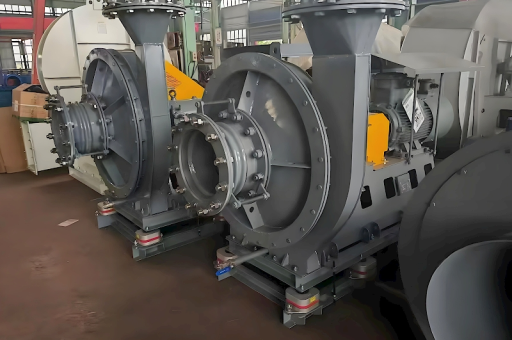
- Vibration isolators to reduce transmitted forces to ductwork and the building structure.
-
Motor & Drive:
- Explosion-Proof (XP) Motors: Rated for the specific chemical gas group (Class I, Div 1 or 2, Groups B, C, D).
- Variable Frequency Drives (VFDs): Often used for precise airflow control, energy savings, and soft-starting large motors. The VFD itself must be in a purge/pressurized cabinet if in a hazardous area.
Common Types of Exhaust Fans Used
| Fan Type | Best For | Key Advantage | Typical Application |
|---|---|---|---|
| Centrifugal (Radial) | High static pressure, long duct runs, scrubbers | Handles corrosive gases, high efficiency | Main process exhaust, scrubber inlet |
| Axial (Vaneaxial/Tubeaxial) | High volume, low pressure, general ventilation | Low cost, compact in duct | Wall exhaust, general building ventilation |
| Inline Centrifugal | Space-constrained ductwork, moderate pressure | Quieter than axial, mounts directly in duct | Laboratory exhaust, small process areas |
| FRP Roof Ventilators | Corrosive vapors, roof-mounted exhaust | Weatherproof, corrosion-resistant | Storage tank vents, reactor building roofs |
| High-Temp Fans (up to 1000°F) | Thermal oxidizers, kilns, dryers | Special alloy or ceramic coating | Exhaust from high-heat processes |
Key Performance & Safety Considerations
- Airflow (CFM) & Static Pressure (SP): Fans must be selected to overcome duct friction, scrubber pressure drop, and process equipment resistance. Undersizing is a major safety hazard.
- Spark Testing: Fans designated for flammable service must be tested and certified (e.g., AMCA Certified Ratings for spark resistance).
- Vibration Monitoring: Continuous vibration sensors (e.g., accelerometers) are often hardwired to the control room to detect bearing failure or impeller imbalance before catastrophic failure.
- Maintenance Access: Fans must have access doors, drain ports, and clean-out provisions for acid/solvent build-up. Bearing lubrication lines must extend to safe areas.
- Ductwork Isolation: Chemical exhaust ducts are often welded steel (for fire resistance) or FRP (for corrosion). They must have fire dampers or isolation dampers at building boundaries.
Common Failure Modes (and How to Avoid Them)
| Failure | Root Cause | Prevention |
|---|---|---|
| Corrosion | Wrong material for the chemical | Proper MOC selection, FRP for acids |
| Imbalance / Vibration | Dust/chemical build-up on blades | Regular cleaning, wash-down nozzles |
| Bearing Failure | Leaking process gas (corrosion), high temp | Proper shaft seals, cooling air, high-temp grease |
| Spark Generation | Metal-to-metal contact from worn parts | Regular tip clearance inspection, use of non-sparking materials |
| Motor Burnout | Overload from blocked duct, wrong voltage | VFD protection, proper motor sizing |
Regulatory & Standards
- OSHA 1910.94 (Ventilation): General ventilation requirements.
- OSHA 1910.307 (Hazardous Locations): Requirements for electrical equipment in classified areas.
- NFPA 91 (Exhaust Systems): Standard for blower and exhaust systems for dust, stock, and vapor removal.
- NFPA 68 (Deflagration Venting): May require explosion vents on fans handling flammable gases.
- AMCA 99 (Standards Handbook): Defines spark-resistant construction ratings.
- API 560 (Fired Heaters): Applications for fans in refinery/chemical plant fired heaters.
Summary Checklist for Specifying a Chemical Plant Exhaust Fan
- Identify the chemical(s): Name, concentration, temperature, and dew point.
- Determine the environment: Is it flammable (group & division)? Is it corrosive?
- Calculate airflow (CFM) and static pressure (SP): Include duct losses.
- Select material: FRP (for corrosion) or high-alloy (for high temp/aggressive).
- Choose spark resistance: Type A, B, or C as required.
- Specify the motor: Explosion-proof, correct HP, and hazardous location rating.
- Add safety accessories: Vibration sensors, shaft seal, clean-out doors, explosion vents.
- Plan for maintenance: Access to bearings, wash-down system, spare parts.
Bottom Line: A chemical plant exhaust fan is a custom-engineered safety device. Never substitute a standard commercial fan for this application. Always consult with a fan manufacturer that specializes in chemical process equipment (e.g., New York Blower, Howden, Greenheck (Industrial), or Croll Reynolds). Improper selection can lead to toxic leaks, fires, or explosions.