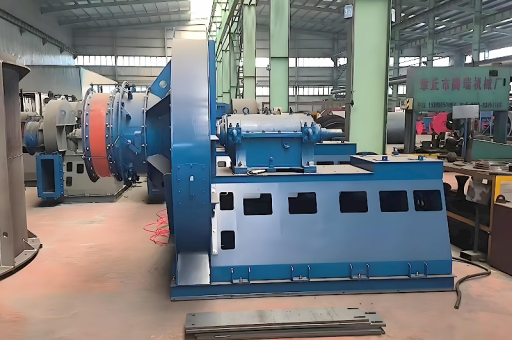
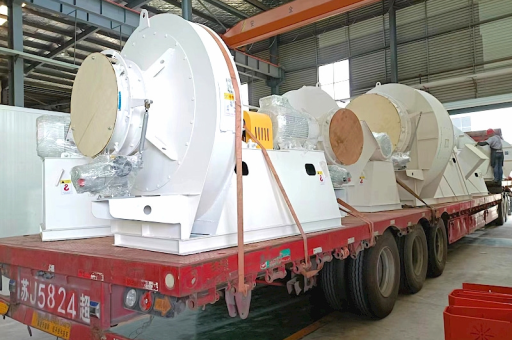
This article's table of contents introduction:
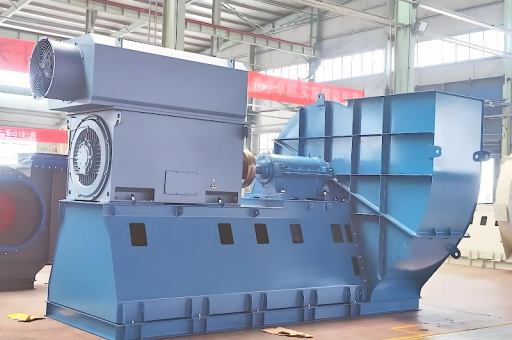
- What is a High-Temperature Resistant Fan?
- Key Applications
- Critical Components & Design Features
- Common Types of High-Temp Fans
- Key Specifications to Look For
- Summary Table: Fan Selection by Temperature
- Safety & Maintenance Tips
- Vendor Selection (Examples - Do your own research)
Here is a comprehensive guide to High-Temperature Resistant Fans, covering what they are, where they are used, key specifications, and types.
What is a High-Temperature Resistant Fan?
A high-temperature resistant fan (or heat fan) is a specialized industrial fan designed to operate reliably in environments with elevated temperatures, typically above 100°C (212°F) and often up to 500°C (932°F) or higher.
Standard fans fail in these conditions because:
- Motors overheat and burn out.
- Lubricants degrade or evaporate.
- Impellers and housings warp, crack, or lose structural integrity.
- Bearings seize.
High-temp fans overcome these challenges through robust construction, specialized materials, and cooling strategies.
Key Applications
These fans are critical in industries where heat is a byproduct or a required process element:
| Industry | Application | Typical Temp Range |
|---|---|---|
| HVAC / Building | Oven hoods, boiler flues, kitchen exhaust for charbroilers | 150°C - 300°C |
| Industrial Processing | Drying ovens, paint curing ovens, baking lines, autoclaves | 200°C - 500°C |
| Glass & Ceramics | Annealing lehrs, tempering furnaces | 400°C - 700°C+ |
| Metalworking | Forge exhaust, heat treatment furnaces, ladle drying | 300°C - 600°C |
| Foundries | Cupola furnace exhaust, sand reclamation systems | Up to 500°C |
| Pharmaceutical / Food | Sterilizing tunnels, drying processes (gentle heat) | 120°C - 250°C |
| Power Generation | Flue gas recirculation, biomass boiler exhaust | 200°C - 400°C |
Critical Components & Design Features
To survive extreme heat, these fans incorporate specific engineering:
Motor Types & Cooling
The motor is the most sensitive component. Three main strategies are used:
- Direct Drive (TENV/TEFC with Heat Shield): The motor shaft connects directly to the impeller. A thick heat shield is mounted between the motor and the fan housing. The motor itself is often TENV (Totally Enclosed Non-Ventilated) to prevent hot air from entering.
- Belt Drive (Pulley System): The motor is placed outside the airstream and connects to the fan shaft via belts and pulleys. This is the most common method for temperatures above 200°C, as the motor stays cool. The fan shaft is supported by bearings that require high-temp grease.
- Water-Cooled Motors: For extreme temperatures (e.g., > 500°C), the motor casing is jacketed with circulating water to keep it cool. The fan itself is often direct-drive.
- Air-Cooled Shaft: A secondary cooling fan (usually a small, simple impeller) is mounted on the shaft behind the heat shield to blow ambient air over the motor and bearings.
Bearings & Lubrication
- High-Temp Grease: Standard grease melts. Bearings are packed with specialized greases (e.g., PTFE-based, silicone-based, or molybdenum disulfide) rated for the specific operating temperature.
- External Grease Fittings: Bearings are often mounted externally so they can be re-greased while the fan is hot and running.
- Water-Cooled Bearings: In very high-temp applications, bearing housings may have water jackets.
Impeller & Housing Materials
| Temperature Range | Recommended Material | Notes |
|---|---|---|
| Up to 250°C | Heavy Gauge Carbon Steel (mild steel) | Acceptable for most ovens; thermal expansion is manageable. |
| 250°C - 500°C | Stainless Steel (304, 316) | Resists oxidation and scaling at high temps. Essential for corrosive fumes. |
| 400°C - 800°C+ | Inconel or Hastelloy (Nickel Superalloys) | Extremely high strength and oxidation resistance. Used in glass and metal industries. |
| All Temps | TIG Welded joints (not spot welded) | Prevents crack propagation from thermal cycling. |
Thermal Expansion Management
- Expansion Joints: The ductwork connecting to the fan must have flexible connectors to absorb the expansion/contraction of metal at high heat.
- Shaft Sealing: High-temp labyrinth seals or carbon ring seals prevent hot gas leakage along the shaft, which could damage bearings.
Common Types of High-Temp Fans
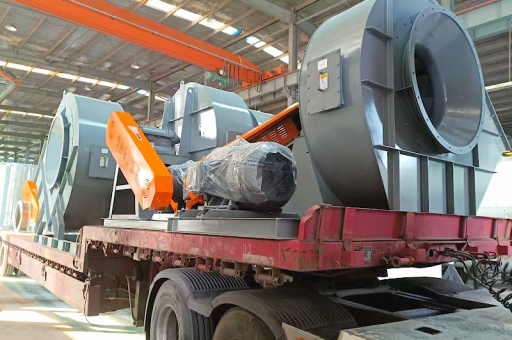
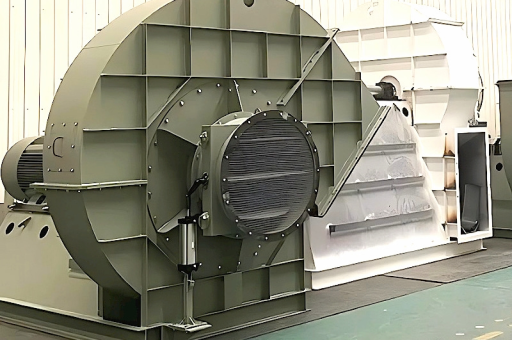
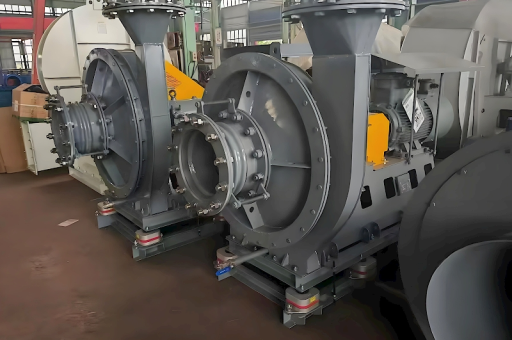
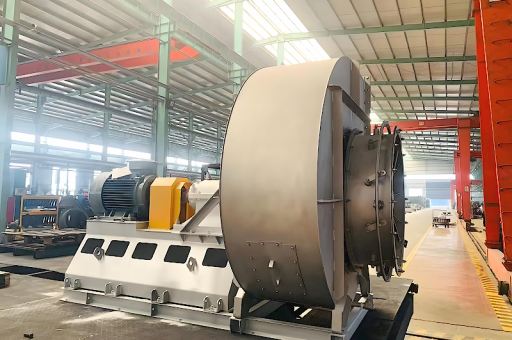
- Centrifugal (Radial) Fans: The most common type. They generate high pressure and are efficient for moving hot air through ductwork.
- Backward Curved Impeller: Most efficient, quiet, but less tolerant of dust.
- Radial Blade (Paddlewheel) Impeller: Simple, rugged, and self-cleaning. Ideal for dirty exhaust.
- Axial Fans: Used for high flow, low-pressure applications like general oven ventilation or cooling towers. They require careful motor protection.
- Squirrel Cage (in-line duct fans): Compact, often used in industrial ventilation.
Key Specifications to Look For
When specifying or buying a high-temp fan, you must define:
- Maximum Continuous Temperature: Not just the peak, but the operating temp.
- Volume Flow (CFM or m³/h): How much air needs to be moved.
- Static Pressure (SP): The resistance in the duct system (measured in inches w.g. or Pa).
- Gas Composition: Is it clean air, corrosive, or laden with particles (e.g., flour, sawdust, metal dust)?
- Ambient Temperature Around the Motor: If the motor is in a hot room (e.g., next to a furnace), it needs separate cooling or insulation.
- Material of Construction: Carbon steel, SS304, SS316, Inconel.
- Motor Mount: Direct drive (with heat shield) vs. Belt drive.
Summary Table: Fan Selection by Temperature
| Temperature | Motor Strategy | Impeller Material | Bearing Strategy | Typical Cost |
|---|---|---|---|---|
| 100 - 150°C | Standard TEFC Motor | Carbon Steel | Standard Grease | Low |
| 150 - 250°C | TENV with Heat Shield | Heavy Carbon Steel | High-Temp Grease | Medium |
| 250 - 400°C | Belt Drive (Motor external) | Stainless Steel (304/316) | High-Temp Grease + External Fittings | High |
| 400 - 600°C | Belt Drive or Water-Cooled | Stainless Steel (316) or Inconel | Water-Cooled Bearings | Very High |
| 600°C+ | Belt Drive (Motor far away) | Inconel / Hastelloy | Water-Cooled Bearings | Extreme |
Safety & Maintenance Tips
- Never stop a hot fan abruptly (unless it's an emergency). The rapid cooling can warp the impeller. Always let it cool down gradually if possible.
- Check thermal expansion. Ensure the ductwork has expansion joints, or the fan housing can crack.
- Grease regularly using the correct high-temp grease. Over-greasing can also cause failure.
- Monitor vibration. High heat can cause imbalance if debris hardens on the blades.
- Protect the motor. Ensure the motor is not exposed to direct radiant heat from the process.
Vendor Selection (Examples - Do your own research)
- Greenheck (Industrial fans)
- Cincinnati Fan (High-temp range)
- New York Blower (Industrial/Process fans)
- Howden (Heavy industrial)
- Twin City Fan (Custom high-temp)
- Soler & Palau (Industrial ventilation)
Need a specific recommendation? Provide the maximum temperature, air volume (CFM), duct diameter, and gas type (clean vs. dirty).