This article's table of contents introduction:
- Understanding the Core Components
- Engineering Challenges & Design Features
- Applications (Where would you use this?)
- Is a "True 1200°C" Ceramic Impeller Practical?
- Summary for Procurement/Engineering
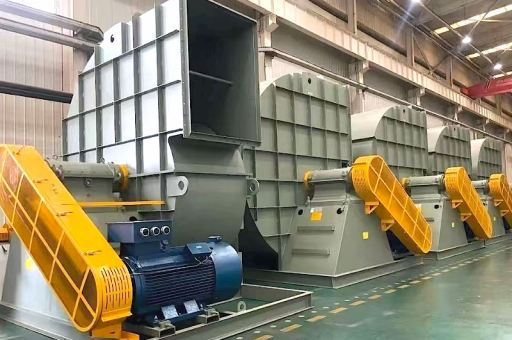
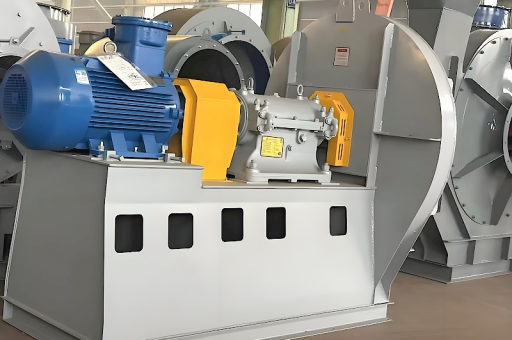
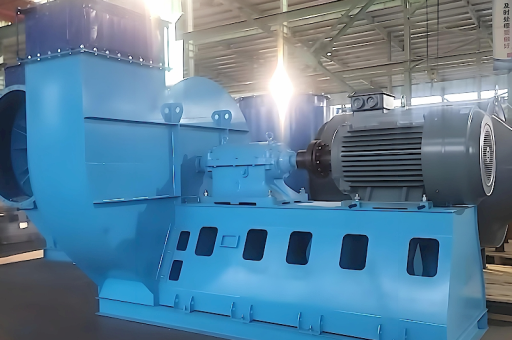
This is a highly specialized piece of industrial equipment. To understand what you are describing, we need to break down the specific technical requirements implied by "1200℃," "Centrifugal Exhaust Fan," and "Ceramic wear-resistant impellers."
This is not a standard industrial fan. A standard fan would fail within minutes at these temperatures.
Here is a detailed analysis of what this system entails, the engineering challenges, and the likely applications.
Understanding the Core Components
A. The "1200℃" Requirement (Extreme High Temperature)
- Challenge: No standard metal (steel, stainless steel) can withstand 1200°C (2192°F) while maintaining structural integrity for rotating parts like an impeller. At this temperature, metal loses most of its tensile strength and begins to creep or oxidize rapidly.
- The Misnomer: The air/gas being moved is likely not 1200°C at the fan itself. If the fan is rated for a 1200°C process gas, there must be a cooling system at the fan inlet or the fan is placed far enough downstream that the gas has cooled.
- Reality Check: A true "1200°C" fan usually means the fan can handle peaks or the system is designed with a dilution air inlet that drops the temperature to a survivable range (e.g., 600°C–850°C) before it hits the impeller.
- Fully 1200°C Gas: If the gas is truly 1200°C at the impeller, the only viable material for the impeller is a special ceramic or C/SiC (Carbon-Silicon Carbide) composite. Standard high-nickel alloys (like Inconel 718, Hastelloy X) will deform or fail above 1000°C in a rotating state.
B. The "Centrifugal Centrifugal Exhaust Fan"
- Function: Creates a pressure difference (draught) to pull hot, dirty gases out of a furnace or kiln.
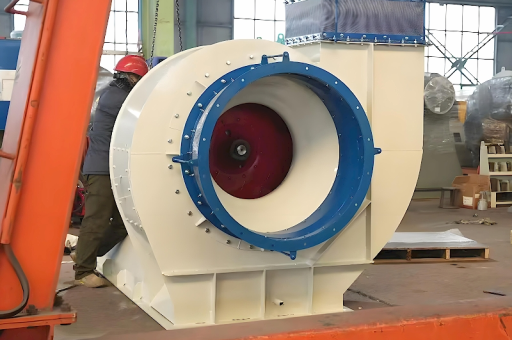
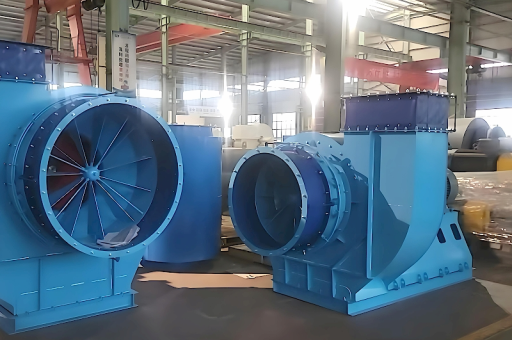
- Impeller Type: Backward-curved blades are preferred for high-temperature particulate-laden gases. They are less prone to material buildup and have a non-overloading power curve.
- Housing: Must be heavily insulated and actively cooled. Often, the housing is lined with refractory ceramic fiber (e.g., Kaowool, Cerachem) and has a water-cooled or air-cooled jacket to keep the external bearing housing and drive shaft below 200°C.
C. "Ceramic Wear-Resistant Impellers"
- Material Options:
- Reaction Bonded Silicon Carbide (RBSiC): The most common. Excellent thermal shock resistance and hardness. Can handle >1200°C in a reducing or neutral atmosphere.
- Sintered Silicon Carbide (SSiC): Extremely hard, but more expensive and slightly more brittle.
- Alumina (Al₂O₃): Cheaper, but lower thermal shock resistance. Prone to cracking if the gas temperature fluctuates rapidly.
- Ceramic Coating on Metal: A thin layer (e.g., APS or HVOF-sprayed ZrO₂/Al₂O₃) on a high-nickel alloy impeller. This is a compromise solution for lower thermal stress.
- Wear Resistance: The "wear" is not just erosion from dust (e.g., fly ash, silica dust). At 1200°C, chemical corrosion (hot corrosion from sulfur, chlorine, or vanadium in the gas) is often the dominant wear mechanism. Ceramics are resistant to this.
Engineering Challenges & Design Features
| Challenge | Solution in this Fan |
|---|---|
| Impeller Material Failure | Use monolithic SiC or alumina impeller. Must be cast/molded as a single piece (if small) or segmented and bonded. Cannot be welded like metal. |
| Shaft Connection | How do you connect a ceramic impeller to a steel drive shaft? The ceramic must be shrink-fit or keyed with a high-temperature alloy hub (e.g., a molybdenum or Inconel hub) that is mechanically clamped, not glued. |
| Thermal Expansion Mismatch | Ceramic expands much less than metal. The shaft hub must be designed with a flexible coupling or expansion gap to prevent the ceramic from shattering as the metal shaft grows. |
| Bearing Life | The drive shaft conducts heat. The fan must have a shaft cooling fan and a bearing housing cooling jacket (water glycol or forced air). Bearings are typically high-temp grease (e.g., Krytox) or oil-mist lubricated. |
| Gas Sealing | Hot gases will exit around the shaft. A high-temperature gas seal (carbon or labyrinth) is required to prevent premature bearing failure. |
| Vibration | Ceramic is brittle. The impeller must be balanced perfectly (to ISO G1.0 or better) and the fan must be isolated on a heavy base with vibration dampers. |
Applications (Where would you use this?)
- Cement & Lime Kilns: Exhausting hot, abrasive, alkaline dust from the preheater tower or rotary kiln outlet.
- Steelmaking: Electric Arc Furnace (EAF) fume extraction. The gas is 1000-1200°C with iron oxide dust.
- Glass Manufacturing: Exhaust from glass melting furnaces (rich in sodium sulfates and silica).
- Waste Incineration: Moving flue gas from the secondary combustion chamber that is heavily laden with fly ash and acidic compounds.
- Pyrometallurgy: Copper, nickel, or zinc smelting off-gas handling.
- Catalytic Cracking (Oil Refining): Exhaust from FCC regenerators (extremely hot, catalyst fines).
Is a "True 1200°C" Ceramic Impeller Practical?
Yes, but with strict limitations.
- Maximum RPM: The material limits the tip speed. A 100% ceramic impeller (RBSiC) is heavy (density ~3.1 g/cc) and has low tensile strength (brittle).
- Typical max tip speed for ceramics: 80 m/s (low to medium pressure).
- Typical max tip speed for metal: 150 m/s (high pressure).
- Physical Size: Large diameter (>1000mm) all-ceramic impellers are extremely difficult to manufacture reliably. Most are small to medium diameter.
- Cost: A 1200°C-rated ceramic impeller fan costs 5–10x more than a standard heavy-duty industrial fan.
Summary for Procurement/Engineering
If you are looking to specify or buy this fan, you need to clarify:
- Is 1200°C the process inlet temperature, or the temperature at the fan inlet? If the latter, you likely need dilution air.
- Is the ceramic an all-ceramic impeller (highest cost, best performance) or a ceramic-coated metal impeller (lower cost, medium temperature limit ~850°C)?
- What is the gas composition? (Air, reducing gas, sulfur/chlorine content).
- Is the fan for primary exhaust (high pressure) or secondary exhaust (low pressure / ID fan)?
Bottom line: This is not off-the-shelf. You are describing a custom-engineered solution from specialized manufacturers like New York Blower (NYB), Robinson Fans, Clarage, or a specialty ceramic fan maker like B&W MEGTEC or TLT-Turbo. Expect a lead time of 16-30 weeks and a budget well into the $50,000 - $200,000+ range depending on size.