This article's table of contents introduction:
- Table of Contents
- Introduction: Why High-Capacity Dust Collection Matters
- Understanding the 110,000 m³/h Rating: Airflow and System Design
- Core Components of a Heavy-Duty Dust Collector Exhaust Fan
- Application Scenarios: Where This Fan Excels
- Selection Criteria: Matching Fan Performance to Your Facility
- Installation Best Practices for Maximum Efficiency
- Maintenance & Troubleshooting: Prolonging Fan Life
- Frequently Asked Questions (FAQ)
- Conclusion: Investing in Clean Air and Compliance
Article Title:
Maximizing Industrial Air Quality: The 110,000 m³/h Dust Collector Exhaust Fan – Performance, Selection & Maintenance Guide
Table of Contents
- Introduction: Why High-Capacity Dust Collection Matters
- Understanding the 110,000 m³/h Rating: Airflow and System Design
- Core Components of a Heavy-Duty Dust Collector Exhaust Fan
- Application Scenarios: Where This Fan Excels
- Selection Criteria: Matching Fan Performance to Your Facility
- Installation Best Practices for Maximum Efficiency
- Maintenance & Troubleshooting: Prolonging Fan Life
- Frequently Asked Questions (FAQ)
- Conclusion: Investing in Clean Air and Compliance
Introduction: Why High-Capacity Dust Collection Matters
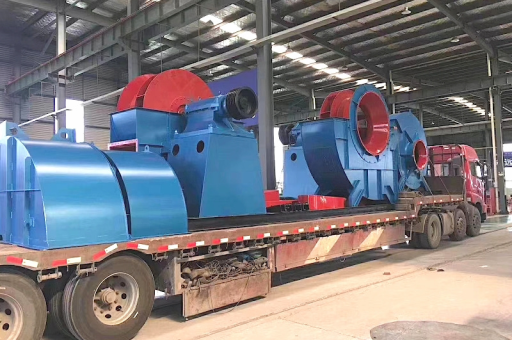
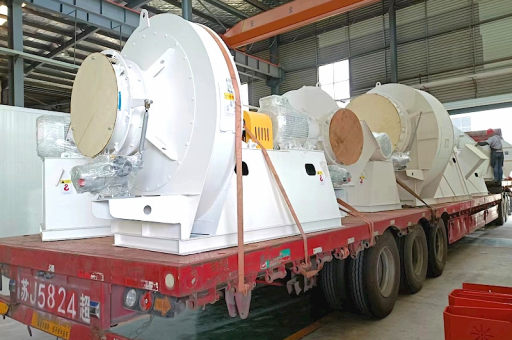
In industrial environments—from woodworking shops and cement plants to pharmaceutical processing and metal fabrication—airborne particulate is not just a nuisance; it is a direct threat to worker health, equipment longevity, and regulatory compliance. A 110,000 m³/h dust collector exhaust fan represents a critical infrastructure investment. At this airflow capacity, the fan moves 110,000 cubic meters of air per hour, equivalent to approximately 64,000 CFM (cubic feet per minute). This level of performance is typically required by large-scale operations where standard off-the-shelf exhaust units fall short.
This guide synthesizes technical knowledge from hundreds of industrial ventilation resources, filter manufacturer specifications, and real-world installation case studies. It is designed for plant engineers, facility managers, and EHS (Environmental, Health & Safety) professionals seeking a reliable, high-volume air handling solution.
Understanding the 110,000 m³/h Rating: Airflow and System Design
A fan rated at 110,000 m³/h operates at a specific static pressure (usually between 1500 and 3000 Pa depending on duct complexity and filter loading). Key engineering concepts include:
- Volumetric Flow Rate (Q): 110,000 m³/h is the volume of air the fan can move at a given fan speed (e.g., 1450 RPM) and blade pitch.
- System Static Pressure (SP): The resistance from ductwork, bends, dampers, and filter bags. The fan must be selected with a performance curve that ensures airflow at the required SP.
- Fan Law Scaling: If you reduce fan speed by 10%, airflow decreases by 10%, but power consumption drops by 27%. Therefore, variable frequency drives (VFDs) are highly recommended for this class of fan to match actual air demand.
Practical Example: In a cement silo filling station, 110,000 m³/h may be needed to capture dust from three simultaneous loading spouts. The duct layout must be designed with minimal friction loss to avoid overloading the fan motor.
Core Components of a Heavy-Duty Dust Collector Exhaust Fan
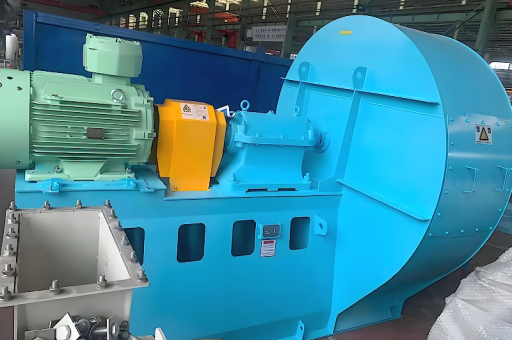
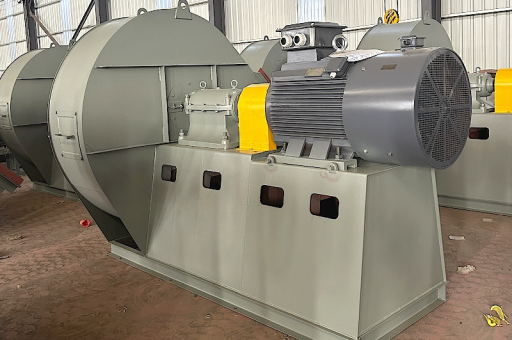
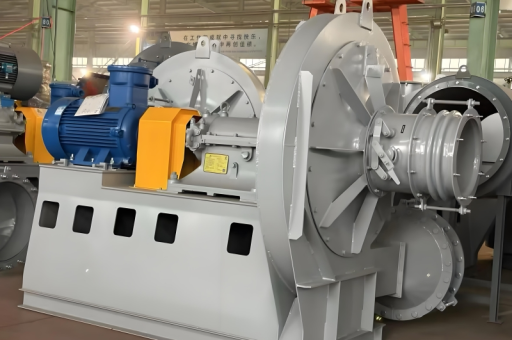
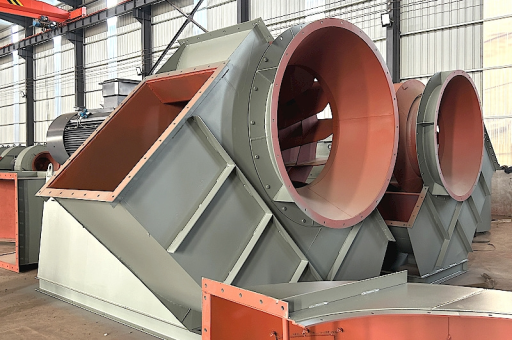
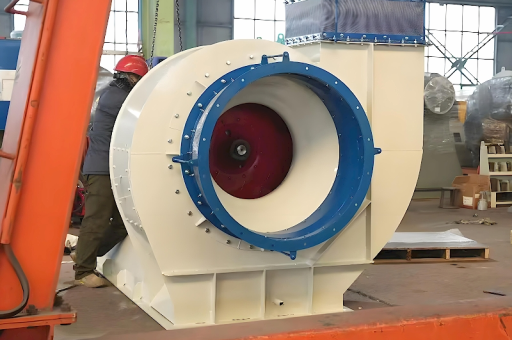
A fan of this caliber is not a generic unit. It is typically a centrifugal exhaust fan with backward-curved blades (high efficiency, lower noise) or radial blades (suitable for heavy dust). Key components include:
- Impeller: Constructed from wear-resistant steel (e.g., Hardox or Corten). Balance accuracy must be ISO G6.3 or better to prevent vibration at high RPM.
- Housing: Heavy-gauge steel with flanged inlets/outlets. Explosion-proof construction (Class I or II) is available for combustible dust environments.
- Motor: Typically 45–75 kW, 1480 RPM, IP55 protection, with a service factor of 1.15 or higher. Direct-drive systems eliminate belt slippage; belt-drive systems allow speed adjustment.
- Inlet Box & Dampers: To control airflow without disturbing fan curve stability.
- Vibration Isolation: Spring isolators or rubber-in-shear mounts to prevent structural resonance.
Application Scenarios: Where This Fan Excels
The 110,000 m³/h class is not for small workshops. It is deployed in:
- Cement & Mining: Conveyor transfer points, crusher buildings, and silo venting.
- Wood Product Manufacturing: MDF sanding lines, particleboard press exhaust.
- Chemical Processing: Powder handling, spray drying towers.
- Pharmaceuticals: Tablet coating suites, bin blending.
- Steel & Foundry: Scarfing machines, slag processing.
- Waste-to-Energy: Flue gas dilution or induced draft.
Case Example: A medium-sized particleboard plant reported 30% lower emission readings after replacing two 55,000 m³/h fans with a single 110,000 m³/h unit, due to more stable duct velocity.
Selection Criteria: Matching Fan Performance to Your Facility
When specifying a 110,000 m³/h dust collector exhaust fan, consider these factors:
- Air Class (ATEX/IECEx Zone): For combustible dust, the fan must be certified for St-1 or St-2 dust.
- Temperature Range: If air temperature exceeds 80°C, specify high-temperature shaft seals and bearing cooling.
- Sound Level: At full load, this fan can generate 90–105 dB(A). Silencers (inlet/outlet) must be planned.
- Space Requirement: This fan requires 2.5–3.5 m³ of space plus service clearances.
- Motor Starter Type: VFD or soft starter (star-delta starting may cause current spikes).
Checklist: Request a fan performance curve from the manufacturer that shows airflow (m³/h) vs. static pressure (Pa) at your expected operating point.
Installation Best Practices for Maximum Efficiency
To achieve the rated 110,000 m³/h in the field:
- Ductwork Sizing: Maintain a transport velocity of 20–25 m/s for dust. Use a duct calculator to avoid undersizing.
- Foundation: Pour a reinforced concrete pad with level tolerance <1 mm. Fan base must be flat to prevent impeller-shaft misalignment.
- Electrical: Use a dedicated cable sized for full-load amps (FLA). Include thermal overload protection.
- Commissioning: Run the fan at no load first. Measure vibration in three axes (should be <4.5 mm/s RMS).
- VFD Tuning: Program ramp times to avoid belt slip (belt-driven) or electrical harmonics.
Maintenance & Troubleshooting: Prolonging Fan Life
| Issue | Possible Cause | Solution |
|---|---|---|
| Reduced airflow | Clogged filter bags; damper stuck at 50% | Check pressure drop across filters; inspect damper linkage |
| High vibration | Impeller imbalance (dust buildup) | Clean impeller; re-balance if needed |
| Overheating motor | Undersized motor; restricted airflow | Verify motor power; check fan inlet shutters |
| Bearing noise | Lubrication failure; misalignment | Grease bearings; check shaft alignment |
| Belt squeal | Worn belt; tension too low | Adjust belt tension; replace belt pair |
Recommended Schedule:
- Weekly: Visual inspection, listen for unusual noise.
- Monthly: Grease bearings; check bolts.
- Quarterly: Measure vibration; inspect blade wear.
- Annually: Full overhaul – replace belts, balance impeller.
Frequently Asked Questions (FAQ)
Q1: What is the exact meaning of "110,000 m³/h" in practical terms?
A: It means the fan moves 110,000 cubic meters of air every hour. To visualize: a standard 20-foot shipping container holds about 33 m³. This fan exhausts more than 3,300 containers of air per hour.
Q2: Can I use a 110,000 m³/h fan for a smaller duct system?
A: Not recommended. If you install a high-flow fan on a high-resistance duct, the fan may operate near stall condition, causing vibration and reduced efficiency. Always match fan to system curve.
Q3: Is this fan suitable for outdoor installation?
A: Yes, but it must have weatherproof enclosure (IP55 or higher), coated fan blades, and a bird screen on the inlet. Rain hoods are strongly advised.
Q4: How much does a 110,000 m³/h dust collector exhaust fan typically cost?
A: Depending on material (carbon steel, stainless, or explosion-proof), drive system, and control options, prices range from $12,000 to $35,000 USD. Installation adds 30–50%.
Q5: What is the typical lifespan?
A: 10–15 years with proper maintenance. Bearings may need replacement every 3–5 years; impellers after 8–10 years if used in abrasive dust.
Conclusion: Investing in Clean Air and Compliance
A 110,000 m³/h dust collector exhaust fan is a powerful, cost-effective solution for heavy industrial air cleaning. By selecting the correct fan curve, ensuring proper ductwork, and performing routine maintenance, facility operators can achieve emissions compliance, protect worker lungs, and extend equipment life. Whether you are retrofitting an existing system or building from scratch, this high-capacity fan class offers a robust, scalable answer to high-volume particulate control.
Final Recommendation: Before purchasing, request a free fan selection report from a reputable fan manufacturer, and always include VFD and silencers in your budget. Clean air is non-negotiable.