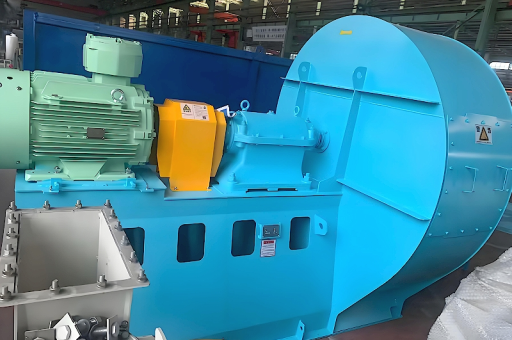
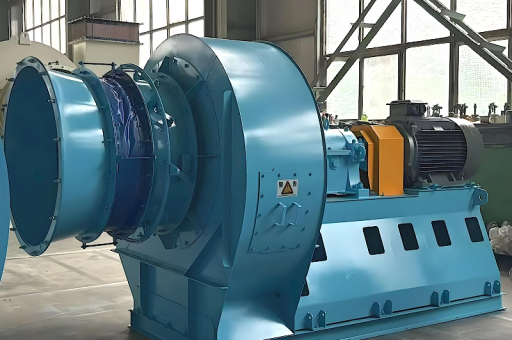
This article's table of contents introduction:
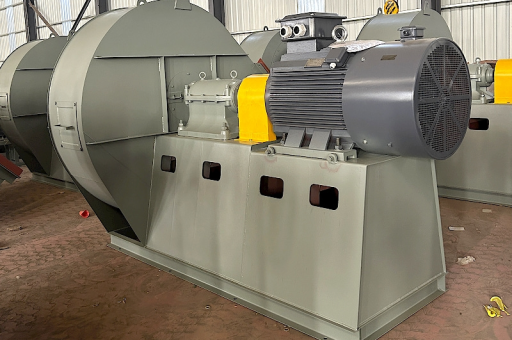
- Table of Contents
- Introduction: The Role of High-Capacity Exhaust Fans in Industrial Dust Collection
- Technical Specifications: What Does a 26000 m³/h Dust Collector Exhaust Fan Entail?
- Key Design Features: Impeller, Motor, and Housing Considerations
- Operational Benefits: Efficiency, Energy, and Compliance
- Installation Best Practices for Optimal Performance
- Frequently Asked Questions (FAQ)
- Conclusion: Future-Proofing Your Dust Collection System
** Maximizing Filtration Efficiency with a 26000 m³/h Dust Collector Exhaust Fan: A Comprehensive Technical Guide
Table of Contents
- Introduction: The Role of High-Capacity Exhaust Fans in Industrial Dust Collection
- Technical Specifications: What Does a 26000 m³/h Dust Collector Exhaust Fan Entail?
- Key Design Features: Impeller, Motor, and Housing Considerations
- Operational Benefits: Efficiency, Airflow, and Compliance
- Installation Best Practices for Optimal Performance
- Frequently Asked Questions (FAQ)
- Conclusion: Future-Proofing Your Dust Collection System
Introduction: The Role of High-Capacity Exhaust Fans in Industrial Dust Collection
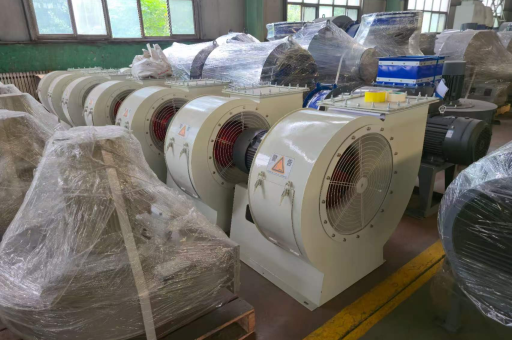
In modern industrial environments, airborne particulate matter poses significant risks to worker health, equipment integrity, and regulatory compliance. A 26000 m³/h Dust Collector Exhaust Fan represents a critical component in centralized dust management systems. This airflow capacity—equivalent to 15,300 CFM (cubic feet per minute)—is typically specified for medium-to-large facilities such as woodworking plants, metal fabrication shops, chemical processing units, and cement handling stations.
Unlike standard ventilation fans, a dedicated dust collector exhaust fan must overcome static pressure losses across filters, ducts, and hoods while maintaining consistent volumetric flow. The 26000 m³/h rating ensures that even when filters become moderately loaded, the system can still capture contaminants at the source. This article explores the engineering behind these fans, practical selection criteria, and operational strategies to maximize return on investment.
Technical Specifications: What Does a 26000 m³/h Dust Collector Exhaust Fan Entail?
A fan rated at 26000 m³/h is defined by several interlocking parameters:
- Airflow (Q): 26,000 cubic meters per hour (≈15,300 CFM)
- Static Pressure (P): Typically ranges from 1,500 to 3,500 Pa depending on filter density, duct length, and system resistance.
- Motor Power: For a direct-drive configuration, this airflow at 2,000 Pa static pressure requires approximately 18.5 kW to 22 kW motors (25–30 HP). Belt-driven options may vary based on pulley ratios.
- Speed: Backward-curved centrifugal fans at this scale often operate at 1,450–1,750 RPM (50 Hz/60 Hz).
- Sound Level: Expect around 75–85 dB(A) at 1 meter, requiring silencers in noise-sensitive areas.
It is crucial to note that a fan’s performance curve must match the system curve. Selecting a fan solely on airflow without verifying pressure capacity leads to underperformance or motor overload.
Key Design Features: Impeller, Motor, and Housing Considerations
For a 26000 m³/h dust collector exhaust fan, robust construction is non-negotiable.
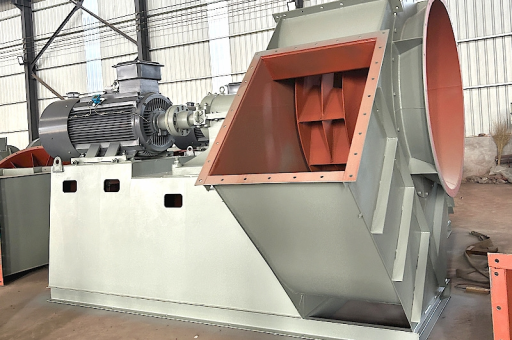
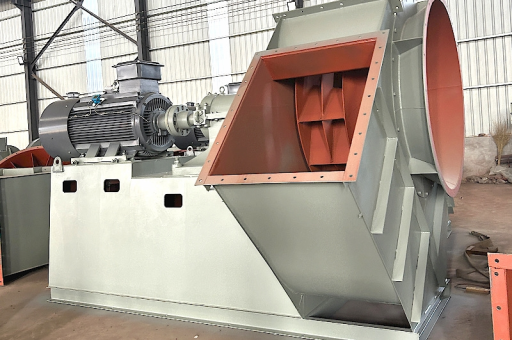
Impeller Type: Backward-curved impellers are the industry standard. They are self-limiting in power consumption (non-overloading) and handle particulate-laden air better than forward-curved designs. For applications with sticky or fibrous dust (e.g., textile lint, plastic regrind), a radial paddle wheel design might be preferred, though it requires higher motor power at equivalent airflow.
Housing & Material: A heavy-gauge steel housing with a minimum thickness of 4–5 mm prevents vibration-induced fatigue. For corrosive environments, options include stainless steel 304/316 or epoxy powder-coated finishes. Inlet boxes and transition pieces should match duct diameters (typically 600–800 mm) to minimize turbulence.
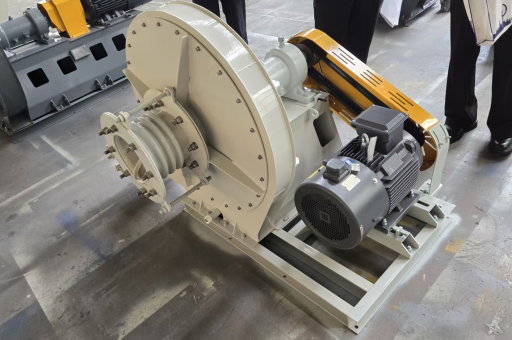
Motor & Drive Arrangement: Direct-driven fans eliminate belt maintenance but require a motor with sealed bearings for dust ingress protection (IP55 or higher). Belt-driven units allow speed adjustments via sheave changes, which is advantageous for systems with variable future requirements. The motor must be placed outside the main airflow path (e.g., using a ventilated motor stand) to prevent overheating from hot exhaust streams.
Operational Benefits: Efficiency, Energy, and Compliance
Investing in a correctly sized 26000 m³/h dust collector exhaust fan yields measurable gains:
- Energy Optimization: By selecting a fan that operates near its Best Efficiency Point (BEP), energy consumption can be reduced by 10–15% compared to an oversized unit. Variable Frequency Drives (VFDs) further allow modulation based on real-time dust generation.
- Filter Longevity: Consistent airflow prevents premature filter blinding. In many systems, a drop of just 5% in airflow can double the cleaning frequency of pulse-jet filters. The 26000 m³/h capacity ensures safety margin without excessive velocity.
- Regulatory Compliance: OSHA permissible exposure limits (PELs) for crystalline silica (0.05 mg/m³) and wood dust (1.0 mg/m³) are easier to maintain with a correctly designed exhaust system. The EPA and local air quality boards often require proof of captured air volume for permit renewals.
- Worker Comfort & Productivity: Lower ambient dust concentrations reduce respiratory complaints, leading to fewer sick days and higher morale.
Installation Best Practices for Optimal Performance
Even a high-quality 26000 m³/h fan will underperform if installation is flawed.
- Foundation & Vibration Isolation: Mount the fan on a concrete inertia base (at least 1.5 times the fan weight) with spring isolators. This prevents structural transmission of low-frequency vibration (5–15 Hz).
- Duct Sizing & Layout: Keep duct velocities between 18–23 m/s for general dust and 20–28 m/s for heavier particles. Avoid sudden expansions or contractions. A long-radius elbow at the fan inlet reduces pre-rotation losses.
- Electrical & Controls: Ensure the motor starter is rated for the locked-rotor current (typically 6–8 times full-load). A VFD should have a minimum 5% line reactor to mitigate harmonic distortion.
- Commissioning: Measure actual airflow using a pitot traverse test. Adjust belt tension or VFD frequency to achieve rated 26000 m³/h at design pressure. Document baseline performance for future maintenance checks.
Frequently Asked Questions (FAQ)
Q1: How do I know if my facility needs a 26000 m³/h exhaust fan? A: Conduct a heat-load and dust-generation assessment. For a 1,000 m² workshop with multiple grinding, sawing, or mixing stations, 2–3 air changes per minute (ACP) are typical. At 60,000 m³ room volume, 2 ACP requires at least 120,000 m³/h total; a single 26000 m³/h fan would serve one zone. Consult an industrial ventilation engineer for exact sizing.
Q2: Can I use this fan for high-temperature exhaust (e.g., 150°C)? A: Standard models are rated for up to 80°C continuous. For elevated temperatures, specify a high-temperature shaft seal, aluminum impeller (vs. steel), and a heat slinger on the motor shaft. For 150°C, a separate cooling fan on the motor is mandatory.
Q3: What is the typical power consumption of a 26000 m³/h fan? A: At 2,000 Pa static pressure, expect around 22 kW (29 HP) absorbed power. At 3,000 Pa, this rises to 32 kW. Multiply by operating hours to estimate annual energy costs. A VFD can reduce consumption by 30–40% during partial-load periods.
Q4: How often should I replace the fan bearings? A: With proper lubrication (grease every 2,000 hours or quarterly), cast-iron housing bearings last 20,000–40,000 hours. Symptoms of failure include unusual high-frequency noise, increased vibration, or seal leakage. Replace bearings in matched sets.
Q5: Does a dust collector exhaust fan require a spark-proof construction? A: Yes, if handling combustible dust (e.g., aluminum, coal, grain). Options include nonsparking aluminum impellers, steel housing with copper grounding straps, and motor enclosures rated for Class II Division 1/2 atmospheres (ATEX certified). Always verify local fire codes.
Conclusion: Future-Proofing Your Dust Collection System
A 26000 m³/h Dust Collector Exhaust Fan is not merely a ventilation component; it is the heart of an effective air quality management strategy. From reducing respirable dust exposures to extending filter life and lowering energy bills, the right fan selection can transform operational efficiency.
When specifying such a fan, prioritize backward-curved impellers for stability, match the motor power to your highest anticipated static pressure, and always include provisions for future capacity expansion (e.g., flanged inlet/outlet, removable access panels). By integrating this equipment with a modern PLC-based monitoring system that tracks airflow, pressure drop, and motor current, facility managers can transition from reactive maintenance to predictive optimization.
For any industrial setting that values worker safety, equipment reliability, and regulatory peace of mind, the 26000 m³/h exhaust fan stands as a benchmark of performance—provided it is chosen, installed, and maintained with precision.
For technical datasheets, selection software, or consultation on sizing a 26000 m³/h dust collector exhaust fan for your specific application, please contact your local industrial ventilation specialist or fan manufacturer directly.