This article's table of contents introduction:
- What is an FGR Fan and its Function?
- Critical Design & Operational Challenges
- Typical Specifications for a 90 kW FGR Fan
- Key Components & Construction
- Applications (Where you'd find a 90 kW FGR Fan)
- Efficiency & Energy Consumption
- Maintenance & Reliability
- Cost & Procurement
- Summary
Here is a comprehensive breakdown of a 90 kW Flue Gas Recirculation (FGR) Fan, covering its function, design considerations, specifications, and typical applications.
This is a large, high-power industrial fan used primarily in thermal power plants, large industrial boilers, and cement kilns.
What is an FGR Fan and its Function?
A Flue Gas Recirculation (FGR) Fan is a critical component in combustion systems designed to reduce Nitrogen Oxide (NOx) emissions.
- How it works: It takes a portion of the flue gas (the exhaust from the boiler/furnace) and re-injects it back into the combustion chamber.
- Why it works:
- Reduces Peak Flame Temperature: The recirculated flue gas is inert (mostly CO2 and N2) and has a high heat capacity. It absorbs heat, lowering the peak temperature in the flame zone.
- Suppresses NOx Formation: Thermal NOx formation is highly temperature-dependent. By lowering the flame temperature, the reaction between oxygen and nitrogen is drastically reduced.
- Lowers Oxygen Concentration: It dilutes the oxygen in the combustion air, further slowing the NOx formation reaction.
For a 90 kW fan, the "90 kW" refers to the power rating of the electric motor driving the fan. This indicates a high-pressure or high-volume application.
Critical Design & Operational Challenges
FGR fans operate in an extremely harsh environment. The design must account for:
- High Temperature: Flue gas temperatures can range from 150°C to 400°C (300°F to 750°F) or higher. The fan, bearings, and shaft seals must handle this.
- Corrosion: Flue gas contains acidic components (Sulfur Oxides - SOx, water vapor). As the gas cools, sulfuric acid can condense, causing severe corrosion.
- Erosion: The gas carries fly ash and other particulate matter, which can erode the fan blades and housing.
- Variable Speed: The recirculation rate must be precisely controlled based on boiler load and emission targets. This requires Variable Frequency Drives (VFDs) .
- High Density: Flue gas is denser than air, requiring more power to move the same volume.
Typical Specifications for a 90 kW FGR Fan
| Parameter | Typical Value / Range | Notes |
|---|---|---|
| Motor Power | 90 kW (120 HP) | The core spec you provided. |
| Voltage | 400V - 690V (3-Phase, 50/60 Hz) | Higher voltage is common for efficiency and reduced cable size. |
| Speed | 980 - 1480 RPM (4-pole) or 1450 - 2950 RPM (2-pole) | Often driven by a VFD; speed range is wide. |
| Flow Rate (Volume) | ~30,000 to 80,000 m³/h (17,700 to 47,100 CFM) | Highly dependent on system pressure drop. |
| Pressure Rise | ~2,000 to 6,000 Pa (8 to 24 in. w.g.) | High pressure is needed to overcome boiler draft losses. |
| Temperature | 180°C (350°F) continuous; 250°C (480°F) peak | Design temperature is critical for material selection. |
| Blade Type | Backward-curved, airfoil, or radial tip | Airfoil blades are most efficient; radial tips handle dust better. |
| Material (Impeller) | Corten (Atmospheric Corrosion Resistant Steel), Stainless Steel (SS316, SS304), or High-Nickel Alloys | SS316 is common for corrosion resistance. Corten is cheaper but less durable. |
| Material (Housing) | Carbon Steel with or without internal lining (e.g., ceramic, rubber) | Lining protects against erosion. |
| Drive Type | Direct Drive (preferred for reliability) or Belt Drive (for speed adjustment) | Direct drive minimizes maintenance. Belt drives offer mechanical speed adjustment. |
| Bearing Type | Spherical roller bearings with high-temperature grease | Often mounted on a sturdy base plate with cooling fins or a cooling fan. |
| Shaft Seal | Labyrinth seal or carbon ring seal | Prevents gas leakage into the bearing house and environment. |
| Vibration Monitoring | Accelerometers on bearing housings | Essential for Predictive Maintenance (PdM). |
| Standards | ISO 13795, API 673 (for heavy-duty), AMCA |
Key Components & Construction
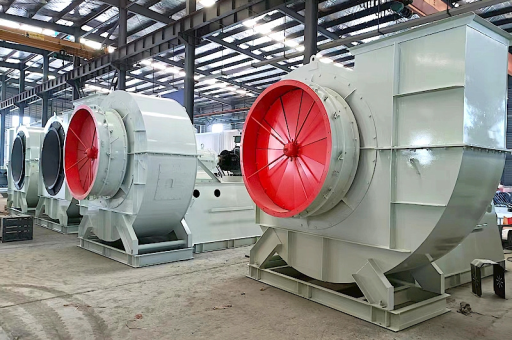
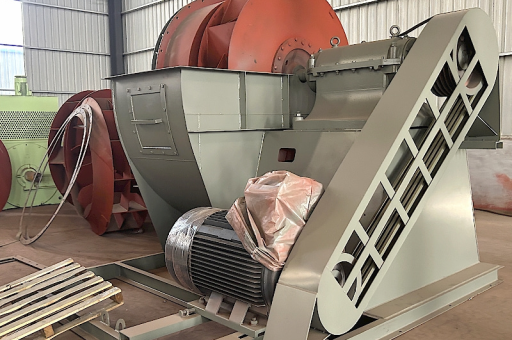
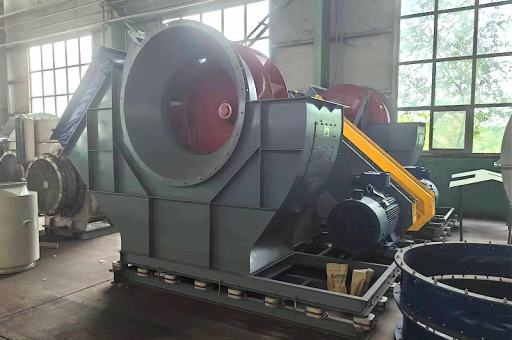
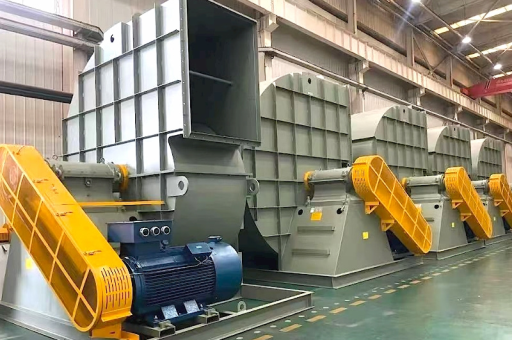
- Fan Housing: Heavy-gauge steel, split horizontally for easier maintenance access. Inlet and outlet elbows are often integrated.
- Impeller: The most critical part. High-strength steel with specially designed blades to minimize erosion and handle high temperatures.
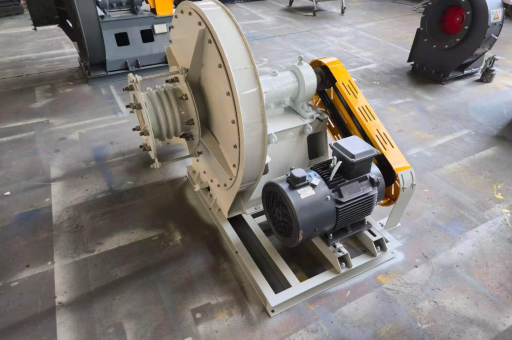
- Shaft: Large diameter, precision-ground, and supported by robust bearings. Often has a cooling fan on the end to keep the shaft cool.
- Motor: Typical TEFC (Totally Enclosed Fan Cooled) squirrel cage induction motor. High-efficiency (IE3 or IE4) is standard.
- Variable Frequency Drive (VFD): Essential for precise control of recirculation rate. It ramps the fan up/down smoothly and matches speed to the boiler's demand.
- Control Dampers: Inlet guide vanes or outlet dampers for manual or fixed-speed control (less common with VFDs).
Applications (Where you'd find a 90 kW FGR Fan)
- Coal-Fired Power Plants: Large utility boilers (200+ MW).
- Oil & Gas Boilers: Large industrial boilers in refineries, chemical plants, and district heating.
- Cement Kilns: To reduce NOx in the precalciner or main burner.
- Waste-to-Energy Plants: Combustion of municipal solid waste (MSW) requires strict NOx control.
- Biomass & CHP Plants: For combined heat and power, especially with stringent local emissions regulations.
Efficiency & Energy Consumption
- Efficiency: A well-designed airfoil blade FGR fan can achieve 85-90% static efficiency.
- Energy Cost: Running a 90 kW fan for 8,000 hours/year at $0.10/kWh costs about $72,000 USD per year. Therefore, even a 2% efficiency improvement saves a significant amount of money.
Maintenance & Reliability
- Critical Checks:
- Vibration Analysis: Weekly. Look for imbalances, bearing wear, or misalignment.
- Thermography: Monthly. Check bearing temperatures and motor winding temperatures.
- Bearing Lubrication: Follow manufacturer's schedule. High temp grease is mandatory.
- Impeller Inspection: Annually (or more often in harsh environments). Check for erosion, cracks, or build-up of deposits.
- Shaft Seal Inspection: Annually. Prevent gas leakage.
- Motor Insulation Resistance (Megger): Annually.
Cost & Procurement
- Equipment Cost: A complete 90 kW FGR fan unit (fan, motor, VFD, baseplate, isolation dampers, expansion joints) can range from $40,000 to $120,000 USD depending on material quality and manufacturer.
- Key Manufacturers:
- Howden (a Colfax company) – Very common in power generation.
- TLT-Turbo GmbH
- FläktGroup
- New York Blower
- Chicago Blower
- Siemens / Flender (for drives)
Summary
A 90 kW Flue Gas Recirculation Fan is a heavy-duty, high-performance piece of equipment essential for modern, environmentally compliant combustion. Its high power rating indicates it is used in a significant boiler or furnace system where a large volume of hot, corrosive, dusty gas must be recirculated against significant backpressure. Material selection, bearing protection, and a robust VFD are the three most critical factors for its successful long-term operation.