
This article's table of contents introduction:
- Table of Contents (导读目录)
- Introduction: The Core of Industrial Thermal Management
- What is a High Volume Air Blower Centrifugal Flow Fan?
- The Engineering Principle: How Centrifugal Force Creates High Pressure
- Critical Applications: Where High Pressure Heat Dissipation Matters
- Performance Parameters: Airflow vs. Static Pressure vs. Power
- Comparative Analysis: Centrifugal vs. Axial Fans for High Pressure
- Innovations in Heat Dissipation: Material & Design Evolution
- Frequently Asked Questions (FAQ)
- Conclusion: Selecting the Right System for Your Operation
*The Ultimate Guide to High Volume Air Blower Centrifugal Flow Fan: High Pressure Heat Dissipation for Industrial Efficiency*
Table of Contents (导读目录)
- Introduction: The Core of Industrial Thermal Management
- What is a High Volume Air Blower Centrifugal Flow Fan?
- The Engineering Principle: How Centrifugal Force Creates High Pressure
- Critical Applications: Where High Pressure Heat Dissipation Matters
- Performance Parameters: Airflow vs. Static Pressure vs. Power
- Comparative Analysis: Centrifugal vs. Axial Fans for High Pressure
- Innovations in Heat Dissipation: Material & Design Evolution
- Frequently Asked Questions (FAQ)
- Conclusion: Selecting the Right System for Your Operation
Introduction: The Core of Industrial Thermal Management
In modern industrial environments, the ability to move vast quantities of air against significant resistance is not a luxury—it is a necessity. Systems ranging from wind turbine cooling loops to heavy manufacturing dust collection rely on a specific class of equipment: the High Volume Air Blower Centrifugal Flow Fan. These machines are engineered to deliver high pressure heat dissipation, ensuring that sensitive electronics, combustion engines, and chemical processes remain within safe thermal thresholds.
Unlike simple desk fans, these blowers operate on the principle of centrifugal force. They accelerate air radially, converting kinetic energy into static pressure. This makes them uniquely suited for applications where ductwork, filters, or enclosed heat exchangers create backpressure. This article provides a deep, SEO-optimized analysis of how these fans work, why they are critical for high pressure heat dissipation, and how to select the right model for your industrial needs.
What is a High Volume Air Blower Centrifugal Flow Fan?
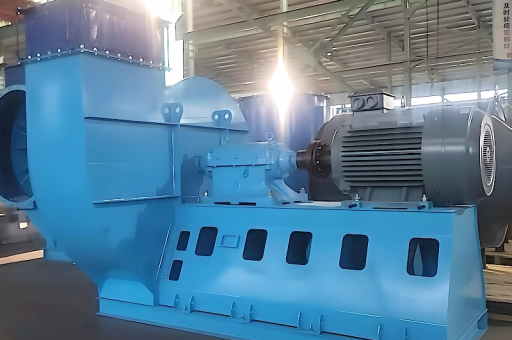
A high volume air blower centrifugal flow fan is a mechanical device designed to move large volumes of air (measured in CFM or m³/h) while generating substantial static pressure (measured in inches of water gauge or Pa). The key distinction lies in its "centrifugal flow" path:
- Air Inlet: Air is drawn axially into the center of a rotating impeller (also called a wheel).
- Acceleration: The impeller, fitted with radial or backward-curved blades, spins at high RPM. Centrifugal force flings the air outward.
- Discharge: The high-velocity air is collected in a spiral-shaped housing (volute) and discharged at a 90-degree angle to the inlet.
This design is fundamentally different from axial fans, which push air straight through. The centrifugal configuration allows the fan to overcome high system resistance—a crucial trait for high pressure heat dissipation in confined spaces like wind turbine nacelles or server room plenums.
The Engineering Principle: How Centrifugal Force Creates High Pressure
To understand high pressure heat dissipation, one must grasp the physics at play. The centrifugal fan converts the rotational energy of the impeller into two types of pressure:
- Velocity Pressure (Dynamic): The speed of the air leaving the blade tips.
- Static Pressure (Potential): The resistance against which the fan can push air.
The relationship is governed by the fan laws. Doubling the impeller speed quadruples the static pressure. This ability to build pressure is why these fans are chosen for wind turbine cooling systems. Inside a wind turbine, the generator and gearbox generate intense heat. A compact, high pressure centrifugal fan forces cooling air through narrow labyrinth seals and heat sinks, ensuring longevity.
Key Equation Insight:
HP = (CFM × SP) / (6356 × Efficiency)
Where SP is static pressure. This formula shows that for high volume and high pressure, motor horsepower must be significant.
Critical Applications: Where High Pressure Heat Dissipation Matters
The phrase High Pressure Heat Dissipation is not just a technical description; it defines a set of challenging environments:
| Application | Requirement | Fan Role |
|---|---|---|
| Wind Turbine Cooling | Remove heat from converters & generators | Forced air through dense heat sinks |
| HVAC Air Handling | Push air through long ducts & filters | Overcome static pressure losses |
| Industrial Oven Exhaust | Remove hot, contaminated air | High temp, high static pressure |
| Pneumatic Conveying | Move granular materials | High velocity against material drag |
| Data Center Cooling | Cool high-density server racks | Directed airflow under raised floors |
In each case, a standard fan fails because it cannot generate the required static pressure. The centrifugal flow fan excels, providing reliable heat dissipation even when air paths are tortuous.
Performance Parameters: Airflow vs. Static Pressure vs. Power
Selecting the right high volume air blower requires analyzing its performance curve. Do not simply look at maximum CFM. You must match the fan's curve to your system's resistance.
- Air Volume (Flow Rate): Measured in CFM or m³/h. "High Volume" typically means >10,000 CFM for large industrial units.
- Static Pressure: Measured in Pa or in.w.g. "High Pressure" often means >5 in.w.g. (1,244 Pa) for industrial blowers.
- Power Consumption: Measured in HP or kW. High pressure heat dissipation demands robust motors, often equipped with variable frequency drives (VFDs) for energy efficiency.
- Temperature Rating: For heat dissipation, the fan must survive the exhaust temperature. Aluminum impellers are common for lower temps; steel or specialty alloys are used for high-heat applications like wind turbine braking resistor cooling.
Pro Tip for SEO: When searching for solutions, use long-tail keywords like "high static pressure centrifugal blower for heat dissipation" or "industrial air mover high temperature exhaust."
Comparative Analysis: Centrifugal vs. Axial Fans for High Pressure
Many engineers mistakenly choose axial fans for cooling. Here is the critical distinction:
| Feature | Centrifugal Flow Fan | Axial Flow Fan |
|---|---|---|
| Pressure Capability | High (up to 40 in.w.g.) | Low (typically <2 in.w.g.) |
| Volume Handling | Medium to High | Very High |
| Efficiency at High Pressure | Excellent | Poor (stall risk) |
| Noise Profile | Moderate (broadband) | High (tonal) |
| Space Footprint | Larger (volute shape) | Compact (inline) |
Verdict: For any application requiring high pressure heat dissipation—such as cooling a wind turbine converter cabinet that is sealed against dust—centrifugal is the only viable choice.
Innovations in Heat Dissipation: Material & Design Evolution
The modern high volume air blower centrifugal flow fan has evolved significantly:
- Backward-Curved Impellers: These offer higher efficiency and a non-overloading power curve, meaning they won't burn out the motor if duct resistance drops.
- Aerodynamic Blading: Computational Fluid Dynamics (CFD) now optimizes blade angles to reduce turbulence, lowering noise while increasing static pressure.
- High-Temperature Bearings: For heat dissipation in foundries or exhaust systems, bearings are now sealed with high-temp grease or use magnetic levitation.
- Modular Housings: Many manufacturers now offer bolt-on inlets and outlets, allowing the fan to be integrated into a wind turbine nacelle without custom fabrication.
Frequently Asked Questions (FAQ)
Q1: Can a centrifugal fan handle corrosive gases for heat dissipation?
Yes. For high pressure heat dissipation in chemical plants, fans are coated with epoxy or made from stainless steel. The centrifugal design isolates the motor from the gas path.
Q2: How do I reduce noise from a High Volume Air Blower?
Noise is a byproduct of high tip speeds. Use sound enclosures, install silencers on the inlet/outlet, or select a backward-curved impeller which is inherently quieter than forward-curved models.
Q3: Is variable speed control important for heat dissipation?
Absolutely. In systems like a wind turbine, heat load varies with wind speed. A VFD allows the fan to run only as fast as needed, saving energy and extending bearing life.
Q4: What is the difference between a blower and a fan?
In practical terms, a "blower" typically refers to a centrifugal device that generates higher pressure. A "fan" often implies axial flow. However, the terms overlap. For high pressure heat dissipation, you always want a blower.
Q5: How do I calculate the required static pressure for my duct system?
Sum the pressure drops of all components: straight duct (friction), elbows, filters, dampers, and heat exchangers. Use ductwork software or manual tables. This value must be less than the fan's rated static pressure at your desired CFM.
Conclusion: Selecting the Right System for Your Operation
The High Volume Air Blower Centrifugal Flow Fan is an irreplaceable tool for high pressure heat dissipation. Whether you are cooling a 5 MW wind turbine generator, exhausting a foundry furnace, or pressurizing a cleanroom, the centrifugal design provides the necessary static pressure to push air through resistance.
When selecting a unit, prioritize the performance curve over maximum airflow. Ensure the motor size matches the brake horsepower required by the system. And remember, modern innovations like backward-curved impellers and VFD compatibility can dramatically reduce your total cost of ownership.
For engineers and procurement managers, understanding these principles is the first step toward reliable, efficient thermal management in the most demanding industrial environments.





