This article's table of contents introduction:
- Why Stainless Steel? The Critical Need
- Key Types of Stainless Steel Used
- Common Fan Types & Configurations
- Critical Selection Criteria (The "Wastewater Checklist")
- Common Manufacturers (Well-Known for Wastewater)
- Comparison Table
- Summary Recommendation
This is a highly specific and practical topic. Stainless steel exhaust fans are critical in wastewater treatment plants (WWTPs) due to the corrosive, humid, and often hazardous environment.
Here is a comprehensive breakdown of why they are used, the key specifications to look for, common applications, and factors to consider when selecting one.
Why Stainless Steel? The Critical Need
The atmosphere in a wastewater treatment plant is uniquely destructive.
- Hydrogen Sulfide (H₂S): Produced during anaerobic decomposition. In moisture, it forms sulfuric acid (H₂SO₄), which is highly corrosive to standard galvanized steel or painted fans.
- High Humidity: Constant moisture accelerates rust.
- Ammonia (NH₃) & Methane (CH₄): Corrosive or explosive gases that require spark-resistant materials.
- Chlorine & Ozone: Used for disinfection; these are powerful oxidizers that attack metals.
Standard fans (carbon steel, aluminum, galvanized) will fail rapidly. Stainless steel (specifically 304 and 316L) provides:
- Corrosion Resistance: The chromium oxide layer protects against chemical attack.
- Longevity: High initial cost, but significantly lower total cost of ownership (TCO) vs. replacing painted fans every 1-3 years.
- Hygiene: Non-porous, easy to clean for preventing biofilm growth.
- Spark Resistance: Non-ferrous or stainless construction is crucial for moving potentially explosive methane gas.
Key Types of Stainless Steel Used
| Grade | Application in WWTP | Pros | Cons |
|---|---|---|---|
| 304 SS | General ventilation, fresh air intake, drier sludge areas, pump rooms (low H₂S). | Good corrosion resistance, lower cost. | Fails in high-chloride, high-H₂S environments (pitting). |
| 316L SS | Wet wells, headworks, sludge tanks, dewatering, disinfection (chlorine) areas. This is the standard. | Excellent resistance to H₂S, chlorides, and acids. Low carbon prevents weld decay. | More expensive than 304. Heavier. |
Note: For extremely aggressive environments (e.g., anaerobic digesters with high H₂S), manufacturers may use Duplex Stainless Steel (e.g., 2205) for even higher strength and pitting resistance.
Common Fan Types & Configurations
Wastewater plants use several fan styles, each best for a specific task:
Axial Fans (Panel, Duct, Wall-Mounted)
- Best for: General ventilation, odor confinement, cooling electrical rooms.
- Pros: High volume, low pressure, compact, cost-effective (for SS).
- Key Features: Must have a rain shield, bird screen, and an explosion-proof (Class 1, Div 1 or 2) motor if near methane. The wheel is typically cast aluminum or 316SS.
- Common Use: Exhausting a room, moving air through a short duct.
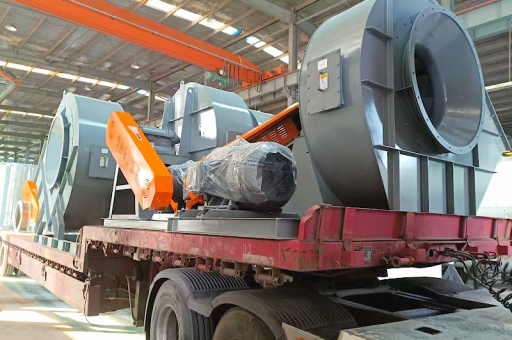
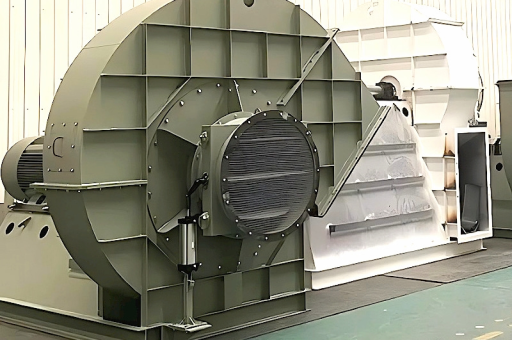
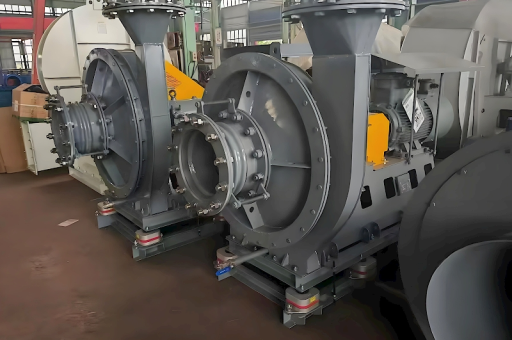
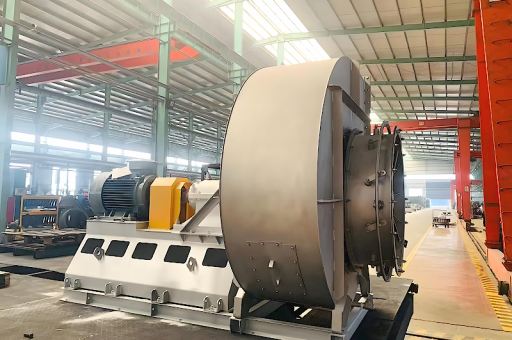
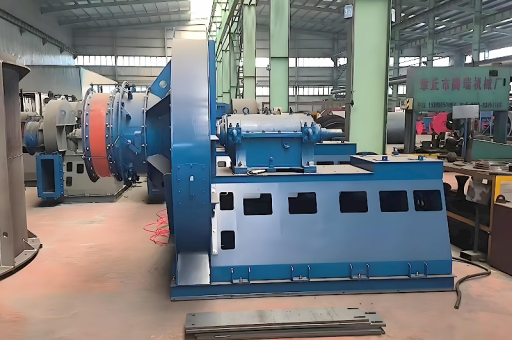
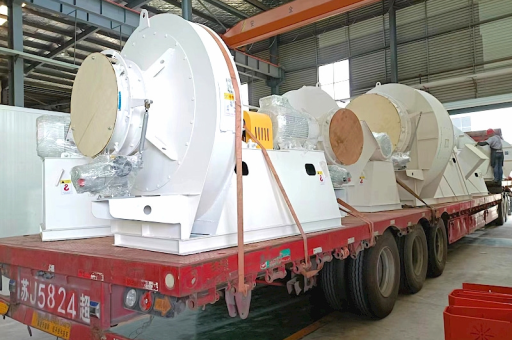
Centrifugal Fans (Squirrel Cage / Blower)
- Best for: Ducted systems, long runs, high static pressure (e.g., forced air into a biofilter or gas scrubber).
- Pros: Can handle high pressure and more resistance; can be belt-driven for speed adjustment.
- Key Features:
- Housing: 304 or 316L stainless.
- Wheel: Backward-inclined (most efficient) or radial (handles particulate/debris better). Must be spark-resistant (aluminum or non-ferrous wheel in a steel housing).
- Drainage: A bottom drain (sealed) is essential to prevent water pooling inside.
- Common Use: Exhausting a wet well, sludge thickening room, or filter press area.
Explosion-Proof (Class I, Division 1) Fans
- Mandatory in: Areas where methane or hydrogen gas can accumulate. This includes:
- Wet wells (confined spaces)
- Digester buildings
- Sludge storage tanks
- Construction: The entire fan assembly (housing, wheel, motor, wiring) is designed to contain an internal explosion without igniting the surrounding atmosphere. Motor is typically rated T3C or higher for methane. The fan must not have a motor inside the airstream unless it's a fully enclosed, explosion-proof motor.
Mixed-Flow / Inline Fans
- Best for: Ducted systems where space is tight (e.g., lying horizontally in a ceiling).
- Pros: Compact, good pressure, good flow.
- Key Features: Look for an UL 762 listing (for grease/grease-like vapor) or UL 705 for typical exhaust.
Critical Selection Criteria (The "Wastewater Checklist")
When purchasing, do not just ask for a "stainless fan." Ask the manufacturer for these specifics:
- Fan Material: Confirm housing is 316L, not just 304. Confirm wheel material (316L, aluminum, or coated steel). Confirm hardware (nuts, bolts) is also 316SS – a carbon steel bolt will ruin the seal.
- Motor Enclosure: TEFC (Totally Enclosed Fan Cooled) is standard. In wet environments, a Washdown Duty or Chemical Duty motor with special epoxy paint is best. Explosion-proof if required by code near methane.
- Bearings: For highly humid applications, sealed, regreasable bearings with labyrinth seals or V-ring seals are crucial to prevent moisture ingress.
- Drainage: Does the fan have a drain plug hole at the lowest point of the housing? If water condenses inside, it must drain out or it will pool and corrode the bottom.
- Housing Gasket: The motor-to-housing and housing-to-duct joints should have a neoprene or silicone gasket to prevent leaks.
- Fire/Smoke Rating: Some building codes require UL 705 (standard) or UL 762 (for kitchens/grease, but often used for sludge drying) and a 1-hour fire-rated damper for ducts penetrating fire walls.
- Certification: Look for AMCA (Air Movement and Control Association) seal for performance and sound rating. UL or CSA listing for safety (especially for explosion-proof).
Common Manufacturers (Well-Known for Wastewater)
These are not endorsements, but reputable brands that offer durable SS fans:
- Greenheck (Excellent for commercial/industrial - their "SW" series and explosion-proof models)
- Twin City Fan (Heavy-duty industrial, very good custom builds)
- New York Blower (NYB) (Extremely rugged, chemical/fume handling)
- Cincinnati Fan (Good for medium-duty corrosive exhaust)
- Hartzell (Air moving, heavy-duty industrial)
Comparison Table
| Feature | Standard Galvanized Fan | Stainless Steel Fan (316L) | Why It Matters in WWTP |
|---|---|---|---|
| Corrosion Resistance | Poor (H₂S/H₂SO₄ will eat through in months) | Excellent | 316L survives years in wet wells. |
| Spark Resistance | No (steel sparks if impacted by debris) | Yes (non-ferrous wheel or 316L is safe) | Critical for methane/explosive gas areas. |
| Cost (Initial) | Low ($500-$2,000) | High ($3,000-$15,000+) | Higher upfront, lower lifetime cost. |
| Maintenance | Frequent repainting or replacement (2-5 yrs) | Low (10-20 years typical) | Less downtime, no repainting. |
| Weight | Light | Heavy | Requires stronger mounting structure. |
| Typical Life in Wet Well | 1-3 years | 10-15 years | The 316L fan pays for itself 3x over. |
Summary Recommendation
For a wastewater treatment plant:
- Use 316L Stainless Steel for the entire fan assembly (housing, wheel, hardware, fasteners).
- Buy a TEFC Motor (Washdown duty if possible). Explosion-proof if the fan is located in a Class I, Div 1 or 2 area (e.g., wet well, digester building).
- Get a Centrifugal Fan for ducted systems (especially with scrubbers or biofilters) or an Axial Fan for general room ventilation.
- Always include a drain in the fan housing.
- Specify your exact H₂S concentration (the fan manufacturer will recommend the specific grade of stainless and any protective coatings like Heresite or Teflon if H₂S > 50 ppm).
If you have a specific application (wet well ventilation vs. sludge drying vs. an aeration blower room), the fan type and size will differ significantly. Let me know if you need help defining the airflow (CFM) and static pressure (SP) requirements for a specific area.