This article's table of contents introduction:
- The Critical Engineering Challenge: Material Selection
- The Bearing (The "Achilles Heel")
- Shaft Seal (Hot Gas Leakage)
- Motor & Drive Configuration
- Specific Design Features for 700°C
- Common Applications at 700°C
- Critical Safety & Operational Concerns
- Summary: What to Specify for a 700°C Fan
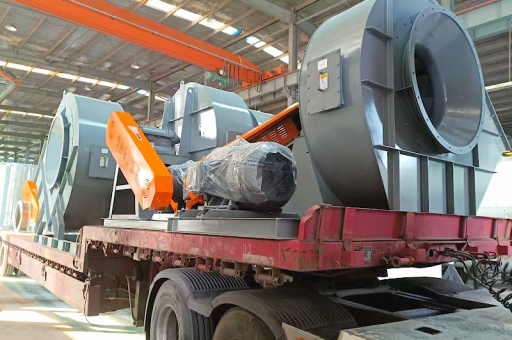
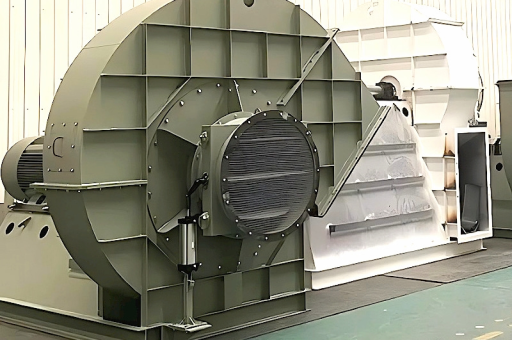
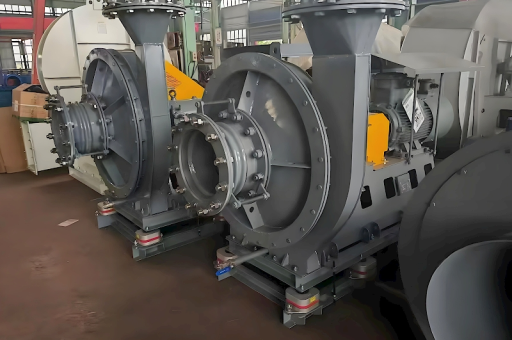
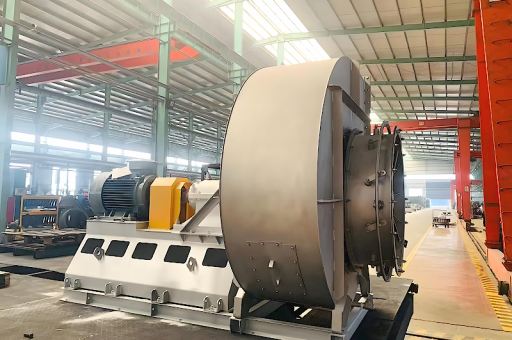
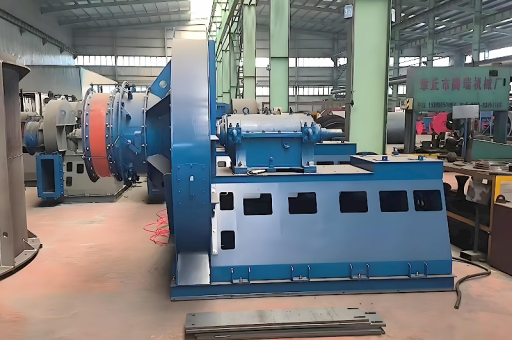
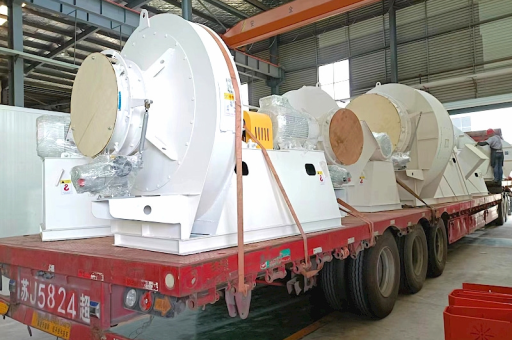
At 700°C (1,292°F), standard industrial fans fail rapidly due to metal creep, bearing failure, and thermal expansion. You are likely looking for High-Temperature Centrifugal Fans (often called "Hot Air Circulators" or "Process Fans").
These are specialized pieces of equipment used in industrial furnaces, kilns, flue gas handling, and heat treatment processes.
Here is the specific engineering breakdown for 700°C (Class C or Special) fans.
The Critical Engineering Challenge: Material Selection
At 700°C, standard carbon steel loses 90% of its structural strength. Materials must be chosen for creep resistance and oxidation resistance.
- Housing & Impeller: Typically made of Stainless Steel 310S or 309S (25% Chromium, 20% Nickel). These are austenitic stainless steels with high creep strength up to 1,000°C.
- Shaft: Usually Inconel 600, 601, or 625 (Nickel-Chromium superalloy) or RA330. These maintain strength at red heat.
- Bolts & Fasteners: Must be high-temperature alloys (A286 or Inconel) to prevent galling and seizing.
The Bearing (The "Achilles Heel")
Standard ball bearings (grease or oil) will carbonize and seize within minutes at 700°C. Solutions include:
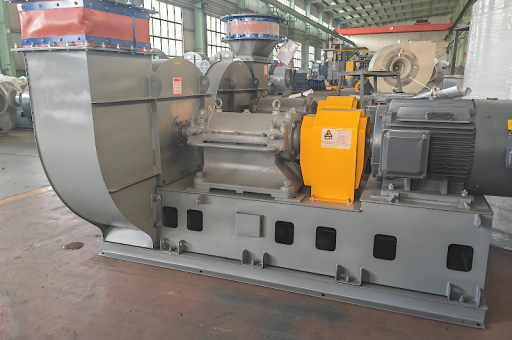
- Shaft Cooling (Mandatory): The shaft extends outside the hot zone. A cooling fan (venturi) is mounted on the shaft between the housing and the bearing to blow ambient air onto the shaft.
- Heat Radiator Disc: A large metal disc on the shaft between the impeller and the bearing to radiate heat away.
- Separated Mounting: Bearings are mounted on a pedestal base, physically separated from the fan housing by an air gap or a cooling collar.
- Lubrication: High-temp grease (Molykote or Krytox) for moderate temps, or a circulating oil system with an external heat exchanger for extreme duty.
Shaft Seal (Hot Gas Leakage)
At 700°C, conventional lip seals melt.
- Packing Gland: Graphite or PTFE (up to ~260°C) is insufficient. Carbon packing rings or ceramic fiber rope seals are used.
- Labyrinth Seal: A non-contact labyrinth seal combined with purge air (compressed air or nitrogen) to prevent hot gas from traveling up the shaft toward the bearing.
Motor & Drive Configuration
The motor must be out of the hot zone.
- Direct Drive (V-Belt or Coupling): The motor is mounted on the fan base, using a shaft extension with a cooling fan. This is preferred for high RPM.
- Belt Drive (Preferred for 700°C): The fan turns at a lower RPM (often 1450 or 1000 RPM) while the motor runs at 3000 RPM. This allows the motor to be further away and reduces thermal transmission via the shaft. Caution: Belts must be heat-resistant (e.g., Kevlar or HTD timing belts), and the belt guard must be ventilated.
- Motor Type: Standard TEFC motors are acceptable if ambient temp at motor is <40°C. For hot ambient, use C-Face mounted motors with a heat slinger or a separate forced ventilation motor.
Specific Design Features for 700°C
- Thermal Expansion: The housing and shaft expand differently. The impeller must have a loose fit on the shaft (no press fit) with a locking taper or split hub to allow expansion without seizing.
- Axial Expansion: The bearing housing must be mounted on a floating (stiff) base with a linear guide on the non-drive end to allow the shaft to expand axially without overloading bearings.
- Impeller Type: Usually radial bladed (paddle wheel) or backward inclined. Radial blades are self-cleaning for dirty gases and tolerate thermal shock better than airfoil blades.
- Welding: All welds must be performed with high-temp filler metals (e.g., 310 or Inconel 82) and stress-relieved. Standard TIG welding with SS filler will crack under thermal cycling.
Common Applications at 700°C
- Heat Treatment Furnaces: Recirculating furnace gases for uniform temperature.
- Kilns: Cement, lime, and ceramic kiln exhaust.
- Flue Gas Recirculation (FGR): In boiler systems.
- Glass Furnaces: Forced air for melters.
- Biomass/Waste-to-Energy: Moving high-temp combustion gases (often with particulate).
Critical Safety & Operational Concerns
- Variable Frequency Drive (VFD) is risky: Standard VFD cables and motors may not survive. Use class H insulation (180°C) or class C (220°C) for the motor if it's close. For motors far away, standard VFD is fine.
- Vibration Monitoring: Essential. High temp accelerates bearing wear and balance shifts due to thermal creep.
- Startup Procedure: Most high-temp fans must be started cold and allowed to warm up slowly (thermal soak) to prevent distortion. Never blast a cold fan with 700°C gas.
- Over-Temp Protection: A thermocouple near the shaft seal or bearing housing should trigger an alarm at ~90°C (beverage can be dangerous via conduction).
Summary: What to Specify for a 700°C Fan
| Component | Requirement |
|---|---|
| Housing Material | 310S Stainless Steel (or Inconel 600) |
| Impeller Material | 310S or RA330 Stainless Steel |
| Shaft Material | Inconel 625 or 20Cr-25Ni Stainless |
| Bearing Type | Split pillow block (SNL or SAF) with heat slinger |
| Cooling | Shaft-mounted cooling fan + heat radiator |
| Seal | Carbon ring or labyrinth with purge air |
| Horsepower | 10-50% more than calculated (due to hot gas density loss) |
| Max RPM | Limited by impeller material; typically < 3,000 RPM |
| Drive | Belt drive (preferred) with isolation base |
Bottom Line: You cannot buy a standard "high-temp" fan (rated 200-400°C) and push it to 700°C. A 700°C fan is a custom-engineered, heavy-duty machine costing significantly more (often 3-5x a standard fan). If you are dealing with this for a specific installation, you should contact manufacturers like Robinson Fans, New York Blower, AirPro Fan & Blower, or Cincinnati Fan with the specific flow (CFM) and pressure (WG) requirements.