This article's table of contents introduction:
- What is a High-Temperature Air-Cooled Fan?
- The Fundamental Design Challenge
- Key Engineering Components (How They Do It)
- Critical Operating Principle: Thermal Expansion
- Types of High-Temperature Air-Cooled Fans
- Common Applications & Industries
- Selection & Sizing Considerations
- Summary of Pros & Cons
- Maintenance Tips
Here is a detailed overview of High-Temperature Air-Cooled Fans, covering their purpose, design challenges, key components, types, and applications.
What is a High-Temperature Air-Cooled Fan?
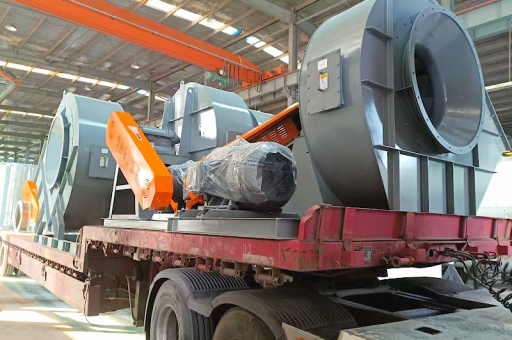
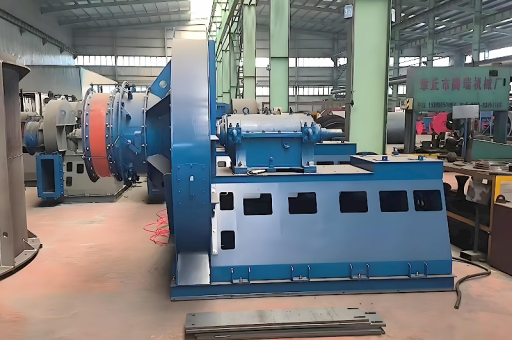
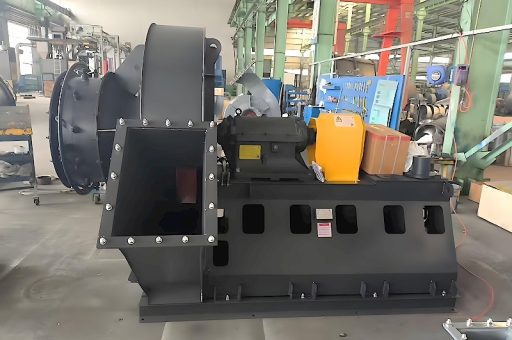
A high-temperature air-cooled fan is a specialized industrial fan designed to move air or exhaust gases at temperatures significantly higher than standard HVAC fans. While "high temperature" is relative, these fans typically handle continuous operating temperatures from 150°C (300°F) up to 650°C (1200°F) or even higher in specialized applications (e.g., 1000°C+ with ceramic components).
Their primary purpose is heat extraction, material handling, drying, or forced air circulation in hot processes.
The Fundamental Design Challenge
The biggest enemy of a standard fan is heat. Heat causes:
- Thermal Expansion: Different metals expand at different rates, causing fans to seize, shafts to bend, or impellers to rub against the housing.
- Loss of Material Strength: Steel loses up to 50% of its yield strength at 400°C (750°F). This leads to creep, warping, and catastrophic failure.
- Bearing & Motor Failure: Heat conducts down the shaft and destroys lubricants, seals, and motor windings.
- Thermal Stress: Rapid temperature changes can crack welds and components.
High-temperature fans are engineered specifically to overcome these issues.
Key Engineering Components (How They Do It)
| Component | High-Temp Solution | Why? |
|---|---|---|
| Impeller | High-strength alloy steel (e.g., 316/310 Stainless, Hastelloy, Inconel). Often radial bladed (paddle wheel) for strength and to handle heavy/dusty gases. Welds are stress-relieved. | To withstand creep and oxidation. Radial blades are less prone to thermal distortion than forward-curved. |
| Shaft | Long, often hollow shaft (to reduce heat conduction). Keyed for secure impeller attachment. Cooled externally if needed. | A long shaft creates a thermal barrier ("cooling neck") between the hot impeller and the bearings. A hollow shaft conducts heat slower. |
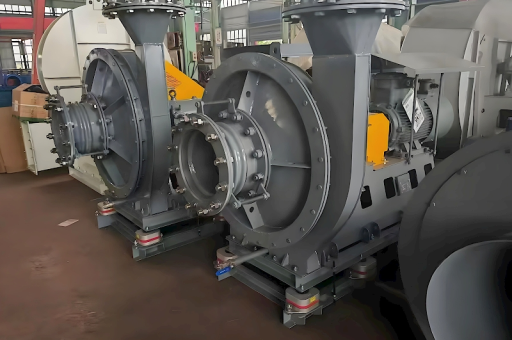
| Bearings | Located outside the hot gas stream. Mounted on a heavy pedestal base plate with cooling fins or a water jacket. | To keep lubricants from vaporizing and to prevent thermal damage. They cannot survive inside the hot zone. |
| Bearing Cooling | Shaft Cooling Discs: Metal discs on the shaft radiate heat away. Water Jackets: Cooling water circulates around the bearing housing. Forced Air: A small fan blows air over the shaft and bearings. |
Prevents heat migration from the impeller to the sensitive bearing assembly. |
| Motor & Drive | - Direct Drive (Belt/Chain): Motor is mounted away from the fan (often on the floor). - Direct Drive (Shaft-Mounted): Requires a heat slinger, long shaft, and often a TEFC (Totally Enclosed Fan Cooled) motor, but the motor must be kept in a cool zone. |
The motor cannot be in the hot gas stream. Belt drive allows the motor to be placed remotely. |
| Housing | Heavy-gauge carbon or stainless steel. Often lined with ceramic fiber or refractory castable. Includes drain plugs for condensation buildup. | To provide strength and insulation. Insulation reduces heat loss and protects personnel. |
Critical Operating Principle: Thermal Expansion
- Radial Clearance: The gap between the impeller tip and the housing is much larger than in a standard fan. This allows the impeller to expand as it heats up without striking the casing.
- Shaft Growth: The impeller expands axially on the shaft. The system must allow for this thermal growth without binding.
- Warm-Up Procedure: High-temp fans often require a slow, steady warm-up to allow all components to expand evenly and prevent thermal shock.
Types of High-Temperature Air-Cooled Fans
-
Radial (Centrifugal) Fans (Most Common):
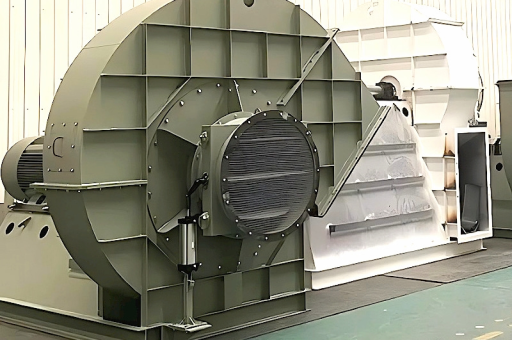
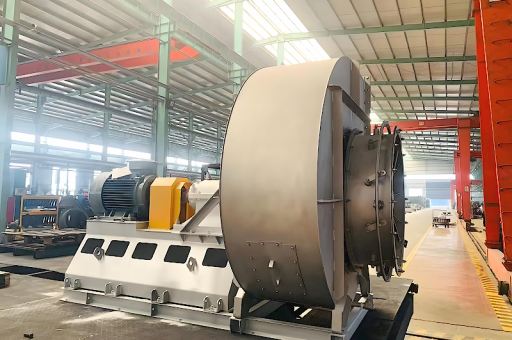
- Paddle Wheel/Radial Blade: Best for dirty, sticky, or high-temperature gases. Very robust. Handles particulate well. (Common in cement, steel, and boiler exhaust).
- Backward Inclined (BI): More efficient than paddle wheel. Good for clean, hot air up to ~400°C. Used in ovens and dryers.
- Forward Curved (FC): Not typically used for high temp due to weak blades that distort easily. Rarely used above 150°C.
-
Axial Fans (High-Volume, Lower Pressure):
- For applications like cooling towers, tunnel ventilation for hot processes, or large furnace exhaust.
- Use long, heavy-duty blades and remote bearings.
-
Plug Fans / Plenum Fans:
Specifically designed for industrial ovens and dryers. The fan is mounted inside a plenum box, and the hot air circulates directly through the impeller and motor (often requiring a special "cooling air" path for the motor).
Common Applications & Industries
- Metallurgy:
- Exhaust from furnaces (reheat, heat treat, melting).
- Forge ventilation.
- Steel mill cooling tables and exhaust.
- Cement & Minerals:
- Kiln exhaust fans.
- Cooler air fans (pulling air through hot clinker).
- Raw mill drying fans.
- Power Generation:
- Induced Draft (ID) fans on boilers (pulling hot flue gas through the boiler, scrubbers, and stack).
- Flue Gas Recirculation (FGR) fans.
- Chemical & Petrochemical:
- Thermal oxidizers & fume incinerators.
- Process dryers and kilns.
- Ovens & Drying:
- Industrial ovens (paint curing, baking, textile drying).
- Food processing (dryers, roasters).
- Environmental:
- Baghouse exhaust fans (inlet gas from hot processes).
Selection & Sizing Considerations
When specifying a high-temp fan, you must provide:
- Gas Temperature: Operating (continuous) and peak (transient) temperature.
- Gas Composition: Is it dirty (dust, fume), corrosive (acid gases), explosive?
- Flow & Pressure: Required CFM (volume) and static pressure (resistance).
- Drive Method: Direct, belt, or direct with a fluid coupling (often used for large ID fans).
- Cooling Method: Water jacket, forced air, heat slinger, or just a long shaft.
- Material Spec: 304, 316, 310, or specialized alloy.
- Start-Up Procedure: Can the fan start cold into a hot system, or must it ramp up slowly?
Summary of Pros & Cons
| Pros | Cons |
|---|---|
| Enables critical industrial processes. | Significantly more expensive than standard fans. |
| Highly robust and durable for harsh conditions. | Larger footprint (longer shaft, remote bearings). |
| Can handle large volumes of very hot gas. | Lower efficiency due to larger clearances and heavy impellers. |
| Can be engineered to handle corrosive or abrasive gases. | Requires careful warm-up/cool-down procedures. |
| Customizable for extreme temperatures (1000°C+). | Not suitable for high-efficiency, low-cost applications. |
Maintenance Tips
- Check Bearing Temperatures regularly (keep below 90°C / 200°F).
- Listen for Rub: A scraping sound indicates impeller expansion or warping.
- Monitor Vibration: Unbalance is a primary failure mode for hot fans (due to dust buildup or thermal distortion).
- Inspect Cooling Systems: Clean water jackets, check air cooling slots for obstructions.
- Perform Thermography: Use an IR camera to check for hotspots on the shaft or housing insulation.
In short: High-temperature air-cooled fans are heavy-duty, specialized machines designed to survive where standard fans would melt or warp. Their success lies in managing heat migration away from sensitive components (bearings, motor) and using materials that can handle the thermal stress.