This article's table of contents introduction:
- What is it?
- Primary Applications
- Critical Design Features for 700°C Operation
- Key Specifications to Look For (When Selecting)
- Important Safety & Operational Notes
- Example Manufacturers (Global & Regional)
- Summary
This is a specialized piece of industrial equipment. A 700℃ High-Temperature Centrifugal Exhaust Fan is designed to handle extreme thermal conditions that would destroy standard fans within minutes.
Here is a comprehensive breakdown of what this fan is, its applications, key design features, and selection criteria.
What is it?
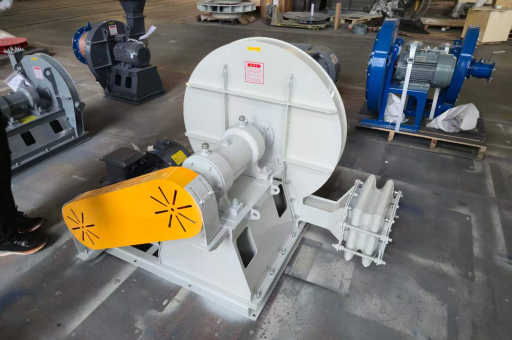
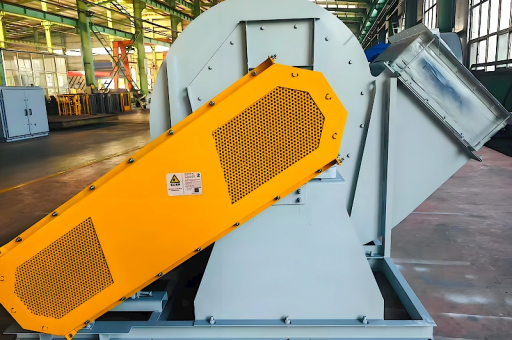
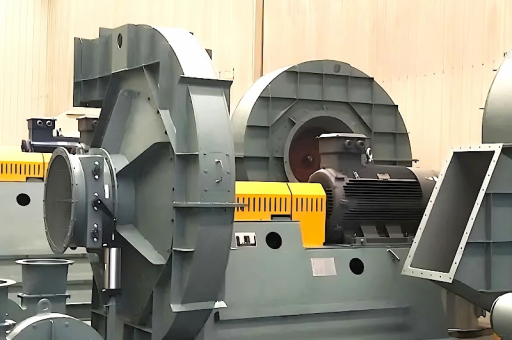
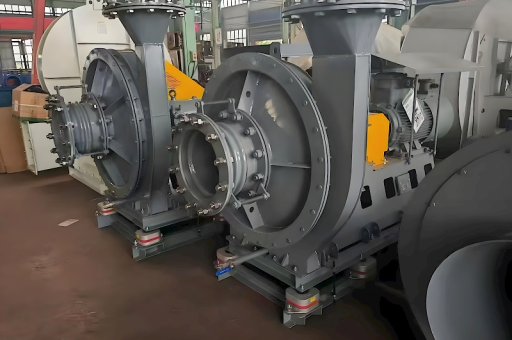
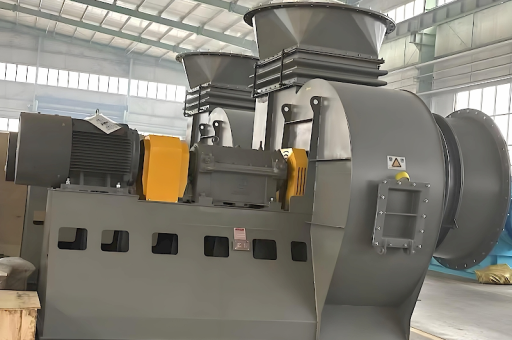
It is a centrifugal (radial) fan built to continuously extract or circulate air and gases at temperatures up to 700°C (1292°F) . Unlike standard fans that use electric motors directly in the airstream, these fans use a motor-on-base or belt-driven configuration to isolate the motor from the heat.
Primary Applications
These fans are critical in industries where high-temperature exhaust is a byproduct of the process.
- Industrial Ovens & Furnaces: Exhausting hot air from curing ovens, drying ovens, heat treatment furnaces, and ceramic kilns.
- Glass Manufacturing: Removing hot gases from glass forming and annealing processes.
- Cement & Lime Industry: Exhaust from kilns and preheaters.
- Metallurgy: Fume extraction from foundries, smelters, and forging operations.
- Waste Incineration: Handling flue gases in thermal oxidizers and incinerators.
- Power Generation: Forced draft or induced draft in biomass or coal-fired boilers (especially for recirculation).
Critical Design Features for 700°C Operation
To survive at 700°C, the fan must be engineered with specific materials and cooling strategies.
Motor Configuration (The most important part)
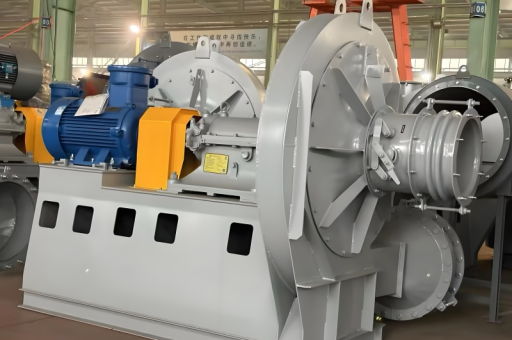
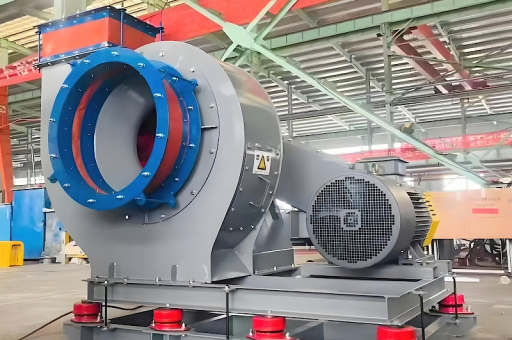
- No direct-drive motors. The motor is mounted externally on a heavy-duty baseplate.
- Shaft Cooling: A long, exposed shaft between the fan housing and the motor dissipates heat. A cooling fan (a separate, small impeller) is often mounted on the shaft near the bearing housing to blow ambient air over the shaft and bearings.
Materials of Construction
- Impeller (Wheel): Made from high-temperature alloys.
- Stainless Steel (309, 310S): Common for up to ~700°C. Offers good oxidation resistance.
- Inconel (600, 601, 625): Used for the most demanding applications (corrosive + high heat) or prolonged peak operation.
- Housing (Casing): Typically carbon steel for lower temps, but for 700°C, it is also made from stainless steel or heavy-gauge carbon steel with high-temperature ceramic fiber insulation on the inside.
- Bearings: High-temperature grease or specialized oil-lubricated bearings in a water-cooled or air-cooled bearing housing are mandatory.
Cooling Systems
- Shaft Cooling Fan: As mentioned, this is standard.
- Water-Cooled Bearings: Essential for sustained 700°C operation. Water jackets circulate coolant around the bearing housing to keep lubrication effective.
- Insulation: The fan housing is often externally insulated to protect personnel and reduce heat radiating back to the shaft.
Impeller Design
- Radial or Backward-Inclined Blades: Radial/paddle wheel designs are common because they are robust, self-cleaning, and handle particulate-laden hot gases well. Backward-inclined are more efficient for cleaner air.
- Robust Construction: Blades are often thicker than standard and welded with high-strength rods to prevent warping.
Shaft Seal
- A high-temperature labyrinth or carbon ring seal prevents hot gases from leaking out along the shaft towards the bearings.
Key Specifications to Look For (When Selecting)
When specifying a 700°C fan for a manufacturer (e.g., New York Blower, Cincinnati Fan, Greenheck, or a specialized Chinese manufacturer like Derun or Zibo), you must provide:
- Air Volume (CFM or m³/h): Required flow rate at operating temperature.
- Static Pressure (in. w.g. or Pa): Resistance the fan must overcome.
- Gas Temperature (°C/°F): Continuous operating temperature (e.g., 700°C) and any peak/transient temps.
- Gas Composition: Is it clean hot air, or does it contain corrosive fumes (HCl, SOx), abrasive dust (cement), or flammable vapors?
- Altitude: Affects air density and motor power requirements.
- Motor Configuration: Typically a TEFC (Totally Enclosed Fan Cooled) motor on a base with an adjustable belt drive for speed control.
Important Safety & Operational Notes
- Start-Up: Never start the fan while it is at 700°C. The fan must be started and run for a few minutes to establish airflow. The moving air cools the shaft, bearings, and impeller, preventing thermal shock and bearing failure.
- Shut-Down: Similarly, after shutting down overheated process equipment, it is advisable to run the fan for a cool-down period (e.g., 30 minutes) if the gas is still hot.
- Balance: At 700°C, thermal expansion is significant. The impeller must be dynamically balanced at operating temperature or designed with expansion gaps in mind.
- Corrosion: 700°C is the upper limit for many stainless steels. If the gas contains chlorides or sulfur, the alloy must be carefully selected (e.g., Inconel 601) to prevent catastrophic high-temperature corrosion (hot corrosion).
Example Manufacturers (Global & Regional)
- Licensed/Industrial: New York Blower (USA), Howden (Global), FläktGroup (Europe), Cincinnati Fan (USA).
- High-Temp Specialists: Moffitt Corporation, Thermal Component Technologies.
- Chinese Manufacturers (Competitive): Zibo Decheng (Derun Fans), Zhejiang Xingyuan, Shanghai Ventilator. Note: Require very detailed specs and material certifications when purchasing from non-Western manufacturers for safety-critical 700°C use.
Summary
A 700°C fan is not just a "heavy-duty" fan; it is a specific engineering solution. If you are buying one, expect a high price point (often 3-10x a standard fan), a long lead time (custom materials), and a requirement for cooling water hookups. The most common failure points are bearing failure (due to heat migration) and impeller cracking (due to thermal fatigue). Proper material selection and cooling are paramount.