This article's table of contents introduction:
- Decoding the Specifications
- Critical Engineering Calculation: Power Requirement
- Typical Applications for this Spec
- Key Selection Considerations (Important!)
- Sizing Check: Are the specs correct?
- Final Verdict
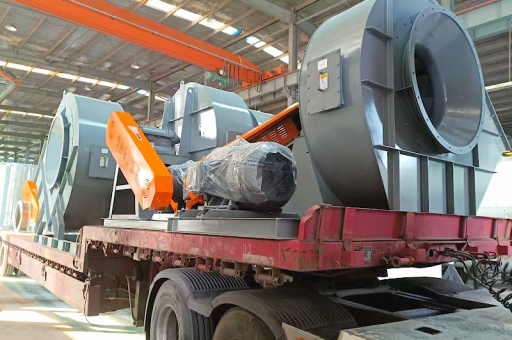
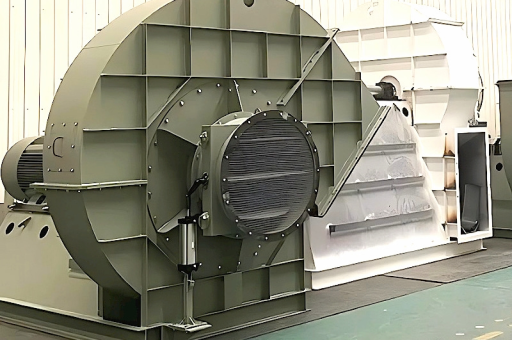
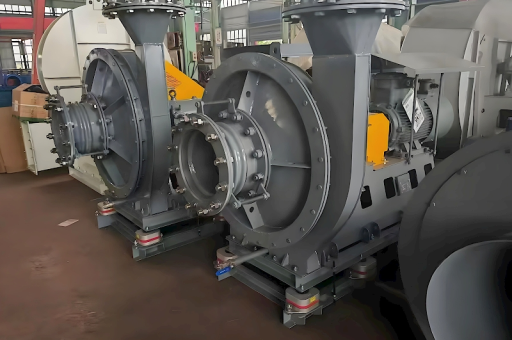
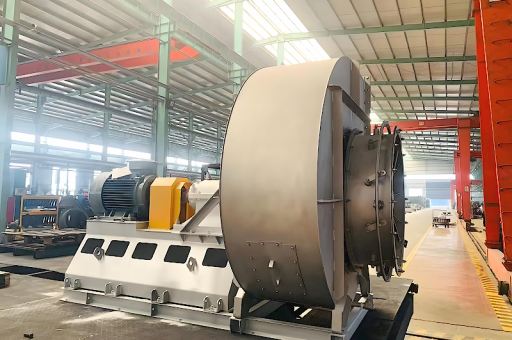
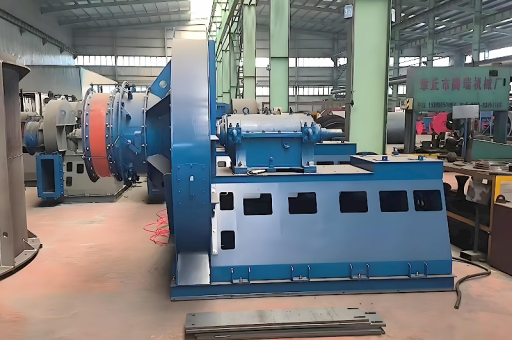
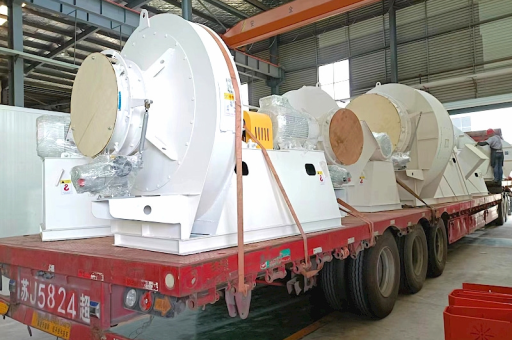
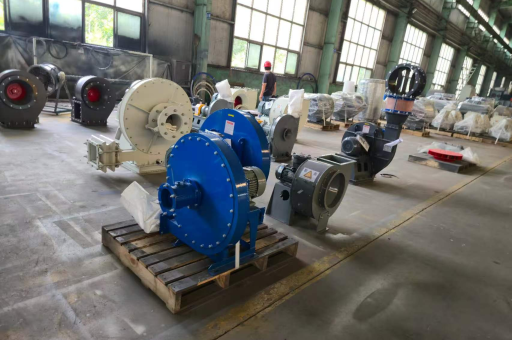
This is a specification for a heavy-duty industrial centrifugal blower (often called a fan or compressor depending on the pressure ratio). Here is a detailed breakdown of what this specification means, typical applications, and critical engineering considerations.
Decoding the Specifications
- 1000 mmAq (Millimeters of Water Gauge):
- This is the Pressure. 1000 mmAq is equivalent to:
- ~9.81 kPa (Kilopascals)
- ~1.42 psi (Pounds per Square Inch)
- ~0.1 kg/cm²
- Classification: This is considered Medium to High Pressure for a blower. Standard axial fans usually operate below 200 mmAq. Radial/blower fans from 500 to 1500 mmAq fall into this higher range.
- This is the Pressure. 1000 mmAq is equivalent to:
- 20,000 m³/h (Cubic Meters per Hour):
- This is the Flow Rate. Equivalent to approximately 11,770 CFM (Cubic Feet per Minute).
- Significance: This is a substantial industrial volume. It is not a small unit; it requires significant power to move this volume against a high pressure of 1000 mmAq.
- High-Pressure Centrifugal Blower:
- Type: Single or double inlet (SI/DI) centrifugal fan with backward-curved blades (most efficient for this pressure) or radial bladed (for heavy dust/materials).
- Motor: Typically a 4-pole motor (1450-1500 RPM) or direct drive via coupling.
Critical Engineering Calculation: Power Requirement
This is the most important number for selecting or building this blower.
Formula: $P = \frac{\text{Flow (m³/s)} \times \text{Pressure (Pa)}}{\text{Fan Efficiency} \times \text{Drive Efficiency}}$
- Convert Flow: 20,000 m³/h ÷ 3600 = 56 m³/s
- Convert Pressure: 1000 mmAq × 9.81 = 9810 Pa
- Calculate Air Power: 5.56 m³/s × 9810 Pa = 54,543 Watts (54.5 kW)
Real-World Motor Size (Calculated):
- Assume Fan Efficiency: 75% (0.75) for a well-designed backward-curved blower.
- Assume Drive Loss: 5% for belt drive (0.95) or 2% for direct drive (0.98).
- Belt Drive Motor Input: 54.5 kW / (0.75 × 0.95) = 5 kW
- Direct Drive Motor Input: 54.5 kW / (0.75 × 0.98) = 1 kW
Recommendation: You will require a 75 kW to 90 kW (100-125 HP) electric motor.
Note on Current:
- 380V/3Ph: 75kW motor draws ~135 Amps.
- 415V/3Ph: 75kW motor draws ~125 Amps.
- 600V/3Ph: 75kW motor draws ~85 Amps.
Typical Applications for this Spec
This high-pressure, high-volume combination is used for industrial processes where resistance is high.
- Pneumatic Conveying: Moving cement, fly ash, plastic pellets, grains, or powders through pipelines over long distances (not positive displacement, but dense phase or lean phase).
- Dust Collection: Centralized baghouse systems or cartridge collectors for large factories (foundries, woodworking, cement plants) where ductwork is long and restrictive.
- Kiln & Dryer Combustion Air: Providing primary or secondary air to cement kilns, rotary dryers, or industrial boilers.
- Mine Ventilation: Secondary/auxiliary ventilation in large tunnels or underground mines.
- Vacuum Cleaning: Central industrial vacuum systems.
Key Selection Considerations (Important!)
If you are buying or designing this, do not ignore these:
A. Impeller Material & Design
- Pressure: At 1000 mmAq, the impeller experiences significant stress.
- Material: Carbon steel (MS) is standard, but SS304/316 is required for corrosive gases or high humidity.
- Thickness: Impeller blades must be thick enough to prevent fatigue failure at high RPM.
- Type: Backward Curved (BC) or Backward Inclined (BI) are most efficient. Radial blades are less efficient but handle sticky materials better.
B. Speed vs. Size
- Option A (Large Diameter, Slow Speed): A 1.2m diameter impeller running at 900 RPM. Lower noise, lower bearing wear, higher cost.
- Option B (Small Diameter, High Speed): A 0.8m diameter impeller running at 1500 RPM. Smaller footprint, lower cost, higher noise, requires stronger bearings.
C. Motor & Drive
- Motor Frames: An 75kW+ motor is physically large (Frame 280 or 315).
- VFD (Variable Frequency Drive): Highly recommended. It allows you to fine-tune the flow (20,000 m³/h) and pressure (1000 mmAq). Without a VFD, you rely on a damper (which wastes power).
D. Noise
- A 75kW blower running at high pressure is loud.
- Silencer: You will need an inlet silencer (absorption or reactive type).
- Enclosure: For worker safety, an acoustic enclosure may be necessary.
Sizing Check: Are the specs correct?
Here is a quick "sanity check" for you:
- Specific Speed (Ns): $\text{Ns} = N \times \frac{\sqrt{Q}}{H^{0.75}}$
- If N = 1500 RPM, Q=5.56 m³/s, H=1000 mmAq.
- Ns ≈ 1500 * (2.36) / 177 ≈ 20.
- This Ns of ~20 is on the low side for a pure "fan" and high for a compressor. This confirms it is a Medium-Pressure Blower with high torque requirements.
Final Verdict
- Feasibility: Technically feasible and common for industrial processes.
- Cost: You are looking at a $15,000 - $40,000 USD unit (depending on material, brand (Howden, TLT-Babcock, Gardner Denver, etc.), and accessories).
- Gotcha: The most common failure for this spec is motor overheating or impeller fatigue from running the blower outside its design curve (e.g., running with a closed damper).
Would you like help calculating the duct diameter or motor starter type (Star-Delta vs VFD) for this 75kW+ load?