This article's table of contents introduction:
- Performance Analysis
- Required Motor Power (Estimation)
- Typical Impeller Types for this Spec
- Key Applications
- Critical Selection Checklist
- Summary of a Potential Supplier Specification Sheet
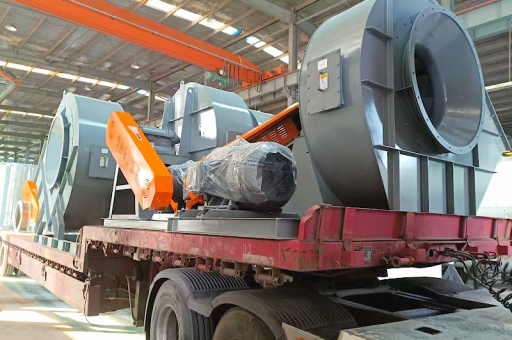
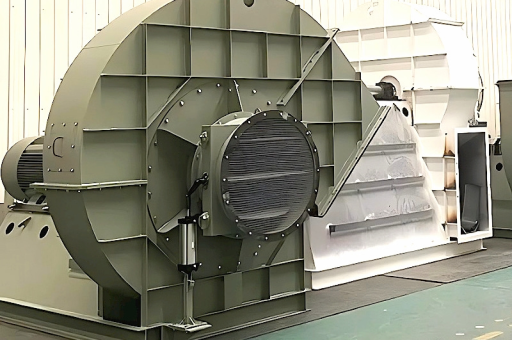
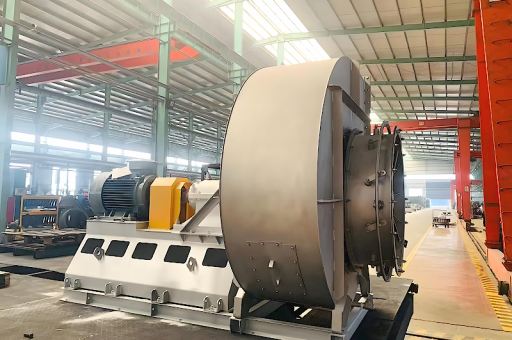
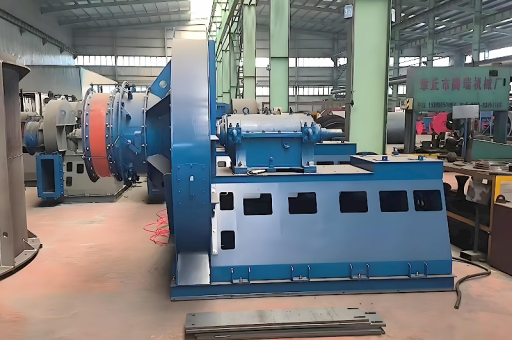
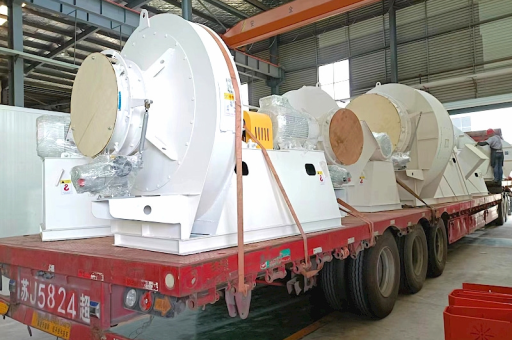
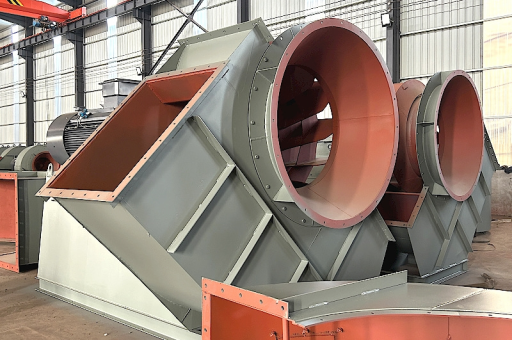
This is a specification for a high-power industrial centrifugal blower. The combination of 9,800 Pa (pressure) and 20,000 m³/h (flow) requires a significant amount of power, typically in the 55 kW to 90 kW range depending on efficiency, air density, and specific fan design.
Here is a detailed breakdown of what this specification means, typical applications, and key engineering considerations.
Performance Analysis
- Pressure: 9,800 Pa (≈ 1,000 mmH₂O or 1.42 psi)
- Classification: This is considered a high-pressure centrifugal fan, not a standard ventilation fan (which usually operates below 2,000 Pa).
- Implication: The blower must have a robust impeller design (often backward-curved or radial blades) to generate this force.
- Flow: 20,000 m³/h (≈ 11,775 CFM)
- Classification: This is a high-volume industrial flow rate.
- Implication: Large inlet/outlet diameters (likely DN 500 to DN 630 or larger) and a substantial housing.
- Frequency: 50 Hz / 60 Hz
- Design: This indicates a dual-frequency motor or a motor designed to perform at both standards.
- Important Ratio: Because fan performance follows fan laws:
- At 60 Hz (vs 50 Hz), the speed is 20% higher.
- Flow increases by 20% (to ~24,000 m³/h).
- Pressure increases by 44% (to ~14,112 Pa).
- Power increases by 72%. A motor sized for 60 Hz will be significantly larger than one sized for 50 Hz.
Required Motor Power (Estimation)
Using the fan power equation: $$P = \frac{Q \times p}{\eta}$$
- Q = Flow (m³/s) = 20,000 / 3,600 = 56 m³/s
- p = Pressure (Pa) = 9,800 Pa
- η = Total Efficiency (Assume high-efficiency backward curved fan = 75%-82%)
Calculation: $P{shaft} = (5.56 \times 9800) / 0.78$ $P{shaft} \approx 69,846 W \approx 70 kW$
Recommended Motor Size:
- 50 Hz: 75 kW (Standard frame size, e.g., IE3 or IE4)
- 60 Hz: 110 kW (To handle the 72% power increase)
Typical Impeller Types for this Spec
For 9,800 Pa / 20,000 m³/h, the impeller must be strong and efficient. The most common types are:
| Impeller Type | Suitability | Efficiency | Noise |
|---|---|---|---|
| Backward Curved (BC) | Best Choice. High efficiency, non-overloading power curve. Handles 10,000 Pa well with a strong shaft/plate. | Very High (82%+) | Moderate |
| Radial (Paddlewheel) | Suitable if air has dust/particulates. Very robust, but lower efficiency. | Low (60-65%) | High |
| Airfoil (AF) | Best efficiency, but more expensive. Excellent for clean, high-volume air. | Highest (86%+) | Lowest |
Key Applications
This specific pressure and flow combination is ideal for:
- Pneumatic Conveying: Moving cement, wood chips, grains, or plastic pellets over medium distances.
- Industrial Drying Systems: Paper machines, textile dryers, or spray dryers requiring high static pressure to push through narrow ducts and nozzles.
- Flue Gas Desulfurization (FGD): Forced draft in power plants or scrubber systems.
- Air Knife Systems: Drying bottles or sheets after washing.
- Wastewater Treatment: Aeration in deep tank biological reactors (membrane or fine bubble diffusers).
Critical Selection Checklist
If you are sourcing this blower, verify the following:
- ☐ Dual Frequency Motor: Specify if the motor must run on both 50 Hz and 60 Hz (e.g., for export or variable grid). The VFD (Variable Frequency Drive) must be programmed for both.
- ☐ Inlet/Outlet Orientation: Define the discharge angle (e.g., Top 90°, Bottom 0°, etc.) and rotation direction (CW or CCW).
- ☐ Material of Construction:
- Standard: Mild Steel (MS) or Corten steel for the housing, S45C steel for the shaft.
- Corrosive: SS304 or SS316L for impeller and casing.
- Spark Resistant: Aluminum or copper-tipped blades for flammable environments.
- ☐ Temperature: Standard air (-20°C to +80°C). High temperature (e.g., 200°C+ ) requires a cooling fan on the motor shaft, ceramic wool insulation, or a heat slinger.
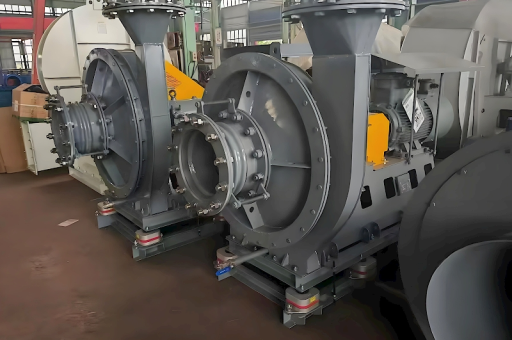
- ☐ Mounting: Typically a heavy-duty I-beam base frame with vibration dampers.
Summary of a Potential Supplier Specification Sheet
| Parameter | Value |
|---|---|
| Model | TB-63-1.5P (Example) |
| Flow Rate | 20,000 m³/h |
| Total Pressure | 9,800 Pa |
| Impeller Diameter | ~630 mm |
| Motor Power (50 Hz) | 75 kW |
| Motor Power (60 Hz) | 110 kW |
| Speed (50 Hz) | ~2,950 RPM (Direct Drive) |
| Speed (60 Hz) | ~3,540 RPM |
| Noise Level | ~85-90 dB(A) (With silencer suggested) |
| Weight | ~1,200 - 1,500 kg |
Next Step: If you are ordering this, provide the density of the gas (Air, Flue gas, etc.) and the operating temperature, as these drastically change the motor power requirement. For example, moving 200°C air requires a much larger motor than moving ambient 20°C air due to lower density.