
This article's table of contents introduction:
- What is it?
- Key Design Features & How They Work
- Why "Energy Efficient"? (The Core Advantage)
- Typical Applications (Where you find them)
- Performance Curve Characteristics (The "BIC" Curve)
- Comparison with Other Designs
- Selection Considerations for Industry
- Example Specification Snippet
- Conclusion
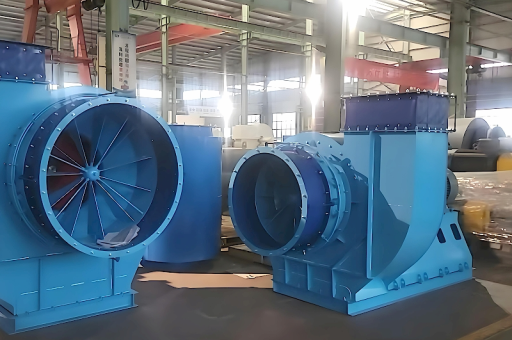
Here is a comprehensive overview of a High Performance, Single Inlet, Energy Efficient Industrial Centrifugal Blower with a Backward Curved Design. This type of fan represents the "gold standard" for moving large volumes of clean or slightly dirty air against moderate to high static pressures with maximum efficiency.
What is it?
This is a specific class of industrial fan (often referred to as a BISW or BI Wheel fan in HVAC/R terminology) designed for high-pressure, high-volume air movement. The defining feature is the backward-curved impeller blades.
- Single Inlet: Air enters from only one side of the impeller.
- Backward Curved: The blades lean away from the direction of rotation.
Key Design Features & How They Work
Unlike forward-curved blades (often found in cheaper residential fans) which "scoop" air, backward-curved blades literally "throw" air outwards via centrifugal force. This fundamental difference leads to superior performance characteristics.
| Feature | Description & Benefit |
|---|---|
| Backward Curved Impeller | Blades tilt away from rotation. This creates a steeper pressure curve and significantly higher efficiency (typically 75-85% peak). |
| Streamlined Housing | The spiral (volute) housing is precisely engineered to convert velocity pressure from the impeller into static pressure with minimal turbulence. |
| Single Inlet Design | Concentrates airflow through one side, making it ideal for ductwork systems with a single source. It also allows for a more compact motor-mount arrangement. |
| Airfoil (Optional) | Many high-efficiency versions use hollow, airfoil-shaped blades (like a wing). This reduces aerodynamic drag and wakes, pushing efficiency to the highest possible levels. |
| Non-Overloading Power Curve | This is a critical safety feature. The motor's horsepower requirement peaks at a specific operating point and then drops. If the ductwork becomes blocked (higher resistance), the motor draws less current, preventing burnout. |
Why "Energy Efficient"? (The Core Advantage)
This is the primary reason engineers and plant managers choose this design.
- Superior Efficiency (Peak Efficiency > 80%): The aerodynamics of the backward-curved blade result in very low energy losses due to turbulence and friction. For continuous-duty industrial fans, a few percent increase in efficiency translates to thousands of dollars in annual electricity savings.
- High Static Pressure Capability: They are excellent at overcoming the resistance of long duct runs, dust collectors, cooling coils, and air filters.
- Stable Operation: Their pressure curve is steeply rising. This means they maintain a consistent airflow even when system resistance changes slightly.
- Non-Overloading Motor: As mentioned, this protects the motor from failure in the event of a system blockage or damper closure.
Typical Applications (Where you find them)
You will find these blowers as the core component in:
- HVAC Systems: Large commercial or industrial air handling units, VAV (Variable Air Volume) systems.
- Industrial Process Ventilation: Fume exhaust, dust collection, drying systems, pneumatic conveying (for light materials).
- Clean Rooms & Laboratories: Where quiet, reliable, and controllable airflow is critical.
- Pollution Control: Baghouse filters, scrubbers, and thermal oxidizers (often handling hot or corrosive gases with special coatings).
- Data Centers: Critical cooling systems (CRAC units) requiring high static pressure to push air through raised floors.
Performance Curve Characteristics (The "BIC" Curve)
If you look at a performance chart, the Backward Inclined (BI) or Airfoil (IA) curve is distinct:
- Airflow (CFM) Horizontal Axis | Pressure (SP) Vertical Axis
- The Curve: Stays relatively flat at high pressure and then "drops off" steeply as airflow increases. The peak horsepower occurs near the peak efficiency point.
- The Pitfall: These fans are not designed for "free air" (open inlet/open outlet). Operating them without sufficient resistance can cause them to operate at the far right of the curve, which can overload the motor if the non-overloading design is not properly matched.
Comparison with Other Designs
| Feature | Backward Curved (High Perf.) | Forward Curved (Residential/Commercial) | Radial (Paddle Wheel) |
|---|---|---|---|
| Efficiency | High (75-85%) | Low-Medium (60-70%) | Low (50-65%) |
| Pressure Capability | High | Low-Medium | Very High (for dirty air) |
| Tolerance for Dust | Poor (requires clean air or pre-filter) | Poor (can clog easily) | Excellent (handles dust, sticky materials) |
| Motor Protection | Non-overloading (Safe) | Overloading (Requires damper or VFD) | Overloading (Requires careful sizing) |
| Noise Level | Low-Medium | Low (smooth flow) | High (turbulent flow) |
| Cost | Medium-High | Low | Medium |
Selection Considerations for Industry
When specifying this blower, consider:
- Airfoil vs. Flat Blade: Airfoil blades are 5-10% more efficient but more expensive and slightly more fragile. Use for clean air applications.
- Class of Construction: Fans are rated by construction class (e.g., Class I, II, III, IV) based on maximum allowable tip speed and housing strength. Higher classes handle higher pressures and RPMs.
- Drive Type:
- Direct Drive (Rare for single inlet): Motor shaft is the fan shaft.
- Belt Drive (Most common): Allows for speed adjustments (sheave changes) to fine-tune airflow and pressure.
- Accessories:
- Vibration Isolators: Essential for floor or roof-mounted units to prevent structural noise.
- Flexible Connectors: Reduce vibration transfer to ductwork.
- Variable Frequency Drive (VFD): The ultimate energy-saving partner. Allows for infinite, highly efficient speed control to match load.
- Drain Connections: For condensation removal in cooling applications.
- Material of Construction: Standard steel, aluminum (for spark resistance), stainless steel (for corrosion), or with specialty coatings (e.g., Heresite, rubber lining).
Example Specification Snippet
"The fan shall be a Class II, single inlet, belt-driven centrifugal fan with a backward-curved airfoil (BCA) impeller. The fan shall have a non-overloading power characteristic. The wheel shall be statically and dynamically balanced. The fan casing shall be constructed of heavy-gauge steel with a continuous welded housing scroll. All units shall be factory tested and performance-rated in accordance with AMCA 210... The motor shall be premium efficiency (IE4 / NEMA Premium) with a 1.15 service factor."
Conclusion
If you need to move a high volume of clean or filtered air against a significant static pressure drop, and you prioritize lower energy costs, quiet operation, and long-term reliability, the High Performance Single Inlet Industrial Centrifugal Blower with a Backward Curved Design is the most technically advanced and cost-effective solution available for most demanding industrial and commercial applications. Its upfront cost is higher than a forward-curved fan, but the Total Cost of Ownership (TCO) over a 10-20 year lifecycle is significantly lower due to energy savings.





