
This article's table of contents introduction:
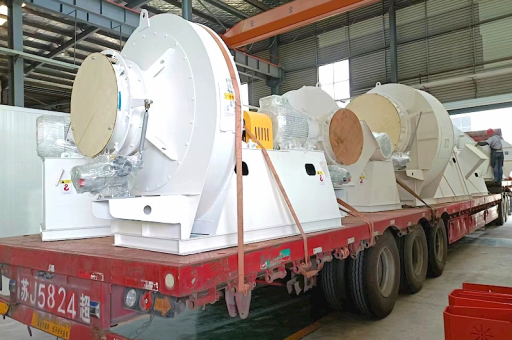
- What Does "7.5 kW Centrifugal Induced Draft Fan" Mean?
- Key Features and Specs (Typical for this class)
- Common Applications
- Typical System Sizing (Example)
- Critical Considerations Before Buying
- Example Model (Generic)
It sounds like you are looking for information on a 5 kW dust removal centrifugal induced draft fan. This is a common piece of industrial equipment used for dust collection, ventilation, and fume extraction.
Here is a breakdown of what this specification means, typical features, applications, and sizing considerations.
What Does "7.5 kW Centrifugal Induced Draft Fan" Mean?
- 5 kW (Kilowatts): This is the motor power. It is roughly equivalent to 10 HP (Horsepower) . This is a significant amount of power, indicating a medium-to-large capacity fan capable of moving a high volume of air against considerable resistance (pressure).
- Dust Removal: The fan is designed to handle air containing particulates (dust, shavings, fibers). It will have a robust construction (usually steel) and an impeller designed to resist wear and clogging.
- Centrifugal: This is the fan type. Unlike an axial fan (like a desk fan), a centrifugal fan uses a rotating impeller (wheel) to accelerate air radially outward. This creates higher pressure, which is necessary for pushing air through long ductwork, filters, cyclones, and other system components. The term "induced draft" means the fan is usually placed after the dust collector (e.g., baghouse or cyclone), pulling air through the system.
- Induced Draft (ID Fan): The fan creates a negative pressure (vacuum) in the ductwork and dust collection device upstream of it.
Key Features and Specs (Typical for this class)
- Airflow (CFM / m³/h): A 7.5 kW centrifugal fan will typically move between 3,000 and 8,000 CFM (5,000 to 13,500 m³/h), depending on the static pressure it must overcome. The exact airflow depends heavily on the fan curve.
- Static Pressure (SP): The fan is designed to handle moderate to high static pressures, typically in the range of 4" to 8" of water gauge (1000 to 2000 Pa) . This is crucial for overcoming the resistance from ductwork, filters, and the dust collector itself.
- Impeller Type:
- Backward Inclined (BI): Most common for clean-ish industrial air. More efficient and non-overloading (motor won't burn up if duct is blocked).
- Radial (Paddle Wheel) / Radial Tip: For heavy dust loads (wood chips, metal grinding). Very rugged but less efficient.
- Airsfoil: Most efficient, for very clean air applications.
- Construction: Heavy-duty steel housing. The impeller is dynamically balanced. Often includes a cleanout door on the housing for maintenance.
- Motor: TEFC (Totally Enclosed Fan Cooled) induction motor, typically 3-phase (especially at 7.5 kW), running on 230V/400V/460V/480V AC.
- Drive: Usually belt-driven. This allows for speed adjustment (by changing pulley diameters) to fine-tune airflow and pressure.
Common Applications
- Woodworking Shops: Central dust collection for table saws, planers, jointers, sanders, and CNC routers.
- Metal Fabrication: Fume extraction from welding, grinding, plasma cutting stations.
- Agricultural Facilities: Grain handling, feed mills, dust control in barns.
- Industrial Manufacturing: General dust removal from packaging, mixing, and bulk material handling processes.
- Small to Medium Baghouses: Serving as the induced draft fan that pulls air through the filter bags.
Typical System Sizing (Example)
A 7.5 kW fan is often used for a system requiring 4" to 6" of static pressure. Here's a rough guide:
- ~3,000 CFM @ 6" SP: Good for a single large machine or a small central system with a few drops. Example: One large table saw + a planer + a bandsaw.
- ~5,000 CFM @ 4" SP: Good for a medium-sized central system with 6-10 machine drops.
- ~7,000 CFM @ 3" SP: Good for a very open, low-resistance system (e.g., a single large dust hood on a big machine).
Critical Considerations Before Buying
- Ductwork Design: This is the most important factor. Poorly designed ductwork (undersized, too many sharp bends) will dramatically increase static pressure and reduce the fan's effective airflow. The fan must be matched to the system curve.
- Fan Curve: You must get the fan's performance curve (typically a graph showing CFM vs. Static Pressure) for the specific model. Do not guess the airflow based on motor power alone. The fan can be stalled (moving zero air) if the system resistance is too high, potentially damaging the motor.
- Explosion Proof (ATEX): If you are handling combustible dust (wood, metal, grain), you may need an explosion-proof motor and a spark-resistant impeller or a spark arrestor in the system.
- Phase: Ensure your facility has 3-phase power. 7.5 kW single-phase motors exist but are large and expensive.
- Sound Level: Centrifugal fans can be loud (80-90+ dB). You may need an attenuator (silencer).
- Inlet/Outlet: Confirm the fan's inlet and outlet sizes (e.g., 12" inlet, 12" outlet) to match your ductwork.
- Mounting: The fan will be heavy (likely 200-400 kg / 450-900 lbs). It needs a strong base or frame.
Example Model (Generic)
- Brand: Many (e.g., Cincinnati Fan, New York Blower, Aerovent, Greenheck, and many Chinese/Asian manufacturers).
- Size: 12" to 16" inlet diameter.
- Motor: 7.5 kW, 3-phase, 400V, 50 Hz.
- Drive: Belt driven.
- Max CFM: ~5,500 CFM @ 3.5" SP.
- Max SP: ~8" @ 3,000 CFM.
In summary: A 7.5 kW centrifugal induced draft fan is a powerful, industrial-grade component for a serious dust collection or ventilation system. To select the right one, you must know your required CFM and static pressure. Get the fan curve. If you can find a specific brand and model number, I can help you interpret its specs.





