This article's table of contents introduction:
- Decoding "Exd IIC"
- Key Characteristics of Exd IIC Fans
- Common Applications (Where you find them)
- Important Safety & Selection Considerations
- Typical Models / Manufacturers (Examples)
- Summary: What you need to know to buy one
This is a technical specification. Here is a breakdown of what Exd IIC means for explosion-proof fans, along with key considerations for selection and use.
Decoding "Exd IIC"
This designation follows the international IEC/EN 60079 standard for equipment in explosive atmospheres.
- Ex: Denotes the equipment is certified for use in explosive atmospheres.
- d: Stands for Flameproof Enclosure.
- How it works: The fan's motor and electrical components are housed in an enclosure strong enough to contain an internal explosion of flammable gas or vapor.
- Function: The enclosure prevents the internal explosion from igniting the surrounding explosive atmosphere. The joints (flanges, threads) are designed to cool escaping gases sufficiently to extinguish any flame.
- IIC: Defines the Gas Group.
- What it means: The fan is certified for use with the most difficult-to-ignite gases, including Hydrogen (H₂) and Acetylene (C₂H₂) .
- Implication: A fan rated for Group IIC is also suitable for Groups IIA (Propane) and IIB (Ethylene). It offers the highest level of protection for gas environments.
Key Characteristics of Exd IIC Fans
- Robust Construction: The fan housing and motor casing are made of high-strength, non-sparking materials (typically cast iron, aluminum, or stainless steel).
- Non-Sparking Impeller: The fan blades (impeller) are made from non-sparking materials like aluminum or copper-aluminum alloys (aluminum bronze) . This prevents sparks from mechanical impact or friction.
- Sealed Motor: The motor is a specialized, totally enclosed fan-cooled (TEFC) design with a flameproof enclosure.
- Certified Cable Entries: The electrical connection point (terminal box) is also Exd certified to prevent gas ingress.
- Temperature Class (T-Rating): The fan will have a T-Rating (e.g., T3, T4, T6). This indicates the maximum surface temperature of the fan during operation. The T-Rating must be lower than the auto-ignition temperature of the hazardous gas being handled.
- Example: T4 (max surface temp 135°C) is safer than T3 (max surface temp 200°C).
- No Internal Ignition Sources: The design ensures that no sparks, arcs, or hot surfaces inside the motor can escape to the outside.
Common Applications (Where you find them)
These fans are mandatory in areas where flammable gases or vapors are regularly present (Zones 1 and 2 under IEC standards).
- Oil & Gas Refineries
- Chemical Processing Plants
- Paint Spray Booths
- Hydrogen Fueling Stations
- Battery Charging Rooms (where hydrogen can accumulate)
- Offshore Platforms
- Solvent Storage Warehouses
- Pharmaceutical Manufacturing (handling flammable solvents)
Important Safety & Selection Considerations
- Certification is Mandatory: Always use fans with a recognized certification mark (ATEX in Europe, IECEx globally, or local equivalents like UL/CSA in North America for Class I, Division 1). Never use a standard industrial fan in a hazardous area.
- Proper Grounding (Earthing): Exd fans require a secure, low-resistance earth connection to prevent static buildup. The fan must be bonded to the plant ground grid.
- Cable Glands: Use only Exd-certified cable glands (e.g., Exd flameproof glands) for the electrical connection. Standard cable glands will negate the safety of the fan.
- Maintenance: Only qualified technicians should service Exd equipment. The flameproof joints must never be damaged, painted over, or opened when the atmosphere is hazardous.
- Airflow Direction: Ensure the fan is installed to direct airflow as intended (exhaust or supply) to properly ventilate the hazardous area.
Typical Models / Manufacturers (Examples)
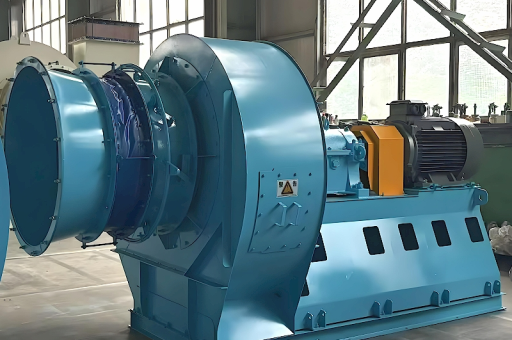
While specific model numbers vary by manufacturer (e.g., ABB, General Electric, Cemp, Vent-Axia, and many regional specialized manufacturers), a common configuration is an Exd IIC T4 fan.
- Specification Summary:
- Type: Axial Flow or Centrifugal
- Certification: ATEX II 2G Ex d IIC T4 Gb
- Material: Cast Iron Casing, Aluminum Impeller
- Motor: Exd Flameproof, IP66 (dust and water ingress protection)
Summary: What you need to know to buy one
- Confirm the Gas Group: Is it Group IIC (Hydrogen)? If so, you need a fan rated for IIC.
- Check the Temperature Class (T-Rating): What is the auto-ignition temperature of the gas? (e.g., for T4, gas must not auto-ignite below 135°C).
- Determine the Zone: Zone 1 (likely present) or Zone 2 (unlikely but possible). Exd is suitable for both.
- Verify Airflow & Pressure: Ensure the fan size (e.g., 500mm, 630mm) and power (kW) meet your ventilation requirements.
- Get a Certificate: The supplier must provide a Declaration of Conformity or Certificate of Compliance showing the specific Ex marking.