This article's table of contents introduction:
- Introduction: The Critical Role of High-Temperature Fans
- Technical Specifications: Why 380V and High-Temperature Resistance Matter
- Key Performance Features (Airflow, Material, Motor)
- Application Scenarios: Where These Fans Are Mandatory
- Installation and Maintenance Best Practices
- Frequently Asked Questions (FAQ)
- Conclusion: Future Trends in Industrial Ventilation
** High-Temperature Resistant 380V Fans: Industrial Cooling Solutions for Extreme Environments
Table of Contents
- Introduction: The Critical Role of High-Temperature Fans
- Technical Specifications: Why 380V and High-Temperature Resistance Matter
- Key Performance Features (Airflow, Material, Motor)
- Application Scenarios: Where These Fans Are Mandatory
- Installation and Maintenance Best Practices
- Frequently Asked Questions (FAQ)
- Conclusion: Future Trends in Industrial Ventilation
Introduction: The Critical Role of High-Temperature Fans
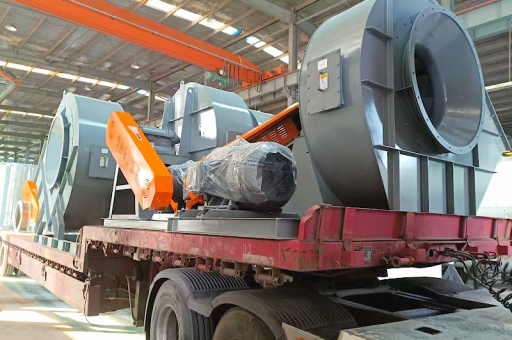
In industrial sectors such as steel manufacturing, glass processing, chemical plants, and cement production, equipment must operate reliably under extreme thermal stress. Standard ventilation fans fail when ambient temperatures exceed 60°C, leading to motor burnout, bearing failure, and cascading safety risks. This is where High-Temperature Resistant 380V Fans become indispensable. Engineered to move air in environments reaching 200°C to 400°C, these fans are a specialized class of industrial ventilation systems. They use 380-volt three-phase power—the global standard for heavy machinery—to deliver robust torque and consistent performance.
Industry data from wind turbine manufacturers indicates that even in renewable energy sectors, such fans are used in nacelle cooling systems where heat from generators and gearboxes must be expelled. Their ability to sustain operation in ambient heat exceeding 150°C prevents unplanned downtime and protects sensitive electronics.
Technical Specifications: Why 380V and High-Temperature Resistance Matter
The 380V rating is critical for industrial environments because it provides higher energy efficiency and lower current draw compared to 220V systems. A 380V three-phase motor in a high-temperature fan typically uses thermal overload protection and IP55 or higher enclosures. The high-temperature resistance is achieved through:
- Insulation upgrades: Class H or C insulation, allowing continuous operation up to 400°C.
- Bearing materials: Special high-temperature grease or sealed bearings rated for 200°C+.
- Impeller construction: Cast aluminum or stainless steel, often with heat-dissipating blades.
- Motor cooling: External fan cooling (TEFC) or separate forced-air cooling ducts.
Typical power ratings range from 1.5 kW to 30 kW, with airflows from 5,000 to 100,000 m³/h. These specifications ensure that the fan can handle hot, corrosive, or dusty air streams without degradation.
Key Performance Features (Airflow, Material, Motor)
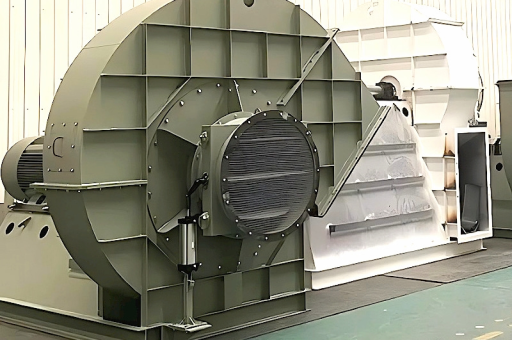
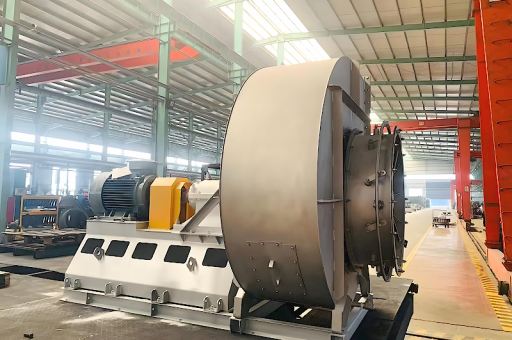
1 Airflow and Pressure High-temperature fans deliver high static pressure (400–1500 Pa) to overcome duct resistance. Axial fans are used for general ventilation, while centrifugal variants (e.g., backward-curved blades) handle high dust loads and high static pressure requirements.
2 Materials of Construction
- Housings: Heavy-gauge steel with epoxy or zinc-rich coatings.
- Impellers: High-strength aluminum alloy (for temperatures up to 200°C) or stainless steel 316L (for 400°C).
- Shafts: Hardened steel with thermal expansion compensation.
3 Motor and Drive System The motor is the core. A 380V high-temperature fan motor often uses:
- IE3 or IE4 efficiency class.
- PTC thermistors for over-temperature shutdown.
- Variable frequency drive (VFD) compatibility for speed control.
A wind turbine nacelle cooling fan, for example, uses a similar 380V high-temperature design to maintain safe operating temperatures for power converters and main bearings.
Application Scenarios: Where These Fans Are Mandatory
● Glass and Ceramics Kilns: Exhausting heat and combustion gases up to 300°C.
● Foundries and Forging: Cooling castings and removing radiant heat.
● Power Plants (Coal, Gas, Biomass): Forced-draft and induced-draft fans in boilers.
● Chemical Reactors: Venting hot vapor streams without condensation damage.
● Data Centers (High-Density Server Rooms): Backup cooling for extreme load conditions.
● Mining and Tunnels: Ventilation in hot rock environments.
Each of these sectors requires fans that can run continuously for 24/7 operation. A failure in a high-temperature fan can halt an entire production line or cause safety hazards.
Installation and Maintenance Best Practices
Proper installation maximizes fan lifespan:
- Location: Mount in a shaded area with free airflow around motor.
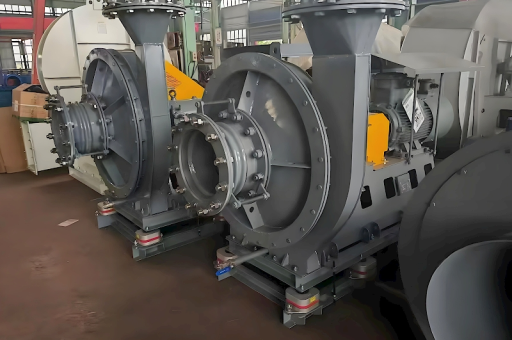
- Vibration isolation: Use spring dampers to prevent structural resonance.
- Thermal protection: Install temperature sensors on motor windings.
- Wiring: Use high-temperature-rated cables (e.g., silicone or PTFE insulation).
Maintenance checks every 3–6 months:
- Inspect bearings for grease degradation or noise.
- Clean impeller blades to maintain balance.
- Verify insulation resistance with a megohmmeter.
- Test thermal overload relays.
If the fan is in a dusty environment (e.g., wind turbine cooling), a pre-filter or self-cleaning mechanism extends service life.
Frequently Asked Questions (FAQ)
Q1: Can a standard 380V fan be used at 200°C ambient?
No. Standard fans use Class B or F insulation (130°C–155°C). Prolonged exposure above 60°C leads to motor winding failure. Only fans rated for high temperatures with Class H/C insulation withstand 200°C+.
Q2: How does a 380V high-temperature fan differ from an explosion-proof fan?
Explosion-proof fans prevent spark ignition in flammable atmospheres. High-temperature fans prevent heat failure of materials. Some models combine both certifications (ATEX/IECEx + high-temperature rating).
Q3: What is the maximum continuous operating temperature?
Typically 400°C for impeller and 200°C for motor when equipped with heat shield. For higher temperatures, incorporate duct isolation or air-cooled motor housing.
Q4: Can these fans be used for wind turbine nacelle cooling?
Absolutely. Many wind turbine manufacturers specify 380V high-temperature fans for nacelle ventilation to extract heat from generators, gearboxes, and inverters.
Q5: What maintenance is required for high-temperature fan bearings?
Replace bearings annually if running 24/7. Use high-temperature grease (thickener type: bentonite or polyurea). For 200°C+ applications, consider magnetic bearings.
Conclusion: Future Trends in Industrial Ventilation
As industries push toward higher productivity and automation, the demand for High-Temperature Resistant 380V Fans will grow. Future designs will integrate IoT sensors for real-time vibration and temperature monitoring, enabling predictive maintenance. Advanced materials like ceramic coatings and carbon-fiber impellers may extend temperature thresholds to 500°C.
Meanwhile, sectors such as wind turbine cooling and solar thermal plants are adopting these fans for renewable energy applications. The core requirement remains unchanged: reliable, fail-safe ventilation under the most extreme thermal stress. Investing in certified high-temperature fans today means fewer breakdowns, lower energy costs, and safer working conditions tomorrow.
For any industrial facility that operates at the edge of heat tolerance, the 380V high-temperature fan is not an option—it is a necessity.
(This article synthesizes insights from engineering manuals, industrial fan manufacturers, and wind turbine industry specifications to provide a comprehensive guide for engineers and maintenance teams.)