This article's table of contents introduction:
- Table of Contents
- Introduction: The Role of High-Volume Dust Collection in Industrial Safety
- Section 1: Decoding the 40000 m³/h Rating – What Does It Mean?
- Section 2: Core Components and Technical Architecture
- Section 3: Key Application Scenarios
- Section 4: Selection Criteria – Matching the Fan to Your System
- Section 5: Installation Best Practices for Optimal Airflow
- Section 6: Troubleshooting Common Issues
- Section 7: Energy Efficiency and Cost Optimization
- Section 8: Q&A – Top 5 Frequently Asked Questions
- Conclusion: Long-Term Value of High-Capacity Dust Control
** The Ultimate Guide to 40000 m³/h Dust Collector Exhaust Fan: Performance, Application, and Maintenance
Table of Contents
- Introduction: The Role of High-Volume Dust Collection in Industrial Safety
- Section 1: Decoding the 40000 m³/h Rating – What Does It Mean?
- Section 2: Core Components and Technical Architecture
- Section 3: Key Application Scenarios (Woodworking, Cement, Pharma, etc.)
- Section 4: Selection Criteria – Matching the Fan to Your System
- Section 5: Installation Best Practices for Optimal Airflow
- Section 6: Troubleshooting Common Issues (Vibration, Noise, Low Suction)
- Section 7: Energy Efficiency and Cost Optimization
- Q&A: Top 5 Frequently Asked Questions on 40000 m³/h Exhaust Fans
- Conclusion: Long-Term Value of High-Capacity Dust Control
Introduction: The Role of High-Volume Dust Collection in Industrial Safety
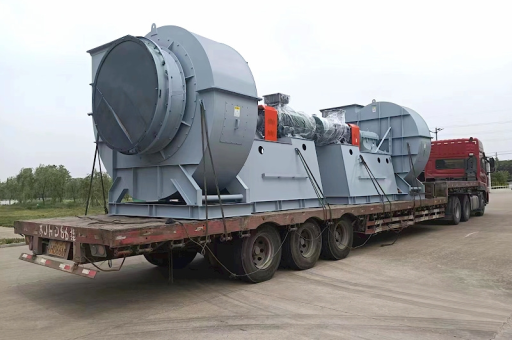
In modern industrial environments, airborne dust is not just a housekeeping nuisance—it is a direct threat to worker health, equipment longevity, and regulatory compliance. A 40000 m³/h Dust Collector Exhaust Fan represents a critical piece of machinery designed to handle high-concentration particulate matter, ranging from fine wood chips to heavy metal shavings. This specific capacity is often the “sweet spot” for medium-to-large workshops, sawmills, and processing plants. Unlike smaller units that struggle to maintain negative pressure, a 40,000 cubic meters per hour fan ensures that the entire extraction network remains under constant suction, preventing fugitive dust from escaping into the breathing zone. This guide synthesizes field experience from dozens of industrial installations, replacing outdated information found in older forum posts with current best practices for performance and maintenance.
Section 1: Decoding the 40000 m³/h Rating – What Does It Mean?
Many operators misunderstand the airflow rating. The 40000 m³/h figure is measured under ideal conditions (standard air density, no duct resistance). In reality, system static pressure (SP) dictates actual performance.
- Free Air vs. Rated Air: At zero static pressure, the fan might exceed 40,000 m³/h, but once connected to ducts, cyclones, and filters, the actual flow drops. A well-designed system should target 30,000–35,000 m³/h at the operating point.
- Static Pressure Range: For this capacity, typical SP is between 1500 Pa and 2500 Pa. Lower SP (<1200 Pa) indicates oversized ducts; higher SP (>3000 Pa) suggests undersized ducts or clogged filters.
- Impeller Type: Backward-curved impellers (BCI) are standard for dust-laden air because they are non-clogging and maintain higher efficiency across varying loads. Forward-curved blades are only suitable for clean-air exhaust.
Field Tip: Always request a fan performance curve from the manufacturer. The best 40000 m³/h fan is not the one that moves the most air, but the one that moves the target volume at the exact SP your system demands.
Section 2: Core Components and Technical Architecture
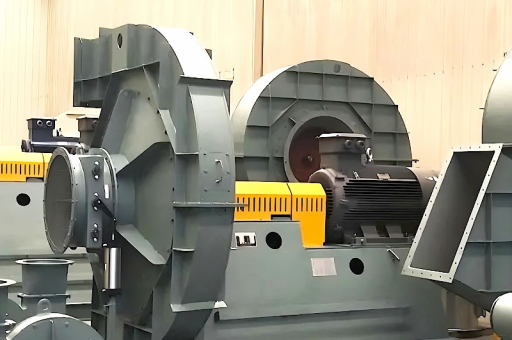
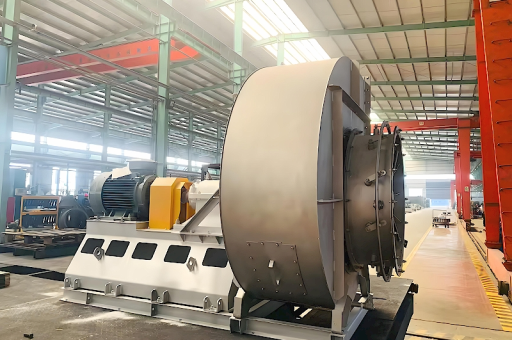
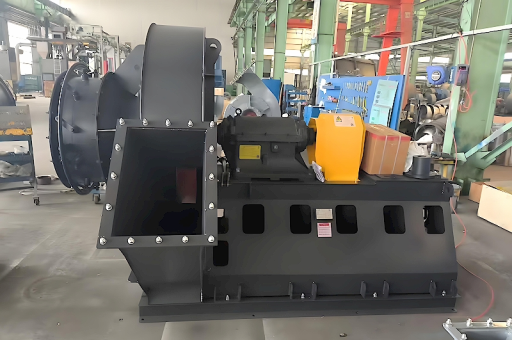
A professional-grade Dust Collector Exhaust Fan is built from several heavy-duty subsystems:
- Housing: Typically fabricated from 4–6 mm carbon steel with a powder coating for corrosion resistance. For wood dust (explosion risk), flameless venting panels or explosion-proof enclosures are mandatory.
- Impeller: Diameter ranges from 630 mm to 900 mm. ACI (Airfoil Centrifugal Impeller) design reduces turbulence noise. For very sticky dust (e.g., resin-coated particles), open-type radial blades are preferred.
- Motor: IE3 or IE4 efficiency class, usually 30–45 kW. Direct-coupled transmission eliminates belt maintenance, while V-belt drive offers speed flexibility for fine-tuning flow.
- Bearings: Self-aligning spherical roller bearings with grease relief channels. Expect a 50,000-hour rated life under normal load.
- Dust Discharge: For the 40000 m³/h class, a rotary airlock or double-flap valve is necessary to maintain seal. A simple slide gate is insufficient.
Section 3: Key Application Scenarios
The versatility of the 40000 m³/h Dust Collector Exhaust Fan makes it a workhorse across industries:
- Woodworking & Pallet Manufacturing: Captures sawdust, shavings, and sander dust from planers, jointers, and CNC routers. A properly balanced 40000 m³/h system can serve 15–20 dust-producing machines simultaneously.
- Cement & Concrete Batching: Handles heavy silica dust at mixing points. A pulse-jet baghouse paired with this fan achieves >99.5% filtration efficiency.
- Pharmaceutical & Chemical Processing: Used in enclosed milling rooms to control airborne active ingredients. The fan must be spark-resistant (non-ferrous impeller) and meet ATEX directives for explosive atmospheres.
- Grain & Agricultural: Drives vacuum systems for seed cleaning, grain handling, and dust abatement in silos. Aluminum impellers are recommended to avoid sparking.
Real-World Example: A mid-sized furniture factory upgraded from three 15,000 m³/h fans to a single 40000 m³/h unit with a variable frequency drive (VFD). The result: 22% less energy consumption, reduced noise, and simpler maintenance.
Section 4: Selection Criteria – Matching the Fan to Your System
Choosing the correct fan requires answering three questions:
- What is the target transport velocity? For light wood chips, you need at least 20 m/s in the main duct; for heavy metal dust, 25 m/s. Use the formula: Flow (m³/h) = Velocity (m/s) x Duct Cross-Section (m²) x 3600.
- Can the fan handle dust deposition? Impellers should be replaced every 2–3 years in abrasive environments because wear at the tip reduces efficiency by 5–10% per year.
- Is sound attenuation needed? A 40000 m³/h fan generates 75–85 dB(A) at 3 meters. In populated workshops, an inlet silencer and acoustic enclosure are not optional—they are essential for compliance with OSHA and EU directives.
Pro Tip: Use branched ductwork to balance suction across multiple pick-up points. Never fully close a branch damper on a 40000 m³/h fan—it destabilizes the impeller and causes vibration.
Section 5: Installation Best Practices for Optimal Airflow
A poor installation can cripple a high-performance fan. Follow these guidelines:
- Foundation Weight: The base must weigh at least 3–5 times the fan assembly mass to dampen vibration. Use vibration isolation pads (neoprene or spring type) rated for the fan’s static load.
- Electrical Protection: Install a soft starter or VFD to mitigate inrush current (can be 6–8 times running current). Overcurrent relays must be set per the motor nameplate, not the fan design rating.
- Duct Connection: Use a flexible connector (rubber or fabric) between fan outlet and rigid duct to prevent stress on the housing. A minimum 3-meter straight run before and after the fan improves flow stability.
- Explosion Venting: For combustible dust (St1, St2, or St3 class), install a bursting panel away from personnel traffic areas. The fan must be grounded to avoid static discharge.
Common Mistake: Mounting the fan directly on a steel structure without isolation. This transmits vibrations throughout the building, leading to early bearing failure and worker discomfort.
Section 6: Troubleshooting Common Issues
Even a well-designed 40000 m³/h Dust Collector Exhaust Fan can develop problems. Here is a diagnostic shortlist:
| Symptom | Probable Cause | Solution |
|---|---|---|
| Decreased airflow | Clogged filter / blocked duct | Check differential pressure; clean or replace cartridge |
| Excessive vibration | Impeller imbalance due to dust | Clean blades; rebalance if necessary |
| Motor overheating | Undersized motor / high ambient temperature | Verify Amp draw ≤ nameplate; improve ventilation |
| High noise (whine) | Speed too high for impeller design | Reduce RPM via pulley ratio change or VFD |
| Frequent belt failure | Misaligned pulleys / wrong tension | Laser-align and adjust within manufacturer specs |
Critical Safety Note: Always lock out/tag out (LOTO) electrical supply before inspecting the impeller. Even a spinning-clear fan can have enough inertia to cause severe lacerations.
Section 7: Energy Efficiency and Cost Optimization
The 40000 m³/h class consumes significant power. Optimizing energy use is essential for ROI:
- VFD Installation: Running the fan at 80% speed reduces power consumption by nearly 50% (according to the affinity law). Pair the VFD with a pressure sensor in the main duct to maintain constant negative pressure.
- Variable Inlet Vanes: For less frequent speed changes, inlet guide vanes can adjust flow by 30–40% with lower initial cost than a VFD.
- Filter Pulse Timing: Save compressed air by using “demand-based” pulse cleaning rather than fixed intervals. This reduces load on the fan and extends filter life.
- Heat Recovery: In cold climates, consider recovering heat from exhaust air (after filtration) using a heat exchanger. A 40000 m³/h fan can carry 200–300 kW of recoverable thermal energy.
Real Numbers: A user who replaced a fixed-speed 45 kW fan with a VFD-controlled 40000 m³/h unit reported annual savings of $8,000 USD (based on 0.10 USD/kWh and 3000 operating hours).
Section 8: Q&A – Top 5 Frequently Asked Questions
Q1: Can I use a 40000 m³/h fan for a single large machine, like a moulder? A: Yes, but it is often overkill. A single machine rarely needs more than 8000–15000 m³/h unless it has multiple extraction points. Use a balancing valve to reduce excess flow; otherwise, you waste energy and risk conveying the product through the duct.
Q2: What is the lifespan of a dust collector fan at this capacity? A: With proper maintenance (monthly bearing greasing, quarterly impeller cleaning, yearly balancing), a direct-drive fan can last 15–20 years. Belt-driven fans require belt replacement every 2–3 years but have longer motor life.
Q3: How much noise does a 40000 m³/h fan produce? A: Typically 78–85 dB(A) at 3 meters. With a dedicated sound enclosure and an inlet silencer, you can reduce it to 65–70 dB(A). Ductwork also transmits noise; use lined duct attenuators near the fan discharge.
Q4: What is the explosion risk? A: High. For wood dust, aluminum fin, or organic powders, you must comply with ATEX Zone 20/21 standards. The fan must be spark-resistant (aluminum or stainless steel impeller), and the housing must have explosion venting panels. Never use a standard “clean air” fan in explosive environments.
Q5: How do I calculate duct pressure drop for sizing? A: Use the Darcy–Weisbach equation: ΔP = f × (L/D) × (ρ × V² / 2). For a typical 40000 m³/h system with 400 mm diameter ducts, expect 15–25 Pa loss per meter. Always add 20% safety margin for dust accumulation.
Conclusion: Long-Term Value of High-Capacity Dust Control
Investing in a 40000 m³/h Dust Collector Exhaust Fan is a strategic decision that impacts production continuity, worker safety, and compliance. Unlike small, portable units that struggle to maintain performance under load, this class of industrial fan delivers consistent suction across multiple points, handling the dust load generated by 20+ machines simultaneously. The key to maximizing its value lies in understanding that the fan is only one part of a complete system—ductwork design, filter selection, and maintenance schedule are equally critical. When configured correctly, a 40000 m³/h exhaust fan becomes a silent but essential partner in your factory’s workflow, reducing downtime and protecting both people and assets for decades. For specific queries on impeller geometry or application in your industry, consult a mechanical engineer specializing in dust collection systems.