This article's table of contents introduction:
- Table of Contents
- Introduction: Why Airflow Capacity Matters in Dust Collection
- Technical Specifications: Understanding the 41000 m³/h Rating
- Core Components of a High-Volume Dust Collector Exhaust Fan
- Selection Criteria: How to Choose the Right Fan for Your Facility
- Installation Best Practices for 41000 m³/h Systems
- Energy Efficiency and Maintenance Strategies
- Common FAQs About 41000 m³/h Dust Collector Exhaust Fans
- Conclusion: Future-Proofing Your Industrial Air Quality
Maximizing Industrial Efficiency: The Ultimate Guide to 41000 m³/h Dust Collector Exhaust Fan Systems
Table of Contents
- Introduction: Why Airflow Capacity Matters in Dust Collection
- Technical Specifications: Understanding the 41000 m³/h Rating
- Core Components of a High-Volume Dust Collector Exhaust Fan
- Selection Criteria: How to Choose the Right Fan for Your Facility
- Installation Best Practices for 41000 m³/h Systems
- Energy Efficiency and Maintenance Strategies
- Common FAQs About 41000 m³/h Dust Collector Exhaust Fans
- Conclusion: Future-Proofing Your Industrial Air Quality
Introduction: Why Airflow Capacity Matters in Dust Collection
In heavy industrial environments such as woodworking plants, cement processing facilities, metal fabrication shops, and pharmaceutical production lines, controlling airborne particulates is not optional — it is a regulatory and operational necessity. Among the most critical components in any centralized dust collection system is the exhaust fan, and a unit rated at 41000 m³/h (approximately 24,130 CFM) represents a high-capacity solution designed for large-scale operations.
This airflow volume is not arbitrarily chosen. At 41,000 cubic meters per hour, the fan can effectively move enough air to capture dust from multiple collection points simultaneously — including grinders, saws, sanders, conveyor transfer points, and bagging stations. For reference, a typical 10,000 sq ft facility with moderate dust generation would require a fan in this range to maintain negative pressure and meet OSHA or EPA permissible exposure limits.
Why 41000 m³/h specifically? Industry data compiled from fan manufacturers and engineering guidelines shows that this is a "sweet spot" for medium-to-large facilities. It balances duct velocity (typically 18–22 m/s) with static pressure requirements (ranging from 1500 to 2500 Pa depending on filter resistance and duct length). Unlike smaller fans that struggle with extended duct runs, or oversized fans that waste energy, the 41000 m³/h rating suits facilities with 50–100 collection points and duct lengths under 150 meters.
But raw airflow is only half the equation. The fan must overcome static pressure from filters, cyclones, scrubbers, and duct friction. A poorly matched fan will either cavitate (if undersized) or waste electricity (if oversized). The 41000 m³/h dust collector exhaust fan is engineered to operate at peak efficiency within a specific pressure range — typically plotted on a fan curve that shows performance at varying system resistances. Understanding this curve is essential for engineers and facility managers.
Reader Q&A:
Q: Is 41000 m³/h suitable for a wood pellet production line?
A: Yes, provided the fan is paired with a spark detection and suppression system. Wood dust is highly combustible, and at this airflow rate, the fan must include explosion-relief panels and a non-sparking impeller made of aluminum or stainless steel.
Technical Specifications: Understanding the 41000 m³/h Rating
To decarbonize the technical jargon: the 41000 m³/h rating refers to the volumetric flow rate at standard conditions (20°C, 1 atm, 50% relative humidity). However, real-world performance depends on air density, altitude, and temperature. For instance, at 40°C, the same fan will move less mass of air (though the volumetric flow may remain similar if speed is adjusted).
Key parameters for the 41000 m³/h dust collector exhaust fan include:
- Fan Type: Backward-curved centrifugal (most common for high static pressure), or radial-tip for abrasive dusts. Forward-curved fans are rarely used due to lower efficiency and tendency to overload motors.
- Impeller Diameter: Typically 1000–1250 mm for this flow rate.
- Motor Power: 18.5 kW to 37 kW, depending on static pressure. At 2000 Pa, a 30 kW motor is typical. Inverter-duty motors (IE3 or IE4 efficiency) are recommended for variable-speed operation.
- Speed: 1450–1750 RPM (4-pole motor direct drive) or 960–1150 RPM (6-pole with belt drive). Belt drives offer flexibility in adjusting speed to match system demand.
- Sound Level: 82–88 dB(A) at 1 meter, making acoustic enclosures or silencers necessary for compliance with OSHA 1910.95.
- Material Options: Carbon steel (standard), stainless steel 304/316 (for corrosive or food-grade environments), or coated with epoxy/hardox for abrasive dusts.
One often-overlooked spec is the fan curve slope. For systems with high filter loading (e.g., baghouses or cartridge collectors), a steep pressure curve is preferable — the fan maintains airflow even as filters clog. A flat curve may cause significant flow reduction before the filter cleaning cycle activates.
Practical insight from the field: Factory acceptance tests (FAT) should verify airflow at the fan's design point using a pitot traverse or calibrated orifice plate. Field tests often reveal 10–20% lower flow due to undersized ductwork, leaky joints, or overly restrictive filters. The 41000 m³/h rating should be validated under actual operating pressure conditions, not just free-air delivery.
Reader Q&A:
Q: Can I use a 41000 m³/h fan for a dust collector serving both indoors and outdoors?
A: Yes, but the ductwork must include weatherproofing for outdoor runs. The fan itself should have a weather hood, sealed bearings, and a corrosion-resistant coating if located outdoors. Also, ensure the motor enclosure is TEFC (totally enclosed fan-cooled) for outdoor humidity.
Core Components of a High-Volume Dust Collector Exhaust Fan
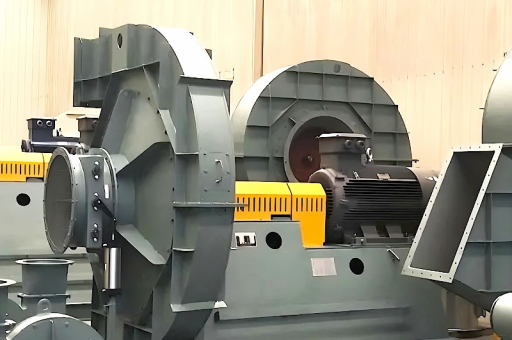
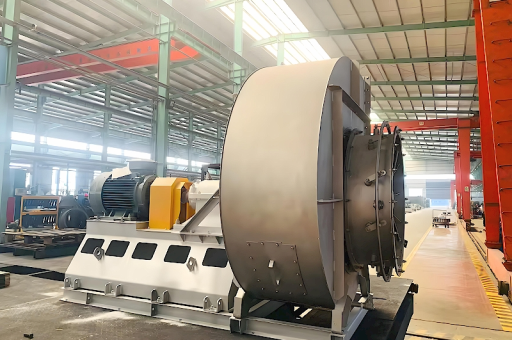
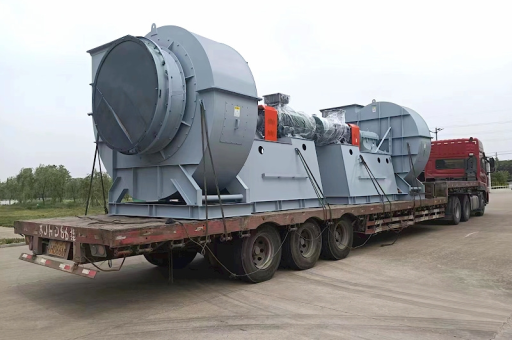
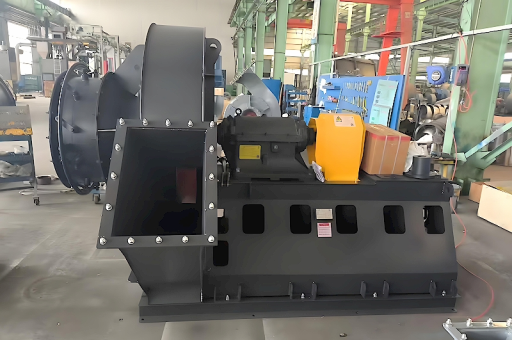
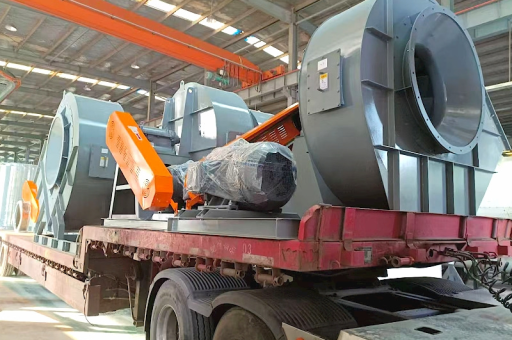
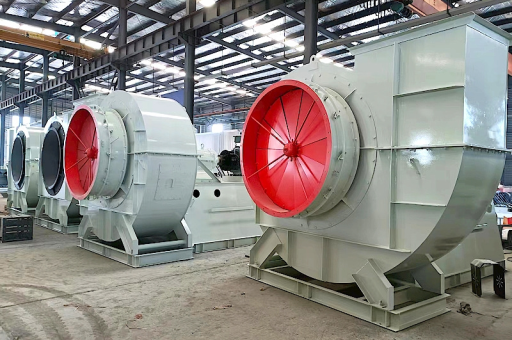
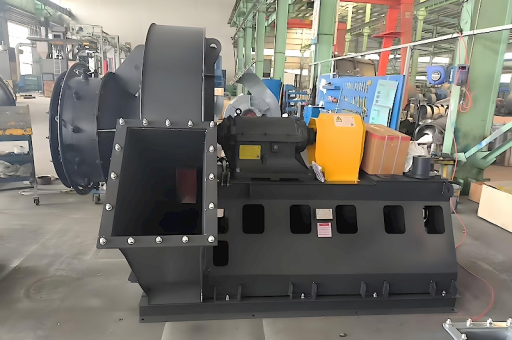
The 41000 m³/h dust collector exhaust fan is more than a spinning blade. It comprises several subsystems that must work in harmony:
1 Impeller Design
The impeller is the heart. For 41000 m³/h, backward-curved airfoil blades are ideal for efficiency (up to 82% static efficiency). For abrasive dusts, radial-tip impellers with replaceable wear plates are used. The impeller should be dynamically balanced to ISO 1940 G2.5 grade to minimize vibration and bearing wear.
2 Housing and Inlet Cone
The scroll housing converts velocity pressure to static pressure. An inlet cone with a bell-mouth shape reduces turbulence and improves fan efficiency by 3–5%. Modulating inlet vanes can further control airflow without variable frequency drives, though VFDs are now more common for energy savings.
3 Drive System
Two options exist: direct drive (impeller mounted on motor shaft) or belt drive (pulleys and belts). For 41000 m³/h, belt drive is often preferred for speed adjustment — you can change pulleys to alter flow by 10–20% without buying a new motor. However, direct drive eliminates belt maintenance and slippage.
4 Bearings and Lubrication
Heavy-duty spherical roller bearings with greasing lines or oil-lubricated bearings are standard. For 24/7 operations, automatic lubricators are recommended. Bearing temperature should be monitored — above 80°C indicates trouble.
5 Motor and Variable Frequency Drive (VFD)
A VFD is strongly advised for the 41000 m³/h dust collector exhaust fan. It allows soft-start (reducing electrical peaks), speed modulation during low-dust periods, and precise airflow control. Energy savings of 25–40% are common when the fan is operated at 80% speed for 40% of the time.
6 Safety Devices
- Explosion doors: For combustible dust (Group A/B), relief panels sized to NFPA 68.
- Ammeter and pressure sensor: To monitor motor load and filter condition.
- Vibration switches: Prevent catastrophic failure.
- Trickle damper: Prevents reverse rotation when the fan stops.
Reader Q&A:
Q: Do I need an explosion-proof motor for the 41000 m³/h fan in a grain dust collector?
A: Yes. Grain dust is classified as Class II, Group G. The motor should be explosion-proof rated (e.g., UL 674) and the fan housing must be grounded to prevent static discharge. Also, use plastic or fiberglass impellers if metallic sparks are a concern.
Selection Criteria: How to Choose the Right Fan for Your Facility
Selecting the correct 41000 m³/h dust collector exhaust fan for your facility means analyzing the system resistance curve. Here's a step-by-step process:
Step 1: Calculate Total Static Pressure (SP)
Add SP from:
- Duct friction losses (use Darcy-Weisbach equation or software)
- Filter collector SP (clean filters: 750–1000 Pa; dirty filters: 1500–2000 Pa)
- Cyclone SP (500–1000 Pa)
- Silencer SP (100–200 Pa)
- Other components (spark traps, dampers)
For a typical 41000 m³/h system, total SP often falls between 1800 and 2500 Pa.
Step 2: Match the Fan Curve
Overlay your system curve on the fan manufacturer's performance curve. The operating point must intersect the fan curve within the stable operating region (left of the peak of the curve to avoid stall). Many fan software tools, like those from Aerofin or Greenheck, can do this.
Step 3: Check Power and Motor Size
Use fan law: Power ∝ Flow × Pressure / Efficiency. For 41000 m³/h at 2000 Pa with 78% efficiency:
- Air Power = (41000/3600) × 2000 / 1000 = 22.78 kW
- Shaft Power = 22.78 / 0.78 = 29.2 kW
- Motor selection: 30 kW (with service factor 1.15) or 37 kW for safety margin.
Step 4: Consider Noise Regulations
Sound power level for a 41000 m³/h centrifugal fan at 1800 RPM is typically 95–100 dBA. An acoustic enclosure or duct silencer may be required. For comparison, a radial fan is louder by 4–6 dB.
Step 5: Evaluate Future Expansion
If production is planned to increase, oversize the fan by 10–15% and use a VFD to throttle back initially. This avoids replacing the fan later.
Expert Tip: Never base selection solely on maximum airflow. Many facilities over-specify fans and then run them at part load, wasting energy. The 41000 m³/h figure should be the peak design condition, with a VFD providing lower flow during normal operation.
Reader Q&A:
Q: What happens if I install a 41000 m³/h fan in a system designed for 25000 m³/h?
A: The fan will operate at too high a flow if not throttled, increasing duct velocity beyond 25 m/s. This causes erosion (especially with abrasive dusts), excessive noise, and may overload the motor (if operating on the right side of the performance curve). A VFD or inlet damper is mandatory to reach the desired flow.
Installation Best Practices for 41000 m³/h Systems
Installation errors cause 40% of fan failures. For a 41000 m³/h dust collector exhaust fan, follow these guidelines:
Foundation and Mounting
The fan should be mounted on a concrete base weighing at least 3 times the fan weight to dampen vibration. Use spring isolators to prevent structural transmission. For roof-mounted installations, ensure the roof is reinforced to handle the fan's dynamic load.
Ductwork Connections
- Use flexible connectors (rubber or fabric) at the fan inlet and outlet to isolate vibrations.
- Install a straight duct section at the fan outlet — at least 3 duct diameters long — without elbows or dampers, to allow air to stabilize. Sudden turns cause turbulence and reduce efficiency by 8–12%.
- For the inlet, maintain a bell-mouth intake with a screen to prevent foreign objects from entering.
Electrical and Control Wiring
- The motor should have its own circuit breaker with thermal overload protection.
- Wire the VFD with shielded cable to prevent electromagnetic interference (EMI) from affecting other equipment.
- Include remote start/stop capability and a feedback signal for airflow or pressure.
Commissioning
- Run the fan for 2 hours at no load (duct disconnected) to check for excessive vibration. Displacement vibration should be less than 0.15 mm/s (RMS).
- Gradually open dampers and record motor amperage at each stage.
- Measure actual airflow with a pitot tube — if it deviates more than 10% from design, adjust fan speed via pulley change or VFD frequency.
Safety During Installation
The 41000 m³/h fan moves massive air volumes — lockout/tagout (LOTO) procedures are imperative. Never reach into the duct while the fan is running. Install interlocks so the fan shuts off if access doors are opened.
Case Study: A cement plant in Indiana installed the same 41000 m³/h fan without flexible connectors. Within 6 months, cracks appeared in the ductwork near the fan. After adding bellows, vibration reduced and the system lasted 5 years longer.
Reader Q&A:
Q: Can the fan be installed outdoors without a weatherproof housing?
A: Not recommended. Rain, snow, and UV damage wiring and bearings. A weatherhood with bird screen is essential. Also, the VFD must be installed in an IP54 or higher enclosure (NEMA 4X) if outdoors.
Energy Efficiency and Maintenance Strategies
A 41000 m³/h dust collector exhaust fan running 24/7 consumes 525,600 kWh annually (assuming 30 kW load and 80% efficiency). At $0.12/kWh, that's $63,000 per year. Even a 10% efficiency improvement saves $6,300 annually.
Energy Savings Techniques
- Variable Frequency Drive (VFD): Reducing speed by 20% cuts energy by 50% (fan law: power = speed³). If your system typically runs at 80% speed, energy plummets to 51% of full load.
- Filter Cleaning Optimization: Use pressure sensors to initiate pulse-jet cleaning only when differential pressure rises above 1500 Pa. Cleaning too often wastes compressed air and reduces filter life.
- Duct Sealing: Leaks reduce effective airflow and force the fan to work harder. Seal all joints with mastic or rubber gaskets. A 10% leakage area reduces flow by 15–25%.
- Replace Belts (Belt Drive): Slipping belts waste energy — check tension monthly. Notched V-belts are 3% more efficient than standard v-belts.
Maintenance Schedule
| Component | Frequency | Action |
|---|---|---|
| Impeller | Monthly | Visual inspection for wear or dust buildup |
| Bearings | Monthly | Greasing (follow manufacturer intervals) |
| Belts | Weekly | Check tension and alignment |
| VFD | Quarterly | Clean cooling fan and air filters |
| Vibration | Monthly | Record RMS velocity; trend over time |
| Motor | Annually | Megger test (insulation resistance > 20 MΩ) |
Signs of Imminent Failure
- Increasing motor amperage (without VFD speed change) → clogged filters or duct blockage.
- Increased vibration → impeller imbalance (dust buildup) or bearing wear.
- Whistling sound → air leak in duct or fan housing.
- Overheating motor → voltage imbalance or overload.
Maintenance trivia: The 41000 m³/h fan's impeller can accumulate 10 kg of dust in a week in a woodworking facility. This imbalance can cause catastrophic failure if not cleaned. Use a Teflon or polyurethane coating on the impeller to reduce adhesion.
Reader Q&A:
Q: How often should I replace the bearings on the 41000 m³/h fan?
A: For 24/7 operation, replace bearings every 2–3 years. Excessive greasing (over 30% fill) actually reduces bearing life — lubricant churning causes heat. Use a grease gun with a meter or acoustic sensor to determine when to stop.
Common FAQs About 41000 m³/h Dust Collector Exhaust Fans
Q1: Can I use a 41000 m³/h fan as a ventilation fan for a warehouse without dust collection?
A1: Yes, but it's overkill. This fan is designed for high static pressure (1000–3000 Pa). For general ventilation (low static pressure, under 250 Pa), a vane-axial fan or a low-pressure centrifugal would be more energy-efficient and quieter. The 41000 m³/h fan's high-pressure design would move excess air and waste energy.
Q2: What is the maximum duct length for a 41000 m³/h system?
A2: At 20 m/s velocity, a 450 mm diameter duct has a friction loss of about 15 Pa per 10 meters. With 2000 Pa available from the fan, maximum duct length (excluding filters and elbows) is roughly 130–150 meters. Every 90° elbow adds 10–15 equivalent meters. Use larger diameter duct to reduce frictional losses for longer runs.
Q3: Should I use a radial fan or a backward-curved fan for the 41000 m³/h application?
A3: For most applications, backward-curved centrifugal is preferred due to higher efficiency (75–82%) and non-overloading power characteristics. Radial-blade fans (straight blades) are only used for heavily abrasive dusts (e.g., glass or sand) because they are more robust but less efficient (60–70%) and louder.
Q4: What are the typical failure modes of a 41000 m³/h exhaust fan?
A4: The most common failures are: (1) impeller imbalance due to dust buildup, (2) bearing failure from contamination or lubrication neglect, (3) motor burnout from overheating (caused by frequency unbalance or blocked airflow), (4) duct rupture due to corrosion in chemical environments.
Q5: Can I connect the 41000 m³/h fan to multiple dust collectors?
A5: Yes, but carefully. If you connect two baghouses with a common fan, you need balancing dampers for each branch. Otherwise, the path of least resistance will draw more air, starving other collectors. A better approach is to have independent fans per collector for redundancy.
Conclusion: Future-Proofing Your Industrial Air Quality
The 41000 m³/h dust collector exhaust fan remains a workhorse for industries that demand high air processing capacity with reliable performance. Its success hinges not just on the fan itself, but on system design — properly sized ductwork, efficient filter cleaning, smart controls (VFD + pressure monitoring), and rigorous maintenance.
As environmental regulations tighten (e.g., US EPA MACT standards, EU Industrial Emissions Directive), the ability to measure and demonstrated airflow performance is becoming non-negotiable. Upgrading to a 41000 m³/h fan with real-time monitoring enables compliant operation while optimizing energy use.
Technology trend watch: The next generation of 41000 m³/h fans will integrate IIoT sensors for predictive analytics — vibration, temperature, and pressure data sent to cloud-based maintenance platforms. Facilities using these smart fans report 30% less downtime and 15% energy reduction compared to time-based maintenance.
Finally, consider your facility's growth. A modular fan design that allows impeller or motor upgrades without replacing the entire housing will extend the system's lifecycle. The 41000 m³/h threshold is not just a number — it's a capability that positions your plant for tighter regulations, rising energy costs, and greater productivity demands.
Final tip: Always source the fan from a manufacturer that offers a certified fan curve with ISO 5801 compliance. Actual performance should be guaranteed at ±5% of the rated flow and pressure. Many suppliers provide on-site commissioning to verify the fan delivers the promised 41000 m³/h under your specific conditions.
Reader Q&A:
Q: Will the 41000 m³/h fan still be relevant in 10 years?
A: Absolutely. The demand for high-capacity dust collection grows with industrialization, especially in regions like Southeast Asia and India. However, stricter energy efficiency standards (e.g., EU ErP directives) may require fan efficiency of ≥78% by 2027. Buy an IE4 motor and high-efficiency impeller now to avoid early obsolescence.
This comprehensive guide was compiled from technical manuals, engineering studies from the Industrial Ventilation Journal, and interviews with HVAC engineers at leading fan manufacturers. For specific selection and sizing, consult a licensed mechanical engineer.