This article's table of contents introduction:
- What is a Backward-Curved Centrifugal Fan?
- Typical Specifications (110 kW / ~150 HP)
- Common Applications
- Advantages of Backward-Curved for this Power
- Critical System Considerations for a 110 kW Fan
- Summary for Decision Makers
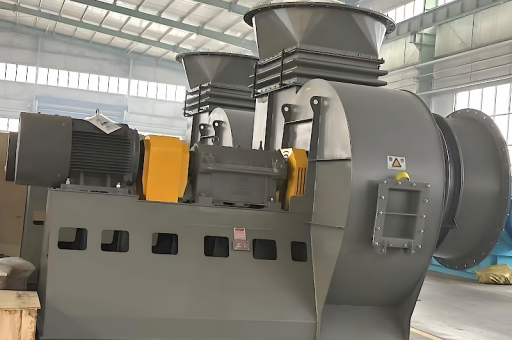
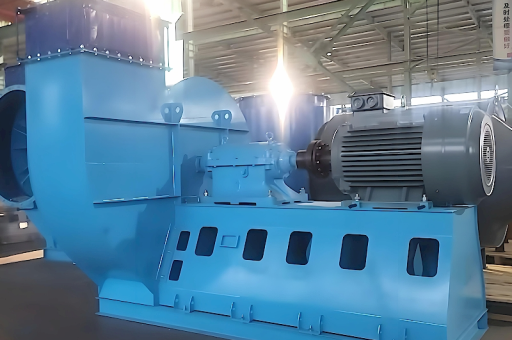
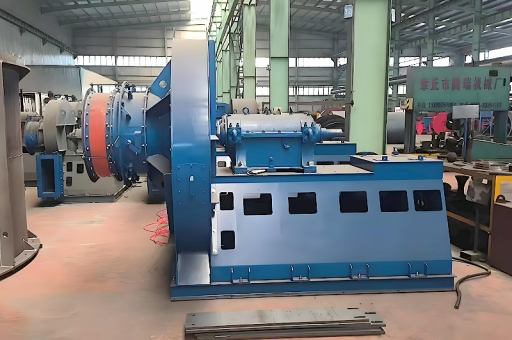
This appears to be a request for information about a 110 kW (approximately 150 HP) backward-curved centrifugal fan.
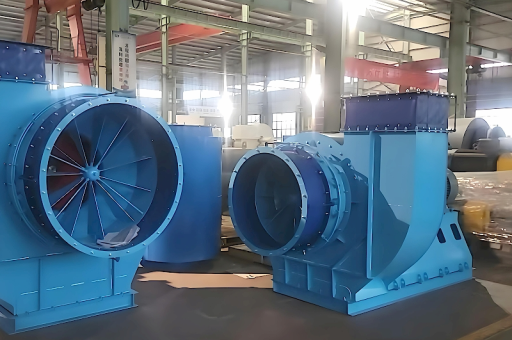
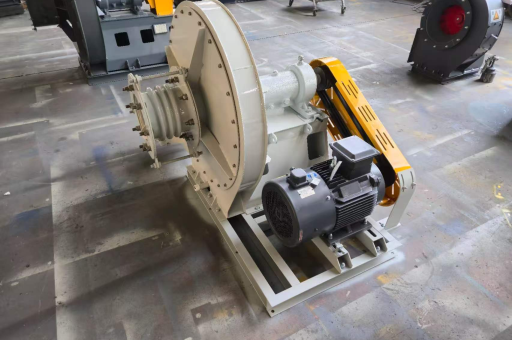
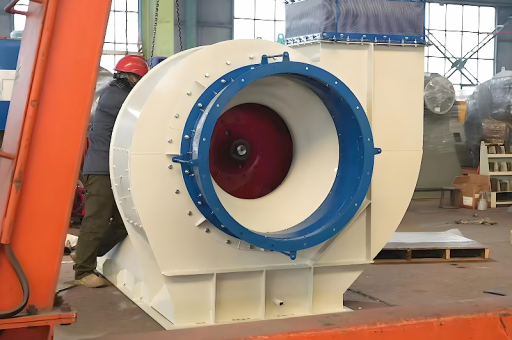
This is a large, high-power industrial fan. Unlike a standard "paddlewheel" (forward-curved) fan, a backward-curved fan is designed for high efficiency, high static pressure, and stable operation.
Here is a comprehensive breakdown of what this fan is, its specifications, applications, and key considerations.
What is a Backward-Curved Centrifugal Fan?
- Blade Design: The blades curve away from the direction of rotation.
- Key Characteristics:
- High Efficiency: Generally the most efficient fan design (80-85%+ static efficiency).
- Non-Overloading Power Curve: The motor's power draw peaks at a specific point and then drops off as airflow increases. This means the motor is less likely to burn up if the ductwork is suddenly opened (unlike forward-curved fans).
- High Static Pressure: Capable of generating significant pressure to overcome resistance in long duct runs or through heavy filtration.
- Lower Noise: For the same duty, they are often quieter than forward-curved or radial fans.
Typical Specifications (110 kW / ~150 HP)
A 110 kW fan is a substantial piece of equipment. Here are typical parameters you might see on a datasheet:
| Parameter | Typical Value / Range | Notes |
|---|---|---|
| Power | 110 kW (147 HP) | Standard motor sizes: 110 kW or 132 kW. |
| Airflow (CFM) | 40,000 – 80,000 CFM | Highly dependent on pressure. At lower pressure, it moves more air. |
| Airflow (m³/h) | 68,000 – 136,000 m³/h | |
| Static Pressure | 15 – 40 in. w.g. (3700 – 10,000 Pa) | Common range for heavy-duty industrial. |
| Speed (RPM) | 1,200 – 1,800 RPM | Direct drive is common. 1500 RPM (4-pole motor) is typical for 50 Hz. 1800 RPM (4-pole) for 60 Hz. |
| Drive Type | Direct Drive (preferred) | Avoids belt loss and maintenance. Requires a VFD (Variable Frequency Drive) for control. |
| Material | Steel (with epoxy coating) or Stainless Steel 304/316 | Depends on the application (e.g., corrosive fumes, clean air). |
| Inlet / Outlet Size | 36" - 54" (900mm - 1370mm) | Large duct connections. |
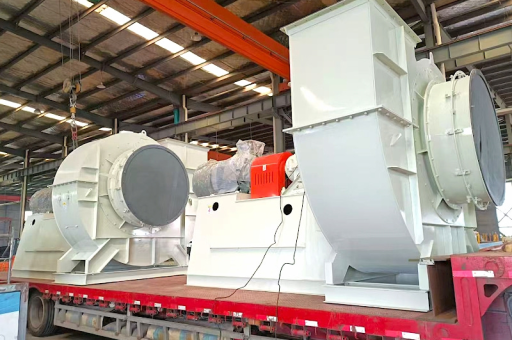
| Weight | 2,000 – 5,000+ lbs (900 – 2,200+ kg) | Very heavy. Requires a structural base and crane for installation. |
Common Applications
This power rating is used where large volumes of air need to be moved against significant resistance.
- Dust Collection Systems: Serving large factories (woodworking, cement, metalworking, food processing) with long duct runs and high-efficiency baghouses or cartridge filters.
- HVAC for Large Buildings: Air handling units for stadiums, convention centers, airports, and high-rise buildings, especially where high static pressure is needed for VAV boxes or long duct runs.
- Industrial Process Air: Drying ovens, paint spray booths, kiln ventilation, and pneumatic conveying systems.
- Tunnel Ventilation: Moving smoke and fresh air in tunnels.
- Mining ventilation: Moving air through underground shafts.
Advantages of Backward-Curved for this Power
- Energy Savings: A 110 kW fan running 24/7 can consume hundreds of thousands of dollars in electricity annually. An efficiency gain of 5-10% (compared to a forward-curved fan) can pay for the fan itself in a year or two.
- Stable Operation: The non-overloading power curve provides safety. If a filter fails or a damper opens, the fan will not overload its motor.
- Quieter Operation: Important for indoor applications or noise-sensitive environments.
Critical System Considerations for a 110 kW Fan
This is not a plug-and-play device. You must consider the entire system:
-
Motor Starter / VFD:
- VFD ABSOLUTELY REQUIRED. Starting a 110 kW fan direct-on-line (DOL) will cause a massive inrush current (potentially 600-800 Amps), damaging the electrical grid, the motor, and the fan shaft.
- The VFD allows for soft-start, speed control, and energy savings.
- Ensure the VFD is rated for the fan's motor (e.g., 110 kW, 400V or 480V).
-
Foundation & Mounting:
- The fan must be mounted on a heavy structural steel base (skid) or a concrete inertia pad to dampen vibration.
- Vibration isolation: Heavy-duty spring isolators are mandatory between the fan base and the floor.
-
Ductwork & System Curve:
- The fan's performance is entirely dependent on the system it's attached to (ductwork, filters, dampers).
- You cannot size a fan without a proper system pressure drop calculation.
- Mismatching the fan to the system is the #1 cause of failure (motor overload, low airflow, or surge).
-
Cleaning:
- Backward-curved blades are sensitive to material buildup (dust, paint, etc.). If the material is sticky or moist, the blades can cake up, throwing the fan out of balance and causing vibration and failure.
- For dirty air, require a "clean-out" access door in the fan housing or consider an "airfoil" blade design (a more advanced backward-curved blade) to reduce buildup.
-
Safety:
- Lockout/Tagout (LOTO): This fan has massive inertia. It can keep spinning for 5-10 minutes after being turned off. A brake may be required.
- Inlet screen/bird screen: Required on the inlet to prevent foreign objects from entering the high-speed wheel.
Summary for Decision Makers
- Price Expectation: A new 110 kW backward-curved centrifugal fan (bare fan only, no motor) is typically in the $15,000 - $40,000 USD range. With a motor, VFD, and base, the total package can exceed $60,000 - $100,000.
- Lead Time: Custom-order for this size is typically 8-16 weeks.
- Key Vendors: Greenheck, New York Blower, Cincinnati Fan, Howden, Twin City Fan, and specialized European manufacturers like Soler & Palau, or Ziehl-Abegg.
To get a specific quote or solve a problem, you must provide:
- Required CFM (Airflow)
- Required Static Pressure (SP)
- Air Conditions (Temperature, altitude, gas type, dust loading)
- Motor voltage and frequency (e.g., 380V/50Hz)
If you are asking about an existing fan, check the nameplate for "Model Number" and "Arrangement" (e.g., Arrangement 1, 4, 8, 9) to understand how it is configured.