This article's table of contents introduction:
- Deconstructing the Name
- Typical Specifications for a 200 kW BC Fan
- Common Applications
- Critical Considerations for Selection & Operation
- Summary Table: 200 kW BC Fan
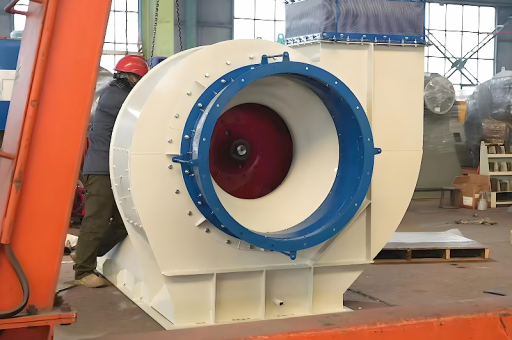
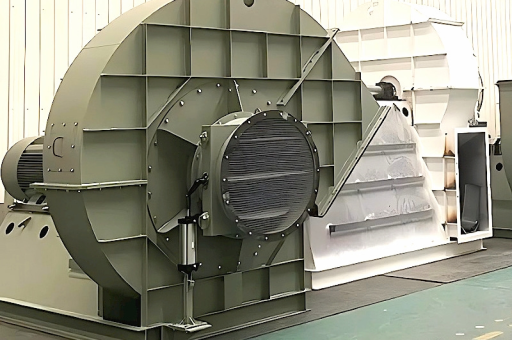
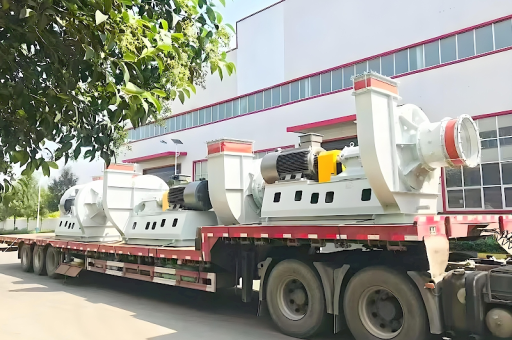
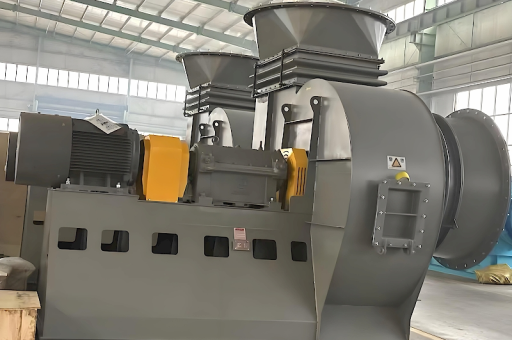
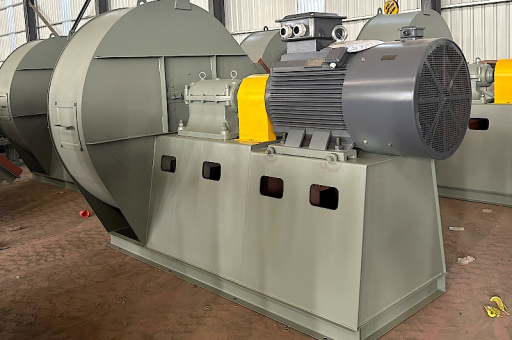
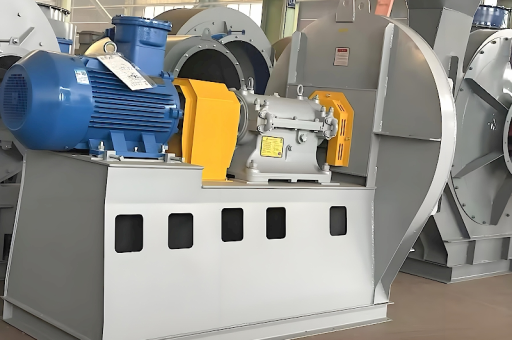
This is a very specific piece of industrial equipment. A 200 kW Backward-Curved Centrifugal Fan is a high-power, heavy-duty air-moving device. To give you a useful and comprehensive answer, I'll break this down into its key components: what the specific terms mean, typical applications, general specifications for a fan of this power class, and critical considerations for operation.
Deconstructing the Name
- 200 kW (Kilowatts): This is the motor power or power consumption at the fan shaft. 200 kW is roughly 268 horsepower. This is a massive amount of power, indicating a very large fan moving a very large volume of air against significant resistance (pressure).
- Backward-Curved (BC): This refers to the shape of the fan blades.
- Design: The blades curve away from the direction of rotation.
- Characteristics:
- High Efficiency: BC fans are the most efficient type of centrifugal fan (typically 75-85% peak efficiency).
- Non-Overloading Power Curve: This is their biggest advantage. As air volume (CFM) increases, the power required peaks and then actually drops. This means the motor is safe from burning out even if the system's ductwork is open or blocked in a way that reduces flow.
- Medium to High Pressure: They are excellent for moving large volumes of air through systems with moderate to high static pressure (ductwork, filters, coils).
- Lower Noise: Generally quieter than forward-curved fans at the same duty point.
- Lower Air Volume: For the same wheel diameter and speed, they move less air than a forward-curved fan, but they do it much more efficiently.
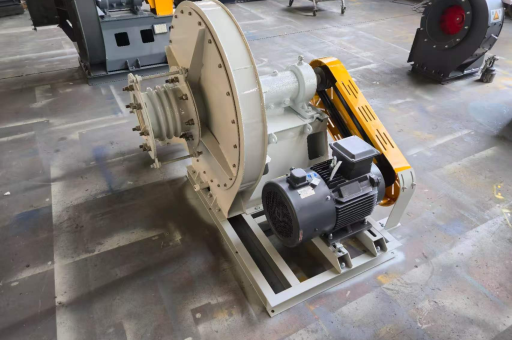
- Centrifugal Fan: The air enters the fan wheel axially (along the shaft) and is discharged radially (perpendicular to the shaft) by centrifugal force. The casing (scroll or volute) collects this air and converts its kinetic energy (velocity) into potential energy (static pressure).
Typical Specifications for a 200 kW BC Fan
A fan of this size is custom-engineered for its specific application. The exact dimensions and performance will vary dramatically. However, a hypothetical "medium-pressure" example might be:
| Parameter | Approximate Value / Range |
|---|---|
| Motor Power (Shaft) | 200 kW (268 HP) |
| Air Volume (CFM / m³/s) | 100,000 - 250,000 CFM (47 - 118 m³/s) |
| Static Pressure (in. wg / Pa) | 10 - 30 in. wg (2,500 - 7,500 Pa) |
| Fan Wheel Diameter | 0 - 3.5 meters (6.5 - 11.5 feet) |
| Fan Speed (RPM) | 500 - 900 RPM (likely VFD-driven) |
| Weight (Fan + Motor) | 3,000 - 8,000+ kg (6,600 - 17,600+ lbs) |
| Construction Material | Carbon Steel, Corten Steel (for abrasion), Stainless Steel (for corrosion/hygiene) |
Crucial Note: A fan with a 200 kW motor could produce significantly higher pressure (e.g., 60-100 in. wg) at a lower volume, or much higher volume at lower pressure. These numbers are a "sweet spot" guess for a general industrial HVAC or process fan.
Common Applications
You will find a 200 kW BC fan in large-scale, critical environments:
- Power Plants: Induced Draft (ID) fans pulling flue gas through scrubbers and electrostatic precipitators. Forced Draft (FD) fans pushing air into coal or biomass boilers.
- Cement Plants: Kiln ID fans, raw mill fans, and baghouse fans for dust collection.
- Mining: Main mine ventilation fans (exhaust or intake), moving vast quantities of air through miles of tunnels.
- Large HVAC for Mega-Structures: Airports, stadiums subways, or large data centers. They might be part of an Air Handling Unit (AHU) or stand-alone.
- Chemical & Process Industries: Fume extraction systems, chemical reactor off-gas systems, and pneumatic conveying.
- Steel Mills: Fume exhaust hoods for electric arc furnaces (EAF) or basic oxygen furnaces (BOF). These often require very high power due to high temperature and dust loading.
Critical Considerations for Selection & Operation
A 200 kW fan is a capital investment with high operating costs. Getting it wrong is very expensive.
- Drive System: Variable Frequency Drive (VFD) is mandatory. A fan this large must be able to vary its speed. Starting across-the-line would cause massive electrical inrush current and mechanical stress. A VFD allows for soft starting, precise flow control, and significant energy savings (by the fan affinity laws: Power ∝ Speed³).
- Bearings: These are not small pillow block bearings. They will be heavy-duty spherical roller bearings or split-cylindrical roller bearings, often with lubrication systems (oil ring or forced oil circulation) and temperature/vibration sensors (RTDs, accelerometers) for continuous monitoring.
- Vibration & Balancing: The impeller must be statically and dynamically balanced (typically to Grade G6.3 or better). The entire fan base must be on a massive, rigid foundation (or vibration isolators for a roof installation) to prevent structural resonance.
- Materials & Coatings:
- Abrasion: If handling particulate-laden air (dust, sand), the wheel blades and housing must be lined with abrasion-resistant materials (e.g., AR400 steel, ceramic tiles, hardfacing).
- Corrosion: For corrosive gases, use Stainless Steel (316L, Duplex) or specialized coatings (e.g., Halar, Teflon).
- High Temperature: For hot gases (up to 400°C+), special alloys and shaft cooling (shaft-mounted heat slingers, cooling disks) are required.
- Inlet & Outlet Conditions: The ductwork design is critical. A poor inlet (e.g., a tight 90° elbow near the inlet cone) will cause turbulence, reduce efficiency, and potentially cause vibration and noise. The fan's performance is very sensitive to its inlet and outlet connections.
- Safety: A 200 kW fan stores immense kinetic energy. Lockout/Tagout procedures are critical. The impeller creates a powerful vacuum. Someone getting their clothing or hair caught near the inlet would be fatal. All guards and screens must be in place.
Summary Table: 200 kW BC Fan
| Aspect | Detail |
|---|---|
| What it is | Heavy-duty, high-efficiency air mover for large-scale industrial processes. |
| Key Advantage | Efficiency and non-overloading power characteristic (safe motor). |
| Typical Volume | 100,000 - 250,000+ CFM (depends on pressure). |
| Typical Pressure | 10 - 40+ inches of water gauge (2,500 - 10,000 Pa). |
| Core Applications | Power plants, cement, mining, mega-HVAC, steel mills. |
| Essential Tech | Variable Frequency Drive (VFD), heavy-duty bearings, robust foundation. |
| Cost | Very high. Not a commodity item. Custom engineered. |
If you have a more specific question about a 200 kW BC fan (e.g., "What is the starting current for a 200 kW, 690V motor?" or "How do I calculate the power savings from reducing the speed by 10%?"), feel free to ask!