
This article's table of contents introduction:
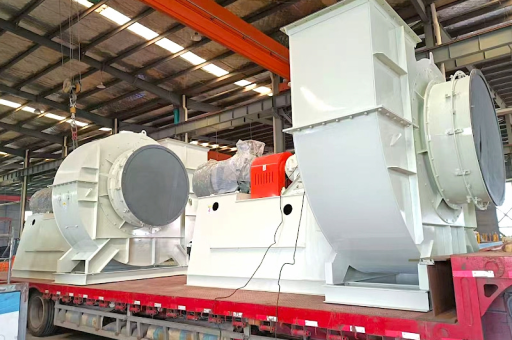
- What is it?
- Key Component: The "Backward" Blade
- Why "V-Belt Driven" instead of "Direct Drive"?
- Typical Applications (Heavy Duty)
- Key Specifications to Look for
- Advantages & Disadvantages
- Common Brand Series (Examples)
This is a specific industrial product category. Here is a detailed breakdown of Backward Heavy Duty Centrifugal Fans, specifically the V-Belt Driven type.
What is it?
A Backward Heavy Duty Centrifugal Fan is a type of air-moving device designed for high-pressure, high-volume, and continuous industrial applications.
- Backward: Refers to the blade design. The blades curve away from the direction of rotation.
- Heavy Duty: Built with thicker materials, stronger bearings, and robust housings to withstand harsh environments (dust, heat, particulates) 24/7.
- V-Belt Driven: The fan wheel (impeller) is not mounted directly on the motor shaft. Instead, a motor turns a pulley, which drives a belt, which turns a larger pulley on the fan shaft.
Key Component: The "Backward" Blade
This is the most critical design feature.
- How it works: Air enters the center of the wheel and is thrown outward by centrifugal force. The backward curve means the air exits with a lower velocity than forward-curved blades, resulting in higher static pressure and higher efficiency.
- Performance Curve (Crucial): Backward curved fans have a non-overloading power curve. This means that as the system resistance (static pressure) decreases, the motor's power draw (amp draw) peaks and then drops. This prevents the motor from burning out if a duct becomes disconnected.
- Efficiency: Typically 75-85% efficient, much better than forward-curved fans.
Why "V-Belt Driven" instead of "Direct Drive"?
| Feature | V-Belt Drive | Direct Drive (Motor mounted on shaft) |
|---|---|---|
| Speed Control | Easily adjustable. Change pulley size to change RPM & airflow. | Fixed to motor speed (e.g., 1750 RPM). Change requires a VFD. |
| Motor Protection | Motor is outside the airstream. Cooler, cleaner operation. | Motor is often in the hot/dirty process air. |
| Starting Torque | Belts slip slightly, reducing shock load on motor during startup. | Full motor torque applied instantly. |
| Cost | Lower initial cost for common speeds. | Higher initial cost, but simpler. |
| Maintenance | Belts wear and need tensioning/replacement. | Less maintenance (just bearings). |
Typical Applications (Heavy Duty)
These fans are the workhorses of industry where the air is tough:
- Dust Collection & Material Handling: Moving wood chips, sawdust, metal filings, cement dust, grain.
- Boiler & Furnace: Induced Draft (ID) fans pulling hot flue gas through a boiler.
- HVAC & Exhaust: Large commercial buildings, parking garages, tunnels (smoke exhaust).
- Cement & Mining: Ventilation and conveying.
- Fume Extraction: Chemical plants, welding shops.
Key Specifications to Look for
When selecting or ordering, you'll need to specify:
- Air Volume (CFM / m³/h): How much air you need to move.
- Static Pressure (in. w.g. / Pa): The resistance the fan must overcome.
- Wheel Diameter: (e.g., 30" or 750mm) determines the physical size.
- Housing Material: (Mild steel, stainless steel, aluminum, or lined for abrasion).
- Motor HP (kW): Calculated based on the power required.
- Operational Speed (RPM): Frequently between 400 - 1200 RPM for large, heavy-duty units.
- Temperature: Standard (up to 180°F / 80°C), Medium (up to 400°F / 200°C), or High Heat (with a cooling wheel for the shaft).
Advantages & Disadvantages
Advantages:
- High Efficiency (saves electricity over the life of the fan).
- Non-overloading motor (safe for dirty filter systems).
- Speed flexibility (via pulley change).
- Handles particulates better than forward-curved designs.
Disadvantages:
- Lower air volume for a given size compared to forward-curved fans (requires a larger housing).
- Higher starting torque requirement.
- Belt maintenance (tensioning, alignment, replacement).
- More expensive than standard duty equivalent.
Common Brand Series (Examples)
- Greenheck: BIDW / BISW
- New York Blower (NYB): HP Series (High Pressure)
- Chicago Blower: "Backward Inclined" (BI) or "Airfoil" (AF) Series
- Cincinnati Fan: HP Series
- Howden / Clarage: Arrangement 1, 3, 9, 10
In short: If you need to move dusty, hot, or fibrous air at a high pressure, and you want to change the speed easily without buying a VFD, a Backward Heavy Duty V-Belt Driven Centrifugal Fan is the standard industrial solution.





