
This article's table of contents introduction:
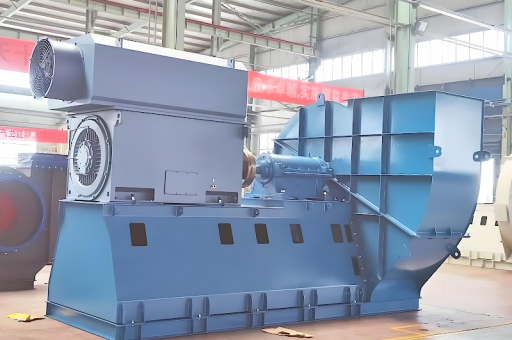
- What is a Coupling Forward Curved Centrifugal Fan?
- How it Works (The Physics)
- Key Performance Characteristics (The "Profile")
- Why Choose a Coupling Drive?
- Advantages & Disadvantages
- Typical Applications
- Summary Table: Forward Curved vs. Backward Curved vs. Radial
- Critical Installation Note
- Conclusion
Here is a comprehensive explanation of a Coupling Forward Curved Centrifugal Fan, covering its design, how it works, its key characteristics, and typical applications.
What is a Coupling Forward Curved Centrifugal Fan?
This term describes a specific type of centrifugal fan defined by two key features:
-
Forward Curved (FC) Blades: The fan wheel (impeller) has blades that curve in the direction of rotation. Imagine looking at the wheel from the side; the blades curl forward, towards the direction the wheel is spinning. This is often called a "squirrel cage" or "sirocco" fan because of the many closely spaced, shallow blades.
-
Coupling Drive (or Direct Drive via Coupling): The fan wheel is not mounted directly on the motor shaft. Instead, the motor shaft connects to a coupling, which then connects to the fan's own shaft and bearing assembly. This is a direct drive arrangement (no belts), but the motor and fan are separate units joined by a flexible or rigid coupling.
How it Works (The Physics)
The "forward curved" name is critical to its performance characteristics.
- Air Entry: Air is drawn into the center of the fan wheel (the eye) axially (parallel to the shaft).
- Air Acceleration & Redirection: The rotating wheel catches the air between the blades. Due to the forward-curved shape, the air receives a significant portion of its energy from impulse (being pushed by the blade tips) rather than just centrifugal force.
- High Speed, Low Pressure: This design imparts a high velocity to the air, but a relatively low static pressure rise compared to other centrifugal fan types (like backward curved or radial).
- Exit: The high-velocity air is collected by the fan housing (volute/scroll) and slowed down, converting some velocity energy into pressure energy before being discharged.
Key Performance Characteristics (The "Profile")
The most important thing to understand is the Horsepower (HP) Curve and the Pressure Curve.
- Pressure Curve: It is relatively steep and has a "dip" or "stall" region near its peak (best efficiency point). This makes it sensitive to system resistance changes.
- HP Curve: This is the defining characteristic. The horsepower requirement rises drastically as the airflow (CFM) increases. The power curve is "overloading." This means:
- At high airflow (low system resistance), the motor will draw significantly more power.
- If operated outside its design range (e.g., in a free-air or low-resistance setup), the motor can easily overload and burn out. This is a critical installation requirement.
Why Choose a Coupling Drive?
The coupling offers several advantages over direct-mount (motor mounted directly on fan) or belt-driven designs.
| Feature | Coupling Drive Advantage |
|---|---|
| Vibration Isolation | The coupling dampens vibration between the motor and fan, reducing noise and stress on motor bearings. |
| Alignment Flexibility | Allows for some misalignment during installation, making setup easier and less critical than direct-mount. |
| Serviceability | You can replace the motor without disturbing the fan wheel or its bearings, and vice-versa. |
| Heat Dissipation | The motor is physically separated from the fan's airstream. This is vital for high-temperature applications (e.g., ovens, furnaces, dryers) where the air is hot. |
| Motor Protection | The motor is not exposed to the conveyed air, which could be corrosive, dusty, or explosive. |
Advantages & Disadvantages
| Advantages | Disadvantages |
|---|---|
| Compact Size: Moves a high volume of air for a relatively small wheel diameter. | Overloading Motor: The HP curve rises with airflow. Never run it in a free-air discharge condition. |
| Quiet Operation: The many, shallow blades produce a smooth, low-noise airflow profile (great for HVAC). | Lower Efficiency: Generally less efficient than backward-curved or airfoil fans. |
| Low Cost (Initial): Simpler blade form makes the wheel cheaper to manufacture. | Sensitive to System Changes: Can easily fall into the unstable "stall" region if system resistance changes. |
| Low to Medium Pressure: Ideal for applications requiring high flow at low to medium static pressures (0.5 - 6 in. w.g.). | Limited Pressure Capability: Cannot generate high static pressures like radial or backward-curved fans. |
Typical Applications
Because of the "squirrel cage" quietness and high-volume, low-pressure output, these fans are found everywhere:
- HVAC Systems:
- Air handling units (AHUs)
- Furnaces and air conditioners (the indoor blower)
- Rooftop units
- Fan coil units
- Light Duty Industrial:
- Small ovens and dryers
- Electronic cooling
- Clean rooms (with HEPA filters)
- Commercial Ventilation:
- Restroom exhaust (large systems)
- Kitchen hoods (low static pressure types)
Summary Table: Forward Curved vs. Backward Curved vs. Radial
| Feature | Forward Curved (FC) | Backward Curved (BC) | Radial (Paddlewheel) |
|---|---|---|---|
| Blade Shape | Curves forward (in rotation direction) | Curves backward (against rotation) | Flat or radial blades |
| Efficiency | Moderate (60-75%) | High (75-85%) | Low (50-65%) |
| Pressure | Low to Medium | Medium to High | High |
| Power Curve | Overloading (rises with CFM) | Non-overloading (peaks then flattens) | Overloading (rises with CFM) |
| Noise | Low (Quiet) | Moderate | High (Loud) |
| Best For | High volume, low pressure (HVAC) | High volume, high pressure (Industrial) | High pressure, dirty air (Conveying) |
Critical Installation Note
Never operate a forward curved fan in a "free air" or "wide open" discharge condition without a motor sized to handle that high-power draw. You must size the motor for the maximum possible airflow (the "wide open" point on the curve). It is often safer to use a motor with a higher horsepower rating or to use a non-overloading fan design (Backward Curved) for variable systems.
Conclusion
A Coupling Forward Curved Centrifugal Fan is the workhorse of the HVAC world: quiet, compact, and cost-effective for moving large volumes of air against low to medium resistance. The coupling drive adds serviceability, vibration isolation, and critical motor protection in hot or hostile environments. However, you must respect its overloading horsepower characteristic to avoid motor burnout.





