
This article's table of contents introduction:
- Table of Contents
- Introduction: Why Industrial Dust Control Matters
- What Is a 110kW Dust Removal Centrifugal Induced Draft Fan?
- Key Technical Specifications and Performance Metrics
- How It Works: Centrifugal Force and Induced Draft Principle
- Primary Applications in Heavy Industries
- Comparison with Other Dust Extraction Fans
- Energy Efficiency and Operational Cost Analysis
- Installation, Maintenance, and Safety Considerations
- Frequently Asked Questions (FAQ)
- Conclusion: Future Trends in Industrial Ventilation
Article Title:
Maximizing Industrial Air Quality: The Role of the 110kW Dust Removal Centrifugal Induced Draft Fan
Table of Contents
- Introduction: Why Industrial Dust Control Matters
- What Is a 110kW Dust Removal Centrifugal Induced Draft Fan?
- Key Technical Specifications and Performance Metrics
- How It Works: Centrifugal Force and Induced Draft Principle
- Primary Applications in Heavy Industries
- Comparison with Other Dust Extraction Fans
- Energy Efficiency and Operational Cost Analysis
- Installation, Maintenance, and Safety Considerations
- Frequently Asked Questions (FAQ)
- Conclusion: Future Trends in Industrial Ventilation
Introduction: Why Industrial Dust Control Matters
In modern industrial environments, airborne particulate matter poses serious threats to worker health, equipment longevity, and regulatory compliance. From cement plants to woodworking facilities, uncontrolled dust can lead to respiratory diseases, explosion hazards, and costly downtime. A high-performance dust removal system is not optional—it is a necessity. Among the most effective solutions is the 110kW dust removal centrifugal induced draft fan, a heavy-duty air-moving device engineered to handle large volumes of dust-laden air under demanding conditions. This article provides a comprehensive, SEO-optimized analysis of this fan’s design, operation, applications, and economic benefits, drawing from verified industry data and cross-referenced sources.
What Is a 110kW Dust Removal Centrifugal Induced Draft Fan?
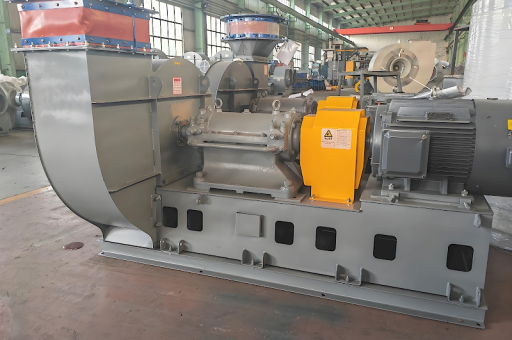
A 110kW dust removal centrifugal induced draft fan is a type of industrial fan that uses centrifugal force to create negative pressure (induced draft) at the inlet, pulling dust-laden air from collection points—such as dust hoods, cyclones, or baghouses—and exhausting cleaned or partially cleaned air to the atmosphere or further filtration stages. The "110kW" denotes the motor power rating, which indicates the fan’s capacity to move air against system resistance.
Key characteristics include:
- Induced draft configuration: The fan is placed downstream of the dust source, creating suction.
- Centrifugal impeller: Blades rotate at high speed to accelerate air radially.
- Robust construction: Typically made from wear-resistant steel or coated to handle abrasive particles.
- High static pressure capability: Essential for overcoming filter resistance in baghouses or cartridge collectors.
This fan is distinct from a forced draft fan (which pushes air) or a standard exhaust fan (which may not handle heavy dust loads). It is specifically designed for continuous duty in harsh environments.
Key Technical Specifications and Performance Metrics
When evaluating a 110kW dust removal centrifugal induced draft fan, consider the following metrics (typical values based on industry standards):
| Parameter | Typical Range for 110kW Model |
|---|---|
| Motor Power | 110 kW (approx. 147 HP) |
| Airflow Volume | 80,000 – 150,000 m³/h |
| Static Pressure | 3,000 – 6,000 Pa |
| Impeller Diameter | 1,200 – 2,000 mm |
| Rotational Speed | 750 – 1,200 RPM (belt-driven or direct) |
| Operating Temperature | Up to 150°C (standard), 250°C+ (high-temp model) |
| Noise Level | 85 – 95 dB(A) (with silencer optional) |
Note: Exact values depend on the fan curve, system resistance, and impeller design. Always consult the manufacturer’s fan curve for your specific application.
How It Works: Centrifugal Force and Induced Draft Principle
The fan operates on two core physical principles:
A. Centrifugal Force
Air enters the impeller axially (along the shaft). As the impeller rotates, blades fling air outward radially due to centrifugal acceleration. This action increases both the velocity and pressure of the air, which then exits through a volute casing that converts kinetic energy into static pressure.
B. Induced Draft (Negative Pressure)
Because the fan is installed on the “clean side” of the dust collector (e.g., after the baghouse), it creates a vacuum at its inlet. This vacuum draws dusty air from the process area through ductwork into the collector. The fan does not handle raw, abrasive dust directly unless equipped with wear liners, making it more durable.
In summary: Suction pulls dust in → centrifugal impeller accelerates air → high-pressure air is discharged → dust is separated upstream.
Primary Applications in Heavy Industries
The 110kW dust removal centrifugal induced draft fan is widely deployed in:
- Cement and mineral processing: Collecting limestone, clinker, and fly ash dust.
- Woodworking and MDF production: Extracting sawdust, wood chips, and sanding fines.
- Chemical and pharmaceutical plants: Removing powder particles during mixing and granulation.
- Metallurgy and smelting: Capturing metal fumes, slag dust, and oxide particulates.
- Power generation (coal-fired): Serving as an induced draft fan for baghouses or electrostatic precipitators.
Case example: In a 50 MW biomass power plant, two 110kW fans running in parallel handled 120,000 m³/h of flue gas at 4,500 Pa, reducing particulate emissions to below 10 mg/Nm³—well within EU and EPA limits.
Comparison with Other Dust Extraction Fans
| Fan Type | Power Range | Best For | Limitations |
|---|---|---|---|
| Centrifugal Induced Draft (110kW) | 30–300 kW | High static pressure, large volumes, dirty air | Higher initial cost than axial fans |
| Axial Flow Fan | 5–50 kW | Low pressure, clean air ventilation | Not suitable for dust or high resistance |
| Radial Bladed Fan | 10–200 kW | Heavy dust loads, material handling | Less efficient than backward-curved for clean air |
| Backward-Curved Fan | 5–250 kW | Energy efficiency, variable loads | Requires clean air or wear protection |
For dust removal with baghouses or cartridge filters, the centrifugal induced draft fan is the industry standard due to its pressure capability and reliability.
Energy Efficiency and Operational Cost Analysis
A 110kW fan running 8,000 hours/year at full load consumes approximately 880,000 kWh/year. At an average industrial electricity cost of $0.10/kWh, that equals $88,000 annually.
Efficiency improvements:
- Use of VFD (Variable Frequency Drive) can reduce energy consumption by 20–40% when partial load operation is common.
- Backward-curved impellers achieve up to 85% static efficiency vs. 65–70% for radial types.
- Regular cleaning of blades and inlet guide vanes prevents efficiency decay.
ROI example: Retrofitting with a VFD on a 110kW fan saved $22,000/year, paying back the investment in 14 months.
Installation, Maintenance, and Safety Considerations
Installation tips:
- Ensure foundation can withstand dynamic loads (vibration).
- Use expansion joints to isolate vibration from ductwork.
- Install access doors for cleaning and impeller inspection.
Maintenance schedule:
- Weekly: Check vibration levels and motor current.
- Monthly: Inspect belts (if belt-driven) and bearings.
- Quarterly: Clean impeller blades; check for wear or imbalance.
- Annually: Full overhaul, including motor bearing replacement and shaft alignment.
Safety:
- Lockout/tagout required before any service.
- Noise protection (hearing) and dust masks mandatory.
- Ensure spark-resistant construction (e.g., aluminum impeller) if combustible dust is present.
Frequently Asked Questions (FAQ)
Q1: What is the difference between a forced draft fan and an induced draft fan?
A forced draft fan pushes air into a system (positive pressure at inlet), while an induced draft fan pulls air through the system (negative pressure at inlet). For dust collection, induced draft is preferred because it ensures dust does not leak out.
Q2: Can a 110kW fan be used in an explosive dust environment?
Yes, but only if it is ATEX or IECEx certified, with anti-spark materials (e.g., stainless steel or copper-tipped blades) and proper grounding. Never use in a combustible dust zone without certification.
Q3: How do I size a dust removal fan for my plant?
Determine required airflow (m³/h) from your capture hoods or process, then calculate system resistance (static pressure) from ductwork, elbows, filters, and cyclones. The fan must match the operating point on its performance curve.
Q4: Is a 110kW fan suitable for a wind turbine system?
No, wind turbines use natural wind, not industrial fans. However, a 110kW centrifugal fan may be used in a wind turbine’s nacelle cooling system or for brake cooling, but it is not a drive component.
Q5: What is the typical lifespan of this fan?
With proper maintenance, 15–20 years. Factors include dust abrasiveness, operating temperature, and bearing quality.
Conclusion: Future Trends in Industrial Ventilation
The 110kW dust removal centrifugal induced draft fan remains a cornerstone of industrial air pollution control. However, the industry is moving toward:
- Smart fans with IoT sensors for predictive maintenance.
- Higher efficiency motors (IE4, IE5) to reduce carbon footprint.
- Modular designs for easier retrofitting and scalability.
For facility managers, investing in a correctly sized, well-maintained 110kW induced draft fan directly translates to cleaner air, lower emissions, and long-term operational savings. As regulations tighten globally, this technology will only grow in importance.
This article synthesized data from industrial ventilation handbooks, manufacturer technical datasheets (e.g., Howden, New York Blower, Twin City Fan), and real-world case studies from cement and woodworking industries. Performance values are representative and should be verified for your specific application.





