
This article's table of contents introduction:
- Core Function & Application
- Typical Mechanical Specifications (75kW Example)
- Key Design Features for Dust Removal
- Motor & Electrical Control (75kW)
- Selection Considerations for a 75kW ID Fan
- Typical Manufacturers (Global & Examples)
- Example Part Number / Engineering Spec (Hypothetical)
- Summary: Is a 75kW ID Fan Right for You?
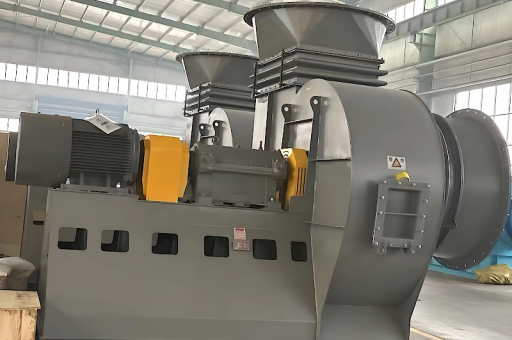
This is a specific industrial equipment request. Here is a comprehensive breakdown of a 75kW Dust Removal Centrifugal Induced Draft Fan, covering its typical specifications, applications, key design features, and selection considerations.
Core Function & Application
- Function: An Induced Draft (ID) fan creates negative pressure (suction) at the outlet of a dust collection system (like a baghouse, cyclone, or scrubber) to pull dusty air through the filtration system and exhaust clean air up a stack.
- Primary Applications:
- Cement Plants: Kiln exhaust, raw mill, coal mill dust collection.
- Steel Mills: Sintering, blast furnace gas cleaning, converter dust removal.
- Power Plants: Flue gas desulfurization (FGD) exhaust, coal handling dust systems.
- Wood Processing: MDF board production, sander dust, chip conveying.
- Chemical & Mining: Material conveying and process exhaust.
Typical Mechanical Specifications (75kW Example)
This is a large, heavy-duty fan. A 75kW (approx. 100 HP) motor indicates a significant airflow and pressure requirement.
| Parameter | Typical Value / Range | Notes |
|---|---|---|
| Power | 75 kW (100 HP) | Motor power rating. Actual consumption depends on system resistance. |
| Airflow (Q) | 40,000 – 80,000 m³/h (23,500 – 47,000 CFM) | Varies greatly with pressure. Lower flow for high pressure, higher flow for low pressure. |
| Static Pressure (P) | 3,000 – 6,000 Pa (12 – 24 in.w.g) | Typical for a baghouse or cartridge dust collector system. |
| Impeller Type | Backward Curved / Airfoil | Most common for high efficiency and non-clogging characteristics. Flat backward inclined for abrasive dust. |
| Impeller Material | Q345B (Steel) or Corten (Weathering Steel) | For standard dust. |
| 16Mn (High Manganese Steel) | For abrasive dust (e.g., sand, clinker). | |
| Stainless Steel (SS304/316) | For corrosive/hygroscopic dust (chemical, food). | |
| Casing Material | 5mm – 8mm steel plate | Typically with wear liners in the volute tongue area. |
| Bearings | Heavy-duty spherical roller bearings | For high radial loads. Often in a water-cooled or oil-lubricated housing. |
| Coupling | Flexible (e.g., coupling with spider element) | Isolates vibration and misalignment. |
| Motor | 4-pole (1500/1800 RPM) or 6-pole (1000/1200 RPM) squirrel cage induction motor. | 4-pole is most common. Frequency converter drive (VFD) is highly recommended for energy savings. |
| Speed | 1450 – 2950 RPM (4-pole) | Higher speed = higher pressure, but more wear and noise. |
Key Design Features for Dust Removal
- Wear Protection: The impeller blades and the casing volute (especially the "cut-off" tongue) must be made of thick material or have sacrificial wear plates. Dust-laden air is highly erosive.
- Non-Clogging: Backward curved blades are less likely to have dust buildup than forward curved blades. Shrouded (hollow) impellers should be avoided; single-plate or riveted designs are better.
- Shaft Seal: A good labyrinth or air-purge (air seal) is critical to prevent dust from leaking out of the fan shaft and entering the bearings.
- Low Vibration: High-speed rotation with an unbalanced load (dust buildup) is dangerous. A heavy-duty baseplate and flexible coupling are essential.
- Drive Options:
- Direct Drive: Most efficient, less maintenance (no belts). Requires a VFD for speed control.
- Belt Drive: Allows for speed adjustment by changing pulley sizes without a VFD. Best used when system resistance is not well defined.
Motor & Electrical Control (75kW)
- Voltage: Typically 380V 3-phase (50Hz) or 480V 3-phase (60Hz). 6kV or 10kV high voltage is also possible for very large duty cycles.
- Starting Method:
- Star-Delta (Y-Δ): Standard, low-cost.
- Soft Starter: Reduces current inrush.
- Variable Frequency Drive (VFD): Strongly Recommended. Allows for soft start, fine-tuned airflow control (saves huge energy), and monitoring of motor load.
- Protection:
- Thermal overload relay.
- Ground fault.
- Vibration sensors (for predictive maintenance on such a large fan).
- Bearing temperature sensors (PT100/RTD).
Selection Considerations for a 75kW ID Fan
Before purchasing, you must have a clear answer to these questions:
- What is the exact System Resistance (∆P)? Total pressure drop across dust collector + ductwork + chimney. An undersized fan cannot move air; an oversized fan wastes energy and causes erosion.
- What is the Dust Type & Concentration? Abrasive (sand, cement) vs. sticky (resin, paint) vs. explosive (grain, wood, coal).
- What is the Gas Temperature? Standard units are for up to 80°C. High-temperature options (with shaft cooling fins or water-cooled bearings) are needed for kiln or dryer exhaust (up to 350°C).
- Is a VFD included? Without a VFD, a 75kW fan starting directly across the line will draw a huge inrush current (up to 7x full load current).
- Sound Level: A 75kW fan at high speed can generate over 90 dB(A). Silencers may be required at the inlet or outlet.
Typical Manufacturers (Global & Examples)
- Greenheck (USA) – Industrial Process Fans.
- New York Blower (USA) – Heavy-duty line.
- Howden / FLSmidth (Global) – Very large cement/steel fans.
- Soler & Palau (Europe) – Industrial range.
- Yilida (China) – High volume, cost-effective industrial fans.
- Fangli / Kelin (China) – Specialized in large dust removal fans.
- Cincinnati Fan (USA) – Custom design.
Example Part Number / Engineering Spec (Hypothetical)
Unit: Centrifugal Induced Draft Fan Model: Y6-51-1 No. 16D Power: 75 kW / 380V / 3PH / 50Hz Airflow: 50,000 m³/h @ 4,500 Pa Impeller: Backward curved, 16Mn material Speed: 1450 RPM (Direct Drive) Motor: IE3 Premium Efficiency Included: Inlet box, expansion joint, VFD control panel.
Summary: Is a 75kW ID Fan Right for You?
- YES: If you have a large central dust collection system (e.g., serving 30+ machines in a woodshop, or a large baghouse for a cement grinding station).
- NO: If you have a small workshop or a single machine. 75kW is industrial-scale energy consumption (roughly $15-$25 per hour in electricity depending on local rates).
Next Step: Contact a fan manufacturer with your System Curve (CFM vs. Static Pressure) and Gas Composition to get a precise selection. A wrong selection on a 75kW fan is a very expensive mistake.





