This article's table of contents introduction:
- Introduction: What Is a 22kW Shredder Blower?
- Key Technical Specifications: Why 22kW Matters
- How It Works: The Mechanics of Shredding and Blowing
- Primary Applications: From Wood Waste to Municipal Green Waste
- Comparative Analysis: 22kW vs. Lower-Power Models
- Energy Efficiency and Operational Cost Calculations
- Safety Features and Best Practices
- Frequently Asked Questions (FAQ)
- Conclusion: Is a 22kW Shredder Blower Right for You?
** The Ultimate Guide to the 22kW Shredder Blower: Power, Performance, and Practical Applications
目录导读 (Table of Contents)
- Introduction: What Is a 22kW Shredder Blower?
- Key Technical Specifications: Why 22kW Matters
- How It Works: The Mechanics of Shredding and Blowing
- Primary Applications: From Wood Waste to Municipal Green Waste
- Comparative Analysis: 22kW vs. Lower-Power Models
- Energy Efficiency and Operational Cost Calculations
- Safety Features and Best Practices
- Frequently Asked Questions (FAQ)
- Conclusion: Is a 22kW Shredder Blower Right for You?
Introduction: What Is a 22kW Shredder Blower?
A 22kW shredder blower is a heavy-duty industrial or semi-industrial machine designed to simultaneously shred organic or fibrous material and then pneumatically convey (blow) the processed output through a discharge pipe or hose. The “22kW” designation refers to the motor power—approximately 29.5 horsepower—which places this equipment in the upper tier of shredding and blowing capability.
Unlike smaller residential units that rely on single-phase power (typically 2–3 kW), the 22kW model requires a three-phase electrical supply (often 380V–415V). This power level enables it to handle dense, wet, or bulky feedstock such as branches up to 150mm in diameter, pallet waste, green garden trimmings, and even certain agricultural residues like corn stalks or coconut husks.
The dual functionality of shredding and blowing sets this machine apart. After size reduction, the material is forced through a blower impeller, creating a high-velocity airstream that can transport shredded output over distances of 10–30 meters, depending on hose diameter and material density. This eliminates the need for separate conveyor belts or manual collection, streamlining workflows in forestry, landscaping, and waste-to-energy operations.
Key Technical Specifications: Why 22kW Matters
To fully appreciate a 22kW shredder blower, one must understand its technical anatomy. Below is a table summarizing the core parameters typically found in premium models:
| Parameter | Typical Value | Explanation |
|---|---|---|
| Motor Power | 22 kW (29.5 HP) | Three-phase, 380–415V, 50/60 Hz |
| Maximum Cutting Diameter | 120–150 mm | Capable of processing tree limbs and thick brush |
| Rotor Speed | 1,500–2,000 RPM | Optimal balance between torque and throughput |
| Blower Airflow | 3,500–5,000 m³/h | Ensures reliable pneumatic transport of chipped material |
| Discharge Distance | 15–30 m (with 150mm hose) | Reduces manual handling and truck loading time |
| Hopper Opening Size | 400×500 mm to 600×800 mm | Large enough to accept bulky green waste |
| Cutting Blades | 2 fixed + 2 swinging or reversible | Carbide-tipped for extended life |
| Weight | 400–650 kg | Requires stable mounting or trailer base |
Why 22kW specifically? Below 15 kW, shredders often struggle with green, sappy wood because their torque is insufficient. Above 30 kW, machines become prohibitively heavy and expensive for mobile use. The 22kW sweet spot allows continuous operation even under heavy load, handling wet material without jamming while remaining portable enough for a truck or trailer setup.
How It Works: The Mechanics of Shredding and Blowing
The operating principle of a 22kW shredder blower follows a three-stage process: feeding, shredding, and pneumatic conveying.
Stage 1: Feeding
Material enters through a wide hopper. Many 22kW models include an auto-feed roller that grabs branches and pulls them toward the cutting rotor. This prevents kickback—a common hazard in lower-power units. The feed speed is controlled either by a hydraulic system or a gear-driven mechanism, which automatically slows down if the motor current exceeds a safe threshold.
Stage 2: Shredding
Inside the cutting chamber, a heavy flywheel-mounted rotor carries two or more hardened steel blades. These blades intersect with a stationary counter-blade (anvil) to create a scissor-like cutting action. Because the rotor’s kinetic energy is high (due to the 22kW motor and the flywheel mass), even large-diameter wood is sliced cleanly rather than being torn. For applications requiring fine mulch, some models offer adjustable screens (e.g., 10mm–50mm apertures) that control the final chip size.
Stage 3: Blowing
The shredded material is ejected from the rotor directly into a centrifugal blower housing. An impeller—often with 4–6 curved vanes—accelerates the flow, creating pressure of 40–70 mbar. The mixture of air and wood chips is blown through a discharge pipe or a flexible hose. At 22kW, the blower can maintain a steady throughput of 3–8 tons per hour, depending on material moisture and chip size.
Primary Applications: From Wood Waste to Municipal Green Waste
A 22kW shredder blower is not a one-size-fits-all tool. Its performance characteristics make it particularly valuable in the following sectors:
- Tree Service Companies: After pruning or removal, crews use the machine to convert branches into chips on-site. The blower can fill a truck bed (capacity 8–12 m³) in under 20 minutes, eliminating the need to manually rake or load.
- Municipal Green Waste Recycling: Parks departments process leaves, grass, and small branches. The 22kW unit’s ability to handle high-moisture content (50%–60%) without plugging is superior to lower-power models.
- Biomass Fuel Preparation: For pellet mills or biomass boilers, the machine produces uniform chips that are suitable for further grinding. The blower can send material directly into a cyclone separator or storage bin.
- Agricultural Waste Management: Orchards and vineyards use these machines to shred pruned branches and then blow the mulch back onto the ground as a soil conditioner.
- Industrial Pallet Recycling: With reinforced blades, a 22kW shredder blower can process softwood pallets (with nails removed or hardwood limiters engaged) into chipboard feedstock.
Comparative Analysis: 22kW vs. Lower-Power Models
To justify investing in a 22kW shredder blower, it is helpful to compare it directly with smaller units (e.g., 7.5 kW and 15 kW):
| Feature | 5 kW Unit | 15 kW Unit | 22 kW Unit |
|---|---|---|---|
| Max Branch Ø | 60–80 mm | 80–100 mm | 120–150 mm |
| Throughput (dry chips) | 5–1.5 t/h | 5–3 t/h | 3–8 t/h |
| Blow Distance | 5–10 m | 10–20 m | 15–30 m |
| Power Source | 1-phase or 3-phase | 3-phase required | 3-phase required |
| Durability Under Wet Load | Low – frequent jamming | Moderate – occasional jams | High – jams rare |
| Cost Range (USD) | $3,000–$6,000 | $8,000–$15,000 | $15,000–$28,000 |
The 22kW model’s advantage is clear when daily throughput exceeds 3 tons. If you process less than 1 ton per day, a smaller machine may be sufficient. However, for commercial or municipal operations, the time savings and reduced downtime from fewer jams often recoup the higher purchase price within one season.
Energy Efficiency and Operational Cost Calculations
Electrical consumption is a major consideration. A 22kW shredder blower operating at full load for one hour consumes 22 kWh. At an average industrial electricity rate of $0.12/kWh, that equates to $2.64 per hour of runtime. However, most machines do not run at full load continuously. Under typical green waste shredding, the actual power draw is 14–18 kW due to variability in feed material. Thus, real-world energy cost is around $1.70–$2.15 per hour.
Compared to a diesel-powered shredder of equivalent throughput (which might consume 15–20 L/h at $1.20/L), the electric 22kW machine saves 80% in fuel costs. Over a 500-hour working season, that represents savings of $9,000 or more—often covering the machine’s price difference from diesel alternatives.
Safety Features and Best Practices
Safety is paramount with any high-power shredder. The 22kW shredder blower typically includes:
- Emergency Stop Button(s): Located on the control panel and often a secondary pull-cord along the feed chute.
- Feed Hopper Safety Bar: If the operator leans into the hopper, the machine auto-reverses the feed roller.
- Overload Protection: The motor controller (often a soft starter or VFD) limits current spikes.
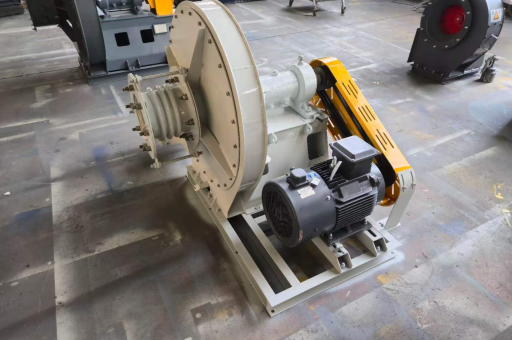
- Belt Guard and Flywheel Lock: Prevents accidental contact with rotating components.
Best practices:
- Always wear hearing protection (noise >95 dB at 1m).
- Never force material into the hopper; let the feed roller pull it.
- Inspect blades daily for dullness or cracks.
- Use a ground-fault circuit interrupter (GFCI) upstream of the machine.
- Empty the discharge area frequently to avoid backpressure.
Frequently Asked Questions (FAQ)
Q: Can a 22kW shredder blower run on single-phase power? A: No, 22kW motors are almost universally three-phase. Converting single-phase to three-phase via a VFD is possible but adds 15–25% cost and reduces efficiency. Always verify your site’s electrical supply before purchasing.
Q: What size hose does it need? A: Most 22kW blowers use a 150mm (6-inch) hose. Some models offer a 200mm option for longer distances. Using a narrower hose (e.g., 100mm) increases backpressure and reduces throughput by up to 40%.
Q: Can I shred fresh green branches without the machine sticking? A: Yes, thanks to the high torque and self-cleaning rotor geometry. Softer materials like wet leaves can be challenging but are generally manageable if fed gradually. Avoid overload by mixing dry and wet material.
Q: How often do blades need replacement? A: Under normal use (tree branches and green waste), blades last 40–80 hours before needing sharpening or reversal. Carbide-tipped blades can extend life to 120–200 hours. Always keep a spare set.
Q: Is it safe to operate in residential areas? A: The noise level (100–110 dB at full load) requires hearing protection. Most municipalities allow daytime operation for tree service trucks, but check local noise ordinances.
Conclusion: Is a 22kW Shredder Blower Right for You?
The 22kW shredder blower represents a high-efficiency tool for professionals who need to process significant volumes of organic waste. Its advantages—3–8 tons per hour throughput, 30-meter blow distance, and robust handling of wet or dense material—make it superior to smaller units for commercial-scale work. The primary limitations are the requirement for three-phase power and a higher upfront investment ($15k–$28k). If your daily throughput exceeds 3 tons and you prioritize speed and reduced manual labor, the 22kW class is likely the best investment you can make. For lighter-duty tasks, a 15kW machine may suffice, but be aware that frequent jamming and slower processing can offset the savings in capital cost.
Final recommendation: Rent one for a week before purchasing. Test it with the exact material mix you process daily. The hands-on experience will confirm whether the extra power translates into tangible productivity gains for your operation.