This article's table of contents introduction:
- Introduction: What is the 9-19-7.1D High-Pressure Centrifugal Fan?
- Technical Specifications and Design Features
- How Does It Compare to Other Centrifugal Fans?
- Primary Industrial Applications
- Installation, Maintenance, and Safety Best Practices
- Common Questions (FAQ) About the 9-19-7.1D
- Conclusion: Why This Fan Dominates High-Pressure Ventilation
*The Ultimate Guide to the 9-19-7.1D High-Pressure Centrifugal Fan: Performance, Applications, and Industry Insights*
Table of Contents
- Introduction: What is the 9-19-7.1D High-Pressure Centrifugal Fan?
- Technical Specifications and Design Features
- How Does It Compare to Other Centrifugal Fans?
- Primary Industrial Applications
- Installation, Maintenance, and Safety Best Practices
- Common Questions (FAQ) About the 9-19-7.1D
- Conclusion: Why This Fan Dominates High-Pressure Ventilation
Introduction: What is the 9-19-7.1D High-Pressure Centrifugal Fan?
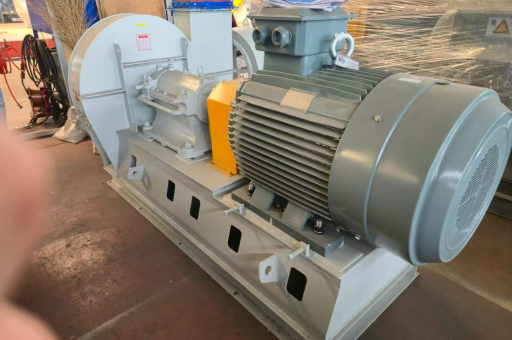
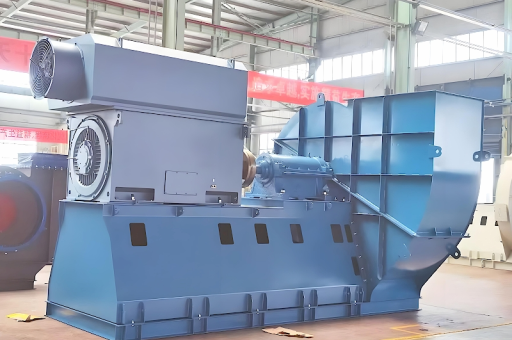
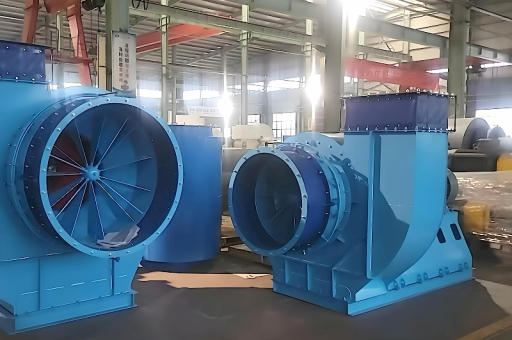
The 9-19-7.1D High-Pressure Centrifugal Fan is a specialized industrial air-moving device designed to generate significant static pressure while maintaining a relatively moderate airflow volume. Unlike standard centrifugal fans (often classified as medium or low pressure), the 9-19 series is engineered specifically for systems where resistance to airflow is exceptionally high—such as long duct runs, material conveying, or combustion air supply.
The "9-19" designation follows a well-known Chinese fan classification standard (JB/T 8689), where the first digit (9) indicates the fan’s specific speed ratio, and the "19" refers to the pressure coefficient. The "7.1D" denotes the impeller diameter (710 mm) and the direct-drive (D) configuration. These fans are renowned for their steep pressure curve, meaning they can maintain high pressure even when airflow fluctuates.
Technical Specifications and Design Features
Key Parameters (Typical)
- Impeller Diameter: 710 mm (7.1D)
- Max Flow Rate: 8,000 – 12,000 m³/h (depending on speed and inlet conditions)
- Max Static Pressure: 8,000 – 16,000 Pa (high-pressure range)
- Speed: 2,900 – 3,500 RPM (direct motor coupling)
- Motor Power: 30 – 55 kW (typical)
- Efficiency: Up to 82% at best efficiency point (BEP)
Design Highlights
- Backward-Curved Blades: The impeller uses backward-curved, airfoil-shaped blades that reduce turbulence and energy loss. This design yields a non-overloading power curve—meaning the motor will not burn out if the system pressure drops suddenly.
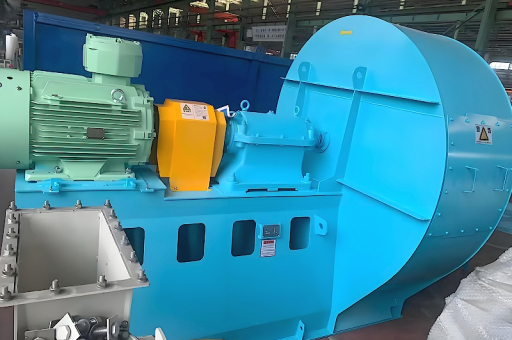
- Reinforced Casing: The spiral volute casing is made from heavy-gauge steel (often 6–8 mm) to withstand the stress of high internal pressure.
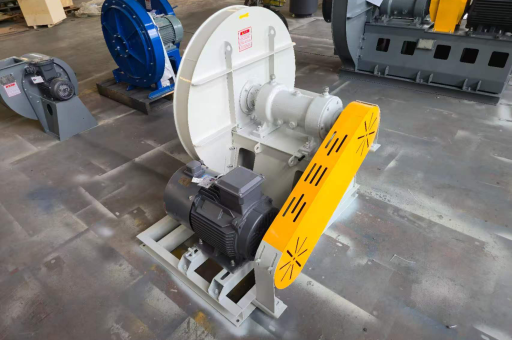
- Direct Drive (D): The impeller is mounted directly on the motor shaft, eliminating belt slippage and maintenance. This ensures consistent speed and pressure.
- Inlet Cone Optimization: A converging inlet cone reduces inlet turbulence, improving aerodynamic efficiency and lowering noise levels.
- High-Temperature Options: For applications like boiler forced draft, the material can be upgraded to Q345R or 304 stainless steel to handle air temperatures up to 300°C.
How Does It Compare to Other Centrifugal Fans?
| Feature | 9-19-7.1D (High-Pressure) | 4-72 Series (Medium-Pressure) | Y5-48 Series (Exhaust) |
|---|---|---|---|
| Typical Pressure | 8,000–16,000 Pa | 2,000–5,000 Pa | 3,000–6,000 Pa |
| Blade Shape | Backward-curved, airfoil | Forward-curved | Backward-inclined |
| Best Efficiency | 80–82% | 75–78% | 78–80% |
| Application | Pneumatic conveying, boiler | General HVAC, ventilation | Dust extraction, fume |
The 9-19-7.1D is not suitable for low-resistance systems because its power consumption rises rapidly when pressure drops. For clean air applications with high pressure drop, it outperforms all medium-pressure fans.
Primary Industrial Applications
The 9-19-7.1D is a workhorse in industries where friction losses are substantial:
- Pneumatic Conveying Systems: Transporting cement, grain, wood chips, or plastic pellets through long pipelines. The fan’s ability to maintain up to 16,000 Pa ensures material moves without settling.
- Boiler Forced Draft (FD): Supplying combustion air to industrial boilers or furnaces. The high pressure overcomes the resistance of burners, air preheaters, and ducts.
- Cement Plant Clinker Cooling: Forcing cooling air through a deep bed of hot clinker requires pressures exceeding 10,000 Pa. The 9-19-7.1D meets this demand reliably.
- Mine Ventilation (Secondary): In underground mines, auxiliary fans must push air through long flexible ducts with high friction. This fan is often used in branch airways.
- Wastewater Treatment (Diffused Aeration): High-pressure aeration systems require blowers that can overcome the head of deep basins. The 9-19 series is sometimes paired with air diffusers.
Note: When handling dusty gas, a pre-filter should be installed to prevent impeller wear.
Installation, Maintenance, and Safety Best Practices
Installation Guidelines
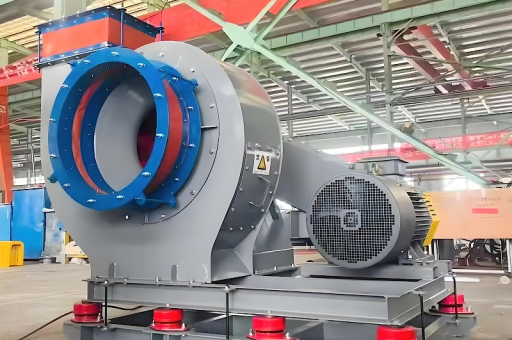
- Foundation: The fan must be mounted on a rigid concrete base or heavy-duty steel frame to dampen vibration. Use anti-vibration pads (rubber or spring mounts) between the base and the fan.
- Ductwork: Inlet and outlet ducts should be supported independently to avoid loading the fan casing. Use flexible connections to isolate vibration.
- Electrical: Ensure the motor matches the supply voltage (380V/660V typical). Install a variable frequency drive (VFD) if flow adjustment is needed, but note that the 9-19 series has a limited turndown range (50–100% speed) due to its steep curve.
Maintenance Checklist
- Weekly: Check bearing temperature (max 70°C) and listen for unusual noise.
- Monthly: Inspect impeller for dust buildup or erosion. Clean blades with a non-abrasive brush.
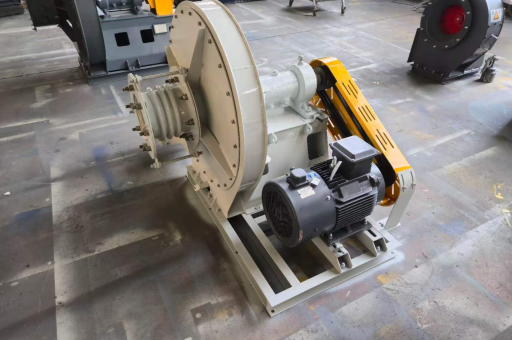
- Every 6 months: Replace grease in bearings (high-temperature lithium-based grease). Check belt tension (if belt-drive variant).
- Annually: Perform a performance test (flow vs. pressure) to detect signs of wear. Rebalance the impeller if vibration exceeds 4.5 mm/s.
Safety Warnings
- Never operate the fan without the inlet screen or guard—the high-velocity air can draw in debris.
- When handling high-temperature gases, install a temperature sensor that shuts down the motor at 350°C (to prevent material failure).
- Lockout/tagout (LOTO) must be performed before any maintenance work.
Common Questions (FAQ) About the 9-19-7.1D
Q1: Can the 9-19-7.1D be used for exhaust applications with corrosive gas? A: Not directly. The standard carbon steel casing will corrode quickly if exposed to acid mists (like in chemical plants). For corrosive environments, you must specify a corrosion-resistant version (e.g., FRP coating or 316L stainless steel). Better suited: the 9-19 series is primarily for clean or mildly dusty air; for aggressive fume extraction, consider the Y9-38 or special alloy fans.
Q2: What is the maximum temperature the impeller can withstand? A: The standard impeller (Q235 steel) is safe up to 80°C continuously. For higher temperatures (up to 300°C), use a Q345R steel impeller with thermal expansion gaps. For temperatures above 300°C, a water-cooled bearing housing is mandatory.
Q3: How do I calculate the required motor power for my system? A: Use the formula: P (kW) = (Q × ΔP) / (1000 × η), where Q is flow (m³/s), ΔP is static pressure (Pa), and η is fan efficiency (0.78 – 0.82). Add 10–15% safety margin. For example: Q=3 m³/s, ΔP=10,000 Pa, η=0.80 → P = (3×10,000)/(1000×0.80) = 37.5 kW → choose a 45 kW motor.
Q4: Can I use a VFD to control airflow? A: Yes, but the 9-19 series has a narrow stable operating range. VFD speed reduction below 70% of rated RPM may cause the fan to operate in an unstable region (surge). Always check the manufacturer’s fan curve for the minimum permissible speed. Belt-drive versions offer more flexibility for flow adjustment by changing sheaves.
Q5: What is the typical noise level, and how to reduce it? A: At full speed, noise can reach 95–105 dB(A) at 1 meter. Solutions:
- Install a silencer on the inlet and outlet.
- Use a soundproof enclosure (plywood lined with acoustic foam) but ensure cooling air flow for the motor.
- Mount the fan on vibration isolators to reduce structure-borne noise.
Conclusion: Why This Fan Dominates High-Pressure Ventilation
The 9-19-7.1D High-Pressure Centrifugal Fan is not a general-purpose fan—it is a precision tool for industries that demand high static pressure without compromising efficiency. Its backward-curved blade design, direct-drive reliability, and robust construction make it the preferred choice for pneumatic conveying, boiler draft, and demanding process ventilation.
While it offers superior pressure performance compared to medium-pressure fans, users must be aware of its maintenance needs, temperature limitations, and surge behavior when using VFDs. By following the installation and maintenance guidelines provided, operators can achieve decades of service life.
For engineers and plant managers looking to optimize systems with pressure drops exceeding 8,000 Pa, selecting a 9-19-7.1D fan from a reputable manufacturer is a proven path to energy savings and uninterrupted operation. Always consult the fan’s performance curve and system curve before purchase, and consider including a spare impeller for critical applications.
This article is intended for professional informational purposes and should be cross-referenced with local standards (e.g., GB/T 1236, ISO 5801) for exact design validation.