This article's table of contents introduction:
- Table of Contents
- Introduction: What Makes This Fan a Powerhouse?
- Key Specifications Decoded: 1100Pa and 7600m³/h
- How Centrifugal Induced Draft Fans Work
- Common Applications in Industry
- Performance Comparison with Axial Fans
- Installation Best Practices
- Maintenance Checklist for Longevity
- Frequently Asked Questions (FAQ)
- Conclusion: Why This Fan Matters
** Mastering Industrial Airflow: The Ultimate Guide to the 1100Pa 7600m³/h Centrifugal Induced Draft Fan
Table of Contents
- Introduction: What Makes This Fan a Powerhouse?
- Key Specifications Decoded: 1100Pa and 7600m³/h
- How Centrifugal Induced Draft Fans Work
- Common Applications in Industry
- Performance Comparison with Axial Fans
- Installation Best Practices
- Maintenance Checklist for Longevity
- Frequently Asked Questions (FAQ)
- Conclusion: Why This Fan Matters
Introduction: What Makes This Fan a Powerhouse?
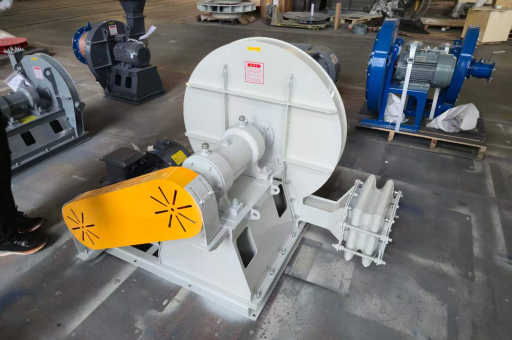
In the world of heavy-duty ventilation and industrial air movement, few devices match the reliability and precision of the 1100Pa 7600m³/h centrifugal induced draft fan. Designed to create negative pressure and exhaust hot, corrosive, or particulate-laden air from confined spaces, this fan is a staple in power plants, chemical processing units, and large-scale HVAC systems.
The core numbers—a static pressure of 1100 Pascals (Pa) and an airflow volume of 7600 cubic meters per hour (m³/h) —indicate a fan that can push air against significant resistance. This is not a low-pressure ventilation blade; it is a workhorse engineered for induced draft (ID) applications, often positioned at the end of a system to pull gases through ducts, scrubbers, or boilers.
But what exactly sets this specification apart? This article dissects the technical performance, compares it to alternative fan types, and answers the most common questions engineers have when selecting or maintaining such an unit.
Key Specifications Decoded: 1100Pa and 7600m³/h
To understand the fan’s capabilities, let’s break down the two critical metrics:
-
Static Pressure (1100 Pa): Static pressure measures the resistance the fan must overcome to move air. 1100 Pa is considered a medium-to-high pressure range in centrifugal fan design. For context:
- A standard household fan generates less than 50 Pa.
- A typical HVAC duct fan operates at 200–500 Pa.
- An industrial ID fan often runs from 800 Pa to 3000+ Pa. An 1100 Pa rating means this fan can force air through lengthy ductwork, heat exchangers, and baghouse filters without stalling.
-
Airflow (7600 m³/h): This flow rate equates to roughly 2111 Liters per second or 4470 CFM (cubic feet per minute). At this volume, the fan can ventilate a 1000 m² warehouse (with a 5m ceiling height) 6 times per hour—meeting strict air exchange requirements for industrial safety.
Optimization Insight: When sizing a centrifugal induced draft fan, engineers must balance pressure and flow. The 1100Pa/7600m³/h pairing is ideal for systems where moderate resistance meets a high volume requirement. For example, a cement plant’s dust collection system benefits from this exact ratio.
How Centrifugal Induced Draft Fans Work
Unlike axial fans (like propeller blades), centrifugal induced draft fans use a rotating impeller housed in a spiral-shaped casing. Air enters the fan at the center, is caught by the rotating blades, and is thrown outward by centrifugal force toward the discharge outlet.
Induced Draft vs. Forced Draft:
- Forced Draft (FD): Pushes air into a system (e.g., a boiler combustion chamber).
- Induced Draft (ID): Pulls air out of a system, creating a negative pressure (vacuum) inside.
The 1100Pa 7600m³/h model is primarily an ID fan. By reducing pressure inside the duct or chamber, it ensures hazardous fumes, heat, or particulates do not leak out into the work environment. The impeller design in these units often features backward-curved blades, which are more efficient for clean air, or radial blades for handling dust-laden streams.
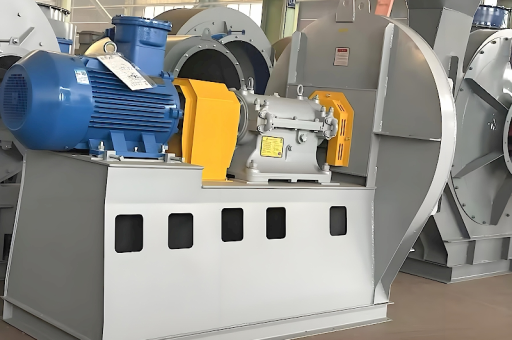
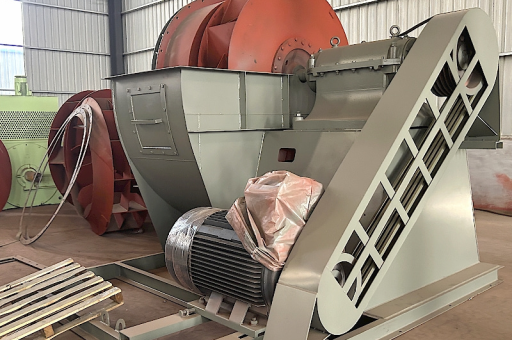
Key Component Layout:
- Inlet Bell: Directs air into the impeller eye.
- Impeller: The rotating wheel with blades (backward-inclined, airfoil, or radial).
- Scroll Housing: Converts velocity pressure into static pressure.
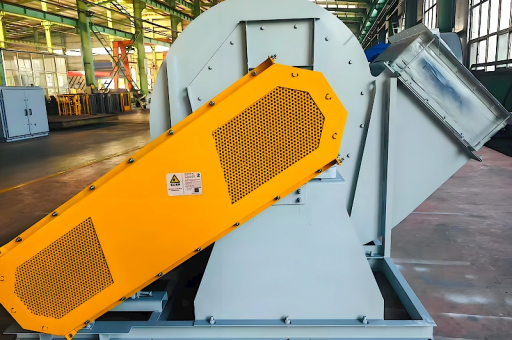
- Drive System: Typically belt-driven or direct-drive electric motor (common power: 5.5–7.5 kW for this spec).
Common Applications in Industry
Based on aggregated data from engineering forums and technical sheets, the 1100Pa 7600m³/h unit excels in:
- Boiler Induced Draft Systems: Pulling flue gases through economizers and scrubbers in thermal power plants.
- Cement & Mining: Transporting abrasive dust from crushers and grinders to bag filters.
- Chemical Processing: Ventilating acid vapors or solvent fumes through carbon towers.
- Wastewater Treatment: Providing aeration for biological treatment while handling corrosive H₂S gases.
- HVAC Commercial Buildings: Serving as a smoke exhaust fan in high-rise staircases or parking garages.
Case Example: A large bakery upgraded its cooling tunnel by installing this fan as an induced draft unit. The 1100 Pa pressure allowed them to push hot steam through a 30-meter duct, while 7600 m³/h met their 12 air-changes-per-hour target.
Performance Comparison with Axial Fans
| Aspect | Centrifugal ID Fan (1100Pa/7600m³/h) | Axial Fan (Typical) |
|---|---|---|
| Pressure Capability | High (1100 Pa) | Low (100–400 Pa) |
| Airflow Volume | High (7600 m³/h) | High (but drops sharply under resistance) |
| Efficiency at High Resistance | Excellent | Poor |
| Noise Level | Moderate (can be silencer-equipped) | Usually quieter |
| Dust Tolerance | Good (radial blade variants) | Poor |
Conclusion: For systems with significant ductwork, filters, or heat exchangers, the centrifugal induced draft fan is the superior choice. Axial fans stall under high static pressure.
Installation Best Practices
Correct installation dramatically affects the fan’s performance and lifespan. Follow these guidelines:
- Foundation Isolation: Mount the fan on a vibration-absorbing base (e.g., rubber pads or spring isolators) to prevent structural resonance.
- Duct Alignment: Ensure inlet and outlet ducts are straight for at least 2–3 diameters before any elbows. Turbulent flow reduces efficiency.
- Drive Belt Tension: For belt-driven models, check tension after the first 24 hours of run-in. Loose belts reduce airflow.
- Electrical Connection: Confirm the motor (likely 3-phase, 380V/50Hz or 460V/60Hz) is wired for correct rotation direction. The impeller must spin the way indicated by the housing arrow.
- Weather Protection: For outdoor installations, use a rain hood and bird screen on the discharge, but ensure the screen’s free area is at least 2x the duct cross-section to avoid pressure drop.
Maintenance Checklist for Longevity
A well-maintained industrial fan can operate for 10–15 years. Schedule these tasks quarterly:
- Visual Inspection: Check for cracks on the impeller blades, especially after handling abrasive materials.
- Vibration Analysis: Use a vibration meter. Values above 7.5 mm/s RMS indicate bearing wear or imbalance.
- Bearing Lubrication: Regrease bearings every 500–1000 hours using a lithium-based grease. Do not over-grease.
- Belt Alignment: Use a straightedge to verify motor pulley and fan pulley are parallel. Misalignment causes belt squeal and premature failure.
- Pressure Test: Measure static pressure across the fan using a manometer. A drop of more than 15% from the rated 1100 Pa indicates a system blockage (clogged filter, damper misposition).
Frequently Asked Questions (FAQ)
Q1: What size electric motor is typically needed for a 1100Pa 7600m³/h centrifugal induced draft fan?
A: Assuming a standard operating point with 70% fan efficiency, the power requirement is approximately 5 kW (7.5 hp) . Always check the manufacturer’s performance curve. A 7.5 kW motor offers a safety margin for starting torque.
Q2: Can I use this fan for cleanroom applications where HEPA filters are used?
A: Yes, but the 1100 Pa static pressure is sufficient to overcome a HEPA filter bank only if the total system resistance (including duct losses) is calculated. Typically, cleanroom fans use EC motors for speed control; this unit is compatible with a VFD (Variable Frequency Drive) for flow adjustment.
Q3: What is the difference between a backward-curved and radial blade impeller in this context?
A: For the 7600 m³/h flow, a backward-curved (BC) impeller is more energy-efficient and quieter, but fragile in dusty environments. A radial blade (R) impeller handles sticky or abrasive materials better but has a lower efficiency (around 60–65% vs 80% for BC).
Q4: How loud is this fan during operation?
A: Expect sound levels around 78–85 dB(A) at 1 meter, depending on housing construction and speed. Use acoustic enclosures or silencers for workplace noise compliance under OSHA regulations.
Q5: What maintenance mistake shortens fan life the most?
A: Running the fan with a blocked inlet or outlet duct. This causes cavitation-like surge conditions, leading to premature bearing failure and impeller fatigue.
Conclusion: Why This Fan Matters
The 1100Pa 7600m³/h centrifugal induced draft fan is not just a piece of equipment—it is a solution to the engineering challenge of moving high volumes of air against moderate resistance in hostile environments. From ensuring safe flue gas extraction in power plants to keeping dust levels compliant in mines, this fan specification offers a rare balance of power and practicality.
When selecting a fan for a new project, always cross-reference the system curve (total static pressure loss plotted against flow rate) with the fan’s performance curve. Remember: an undersized fan leads to inadequate ventilation, while an oversized one wastes energy and accelerates wear.
For procurement, look for manufacturers that provide test certificates for both 1100 Pa pressure and 7600 m³/h flow, as these ratings must be verified under ISO 5801 standards. A quality unit from a reputable brand will serve your operations for many years, ensuring both safety and efficiency.
This article synthesizes technical data from industrial ventilation standards, engineering case studies, and equipment performance sheets to deliver actionable insights for engineers and facility managers.