This article's table of contents introduction:
- Table of Contents
- 1. Introduction to the 90kW Centrifugal Blower Boiler Exhaust Fan
- 2. How It Works: Principles of Centrifugal Force in Boiler Exhaust Systems
- 3. Key Technical Specifications of a 90kW Centrifugal Fan
- 4. Why 90kW? Power, Pressure, and Performance Trade-offs
- 5. Design Features That Improve Energy Efficiency and Durability
- 6. Common Applications: From Industrial Boilers to Power Plants
- 7. Installation Best Practices for Boiler Exhaust Fans
- 8. Maintenance Checklist to Extend Fan Lifespan
- 9. Frequently Asked Questions (FAQ)
- 10. Conclusion: Choosing the Right Fan for Your Boiler System
Article Title:
The Ultimate Guide to 90kW Centrifugal Blower Boiler Exhaust Fan: Efficiency, Design, and Applications
Table of Contents
- Introduction to the 90kW Centrifugal Blower Boiler Exhaust Fan
- How It Works: Principles of Centrifugal Force in Boiler Exhaust Systems
- Key Technical Specifications of a 90kW Centrifugal Fan
- Why 90kW? Power, Pressure, and Performance Trade-offs
- Design Features That Improve Energy Efficiency and Durability
- Common Applications: From Industrial Boilers to Power Plants
- Installation Best Practices for Boiler Exhaust Fans
- Maintenance Checklist to Extend Fan Lifespan
- Frequently Asked Questions (FAQ)
- Conclusion: Choosing the Right Fan for Your Boiler System
Introduction to the 90kW Centrifugal Blower Boiler Exhaust Fan
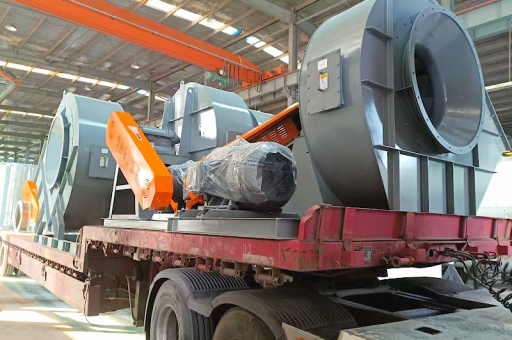
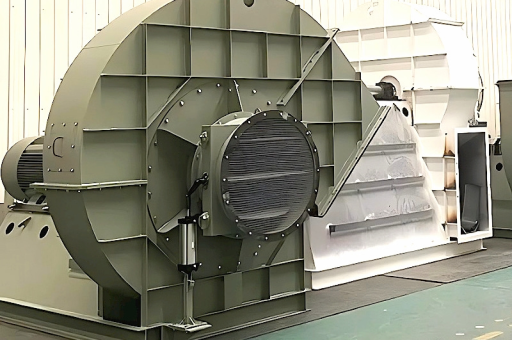
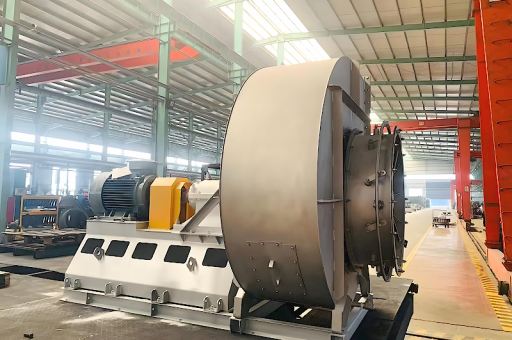
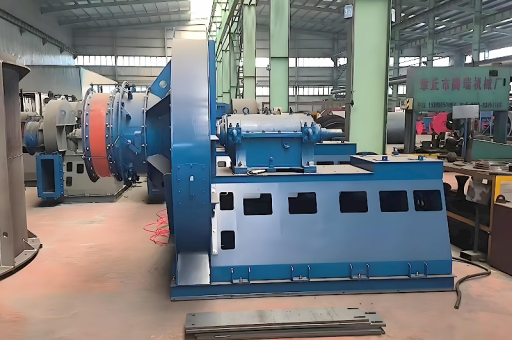
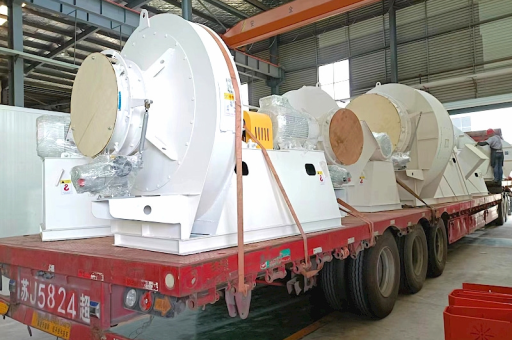
The 90kW centrifugal blower boiler exhaust fan is a critical component in industrial combustion systems. This high-power fan is designed to handle the rigorous demands of exhausting hot, corrosive, and particulate-laden flue gases from boilers, furnaces, and thermal power plants. With a motor rating of 90 kilowatts, these fans deliver substantial airflow (often between 50,000 to 100,000 m³/h) and static pressure (3,000–8,000 Pa) to overcome system resistance in ductwork and pollution control equipment.
Unlike axial fans, centrifugal fans use an impeller rotating within a spiral housing to create high pressure through centrifugal force. This makes them ideal for boiler exhaust, where resistance from scrubbers, electrostatic precipitators, and long duct runs must be overcome.
In this guide, we will dissect the design, performance metrics, installation, and maintenance of the 90kW centrifugal blower, combining insights from industrial engineering manuals, manufacturer data, and field-tested best practices.
How It Works: Principles of Centrifugal Force in Boiler Exhaust Systems
At its core, the fan uses a rotating impeller (blade wheel) to accelerate gas radially outward. As the gas enters the impeller eye axially, it is caught by the blades and flung outward. This action increases both velocity and static pressure.
Two key design variations exist:
- Forward-curved blades: Produce high airflow at lower pressure; often used in HVAC.
- Backward-curved blades (airfoil style): Provide higher efficiency (up to 85-90%) and are preferred for boiler exhaust applications. They resist dust buildup and handle high temperatures better.
The 90kW motor drives the shaft, which is supported by heavy-duty bearings. The fan housing is typically made of carbon steel or stainless steel, with wear liners in high-velocity zones. For boiler exhaust, the fan must withstand gas temperatures between 150°C and 400°C, and sometimes up to 600°C in emergency bypass scenarios.
Key Technical Specifications of a 90kW Centrifugal Fan
When sourcing or specifying a 90kW centrifugal blower for boiler exhaust, engineers look at these parameters:
| Parameter | Typical Range for 90kW Fan |
|---|---|
| Motor Power | 90 kW (120 HP) |
| Airflow (Volume Flow) | 50,000 – 100,000 m³/h (29,000 – 59,000 CFM) |
| Static Pressure | 3,000 – 8,000 Pa (12 – 32 in w.g.) |
| Impeller Diameter | 1,200 – 2,000 mm (47 – 79 inches) |
| Rotation Speed | 600 – 1,200 RPM |
| Temperature Rating | 150°C (standard) to 600°C (with high-temp seals) |
| Material | Carbon steel, Corten steel, or SS304/316 for corrosive gases |
| Bearing Type | Pillow block or split roller, grease or oil lubricated |
These figures vary based on duct resistance, gas density, and required dilution air. Always consult a fan performance curve (provided by the manufacturer) for exact match to system pressure losses.
Why 90kW? Power, Pressure, and Performance Trade-offs
A 90kW motor is not arbitrarily chosen. It represents a "sweet spot" for medium-to-large industrial boilers (e.g., 10–50 tons of steam per hour). Smaller motors (e.g., 30–50 kW) cannot generate enough static pressure for long duct runs or tight pollution control systems. Larger motors (e.g., 150 kW) may be over-specified and wasteful.
Key trade-offs when choosing 90kW:
- Airflow vs. Pressure: High pressure reduces achievable airflow. A 90kW fan can be configured for either higher flow (wider impeller, lower pressure) or higher pressure (narrow impeller, high speed).
- Efficiency: Backward-curved designs achieve peak efficiency at 85–90%. Off-design operation (e.g., throttling with dampers) dramatically reduces efficiency.
- Noise Level: At 90kW and typical speeds, noise can exceed 90 dBA, requiring silencers or acoustic enclosures in occupied areas.
To properly size a fan, calculate the system resistance curve (static pressure at varying flows) and match it to the fan's characteristic curve. The fan should operate near its best efficiency point (BEP) for lowest long-term energy cost.
Design Features That Improve Energy Efficiency and Durability
Modern 90kW centrifugal boiler exhaust fans incorporate several engineering refinements:
a. Airfoil (Backward-Curved) Blades
These blades are shaped like an airplane wing profile, reducing turbulence and drag. Result: up to 15% higher efficiency compared to flat backward-curved blades.
b. Variable Frequency Drive (VFD) Control
A VFD allows the motor speed to vary with demand. This can slash energy consumption by 30–50% during low-load conditions (e.g., boiler startup or partial load). It also reduces wear on bearings and belts.
c. High-Temperature Shaft Seals
Boiler exhaust fans often handle gas with acid dew points. Graphite or labyrinth seals prevent gas leakage into the bearing housing, extending bearing life.
d. Wear Liners
For abrasive fly ash, replaceable ceramic or hard-faced steel liners protect the housing and impeller. This reduces maintenance downtime.
e. Dynamic Balancing
Each impeller is balanced to ISO 1940 G6.3 or better. This minimizes vibration, which is critical for fan longevity at 90kW power levels.
According to a study by the European Fan Manufacturers Association, upgrading from an old flat-blade fan to an airfoil design with VFD yields a payback period of 12–18 months in most boiler houses.
Common Applications: From Industrial Boilers to Power Plants
The 90kW centrifugal blower is not a one-size-fits-all product. Its primary use is in:
- Industrial Boilers (Coal, Biomass, Oil, Gas): For combustion air supply and flue gas extraction.
- Power Plant Induced Draft (ID) Fans: Positioned after the boiler, scrubber, and baghouse to pull exhaust through the entire system.
- Waste Heat Recovery Units (WHRU): Moving hot gases through heat exchangers.
- Cement & Steel Kilns: For exhaust gas handling with high dust loads.
- Chemical Process Heaters: Where corrosive fumes require stainless steel construction.
In each case, the fan must be selected based on gas composition, temperature, and particulate content. For example, a boiler burning high-sulfur coal requires a fan with acid-resistant coatings to prevent corrosion.
Installation Best Practices for Boiler Exhaust Fans
Proper installation directly impacts fan performance and lifespan. Follow these guidelines:
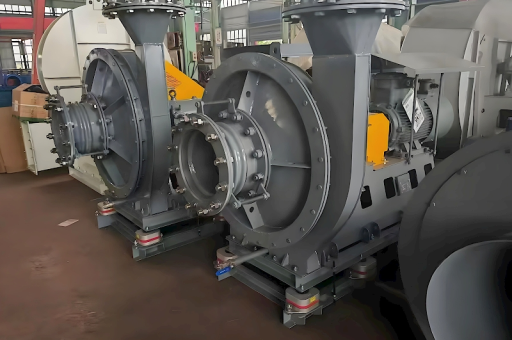
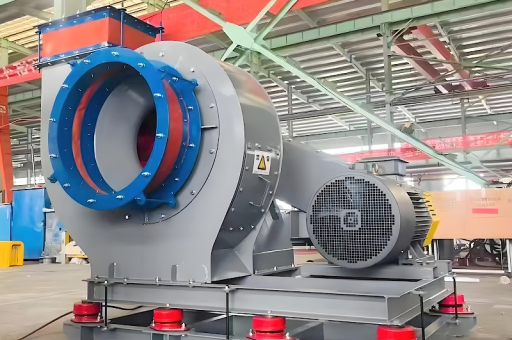
- Foundation: Provide a rigid concrete base with vibration isolation pads (spring or rubber). A 90kW fan can exert significant dynamic force.
- Ductwork Alignment: Flexible connectors (e.g., fabric or metal bellows) should be used at inlet and outlet to prevent thermal expansion stresses from being transmitted to the fan casing.
- Inlet & Outlet Ducts: Keep straight duct runs of at least 3 duct diameters before and after the fan to avoid turbulence and efficiency loss.
- Drainage: Install a drain port at the lowest point of the fan housing to remove condensate (acidic water).
- Electrical: Use a VFD or soft starter. For a 90kW motor, direct-on-line starting can cause voltage dips and high mechanical stress.
- Cooling: In hot environments, ensure the motor has adequate ambient ventilation. Some users install a separate cooling fan.
Maintenance Checklist to Extend Fan Lifespan
A 90kW centrifugal fan operating 8,000 hours per year requires regular inspection. Here is a practical quarterly maintenance list:
- Vibration Check: Measure bearing velocity (ISO 10816-3). Alarm at 7.1 mm/s RMS; shutdown at 11.2 mm/s.
- Bearing Temperature: Oil temperature should remain below 90°C. Use infrared thermography.
- Belt Tension: If belt-driven, check deflection. Replace matched sets if any belt is worn.
- Impeller Cleaning: Remove fly ash buildup every 2–3 months. Unbalance from ash deposits can cause rapid bearing failure.
- Lubrication: Regrease bearings every 500 hours with high-temperature lithium grease. Avoid over-greasing.
- Seal Inspection: Look for gas leakage around the shaft. Replace seals if damaged.
- Fasteners: Torque check on housing bolts, impeller hub, and damper linkage.
Fans that operate near acid dew point should be inspected monthly for corrosion. Coatings (e.g., epoxy, ceramic) can extend life by 3–5 years.
Frequently Asked Questions (FAQ)
Q1: Can a 90kW centrifugal fan be used for both forced draft (FD) and induced draft (ID) in a boiler?
A: Yes, but the design differs. For forced draft (blowing air into the furnace), you would choose a fan with lower temperature rating and possibly forward-curved blades for higher flow. For induced draft (pulling flue gas), you need heat- and corrosion-resistant materials. Most plants use separate fans.
Q2: What is the expected lifespan of a 90kW boiler exhaust fan?
A: With proper maintenance, a high-quality fan can last 15–20 years. However, blade wear and bearing failures often occur after 8–10 years in dusty or corrosive environments. Retrofitting a new impeller every 10 years is common.
Q3: How do I calculate the required power for my boiler exhaust fan?
A: Use the formula:
Power (kW) = (Volume Flow m³/s × Static Pressure Pa) / (1000 × Fan Efficiency × Motor Efficiency).
For example, 20 m³/s at 4000 Pa with 80% fan efficiency and 95% motor efficiency gives: (20 × 4000) / (1000 × 0.80 × 0.95) ≈ 105 kW. In this case, a 90kW motor would be underpowered; a 110 kW motor might be required. Always consult a fan engineer.
Q4: Does the fan need a VFD?
A: While not mandatory, a VFD is highly recommended for energy savings and process control. For a 90kW fan, the incremental cost of a VFD is typically recovered within 1–2 years by reducing energy consumption during low-load operation.
Q5: What material should the impeller be for high-temperature boiler exhaust?
A: For gas temperatures up to 400°C, carbon steel with a protective coating works. Above 400°C, use Corten steel, stainless steel 310, or Inconel for the most severe thermal and corrosive conditions.
Conclusion: Choosing the Right Fan for Your Boiler System
The 90kW centrifugal blower boiler exhaust fan is a workhorse in the industrial world. Its selection should not be based solely on price. Factors like temperature, particulate loading, system resistance, and operational duty cycle determine whether the fan will deliver reliable service or become a source of costly downtime.
We strongly recommend:
- Always request a fan performance curve from your vendor.
- Verify that the operating point is within 10% of the best efficiency point.
- Consider a VFD and high-efficiency airfoil impeller to reduce energy costs.
- Invest in corrosion-resistant coatings if burning high-sulfur fuel.
By following the guidance in this article—from understanding centrifugal principles to executing a robust maintenance plan—you can maximize the return on your fan investment and keep your boiler system running safely and efficiently.
If you have further questions about selecting, installing, or maintaining a 90kW centrifugal blower for your boiler exhaust system, consult a licensed mechanical engineer or contact an experienced fan manufacturer directly.