
This article's table of contents introduction:
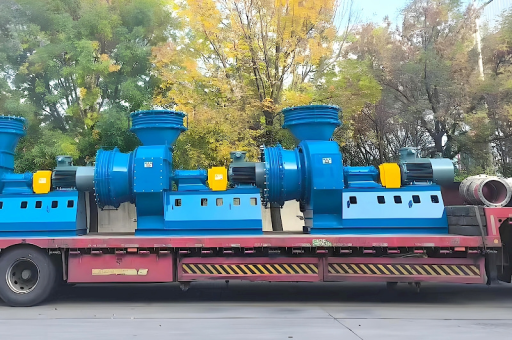
- Key Application: The "ID Fan" in a Boiler System
- The Centrifugal Fan Types for ID Duty
- Voltage Breakdown & Motor Specifications
- Critical Design Features for Boiler ID Fans
- Efficiency & Performance
- Standards & Compliance
- Summary Table for Selection
- Typical Suppliers for 6kV & 10kV ID Fans
This is a highly specific query regarding Industrial Boiler Induced Draft (ID) Fans. The voltages you listed (660V, 6KV, 10KV) indicate you are looking at Medium Voltage (MV) applications, typically found in large power plants, cement plants, or heavy process industries.
Here is a comprehensive technical breakdown of Industrial Boiler ID Fans, focusing on these specific voltage ratings and centrifugal configurations.
Key Application: The "ID Fan" in a Boiler System
- Function: The ID (Induced Draft) fan is located after the boiler, economizer, and dust collector (ESP/Baghouse). It pulls flue gases (negative pressure) through the boiler system to maintain proper combustion and discharge them up the chimney.
- Critical Requirement: High temperature (up to 400°C / 752°F), high dust loading, and resistance to erosion/corrosion.
- Configuration: Almost exclusively Centrifugal (Radial) . Axial fans are rarely used for ID duty due to pressure requirements.
The Centrifugal Fan Types for ID Duty
For a 660V / 6kV / 10kV ID Fan, the impeller type is critical for efficiency and wear resistance:
- Radial / Radial Tip (R-T):
- Best for: High dust loads.
- Pros: Most robust design, self-cleaning.
- Cons: Lower efficiency (~70-75%).
- Use Case: Biomass boilers, heavy coal, or high-ash fuels.
- Backward Curved / Airfoil (BC/BA):
- Best for: Cleaner fuels (gas, oil, fine coal), high efficiency required.
- Pros: Highest efficiency (up to 85-88%).
- Cons: Blades clog easily with sticky dust.
- Use Case: Gas-fired power plants or where an efficient ESP is upstream.
- Backward Inclined (BI):
- Pros: Good efficiency, less prone to dust buildup than airfoil.
- Use Case: Common compromise for medium dust loads.
Voltage Breakdown & Motor Specifications
The voltage determines the motor size, cost, and system integration.
| Voltage | Typical Motor Power (kW) | Insulation Class | Motor Type | Application Scale |
|---|---|---|---|---|
| 660V (Low Voltage) | Up to 500 kW (approx. 670 HP) | Class F or H | Induction Motor (Squirrel Cage) | Small industrial boilers, package boilers. |
| 6kV (Medium Voltage) | 500 kW to 5 MW | Class F or H | Induction Motor (often Slip Ring for starting) | Mid-size power plants, cement kilns. |
| 10kV (Medium Voltage) | 2 MW to 10+ MW | Class F or H | Synchronous or Induction (VFD-friendly) | Large utility boilers, CFB boilers. |
Key Considerations for 6kV & 10kV:
- Starting Method: Direct-on-line (DOL) is rare. Usually via VFD (Variable Frequency Drive) , Liquid Resistance Starter (LRS), or Soft Starter.
- Bearing Protection: Motor bearings must be insulated (on one end) to prevent shaft current damage caused by VFD switching or magnetic imbalances.
- Surge Protection: Required on the motor terminals to protect against voltage spikes.
Critical Design Features for Boiler ID Fans
A. High Temperature / Casing Design:
- Material: Casing is often Carbon Steel with a wear liner.
- Shaft Seal: High-temperature labyrinth seals or pressurized air seals to prevent hot flue gases from leaking out along the shaft.
- Cooling Fan: A separate "cooling fan" on the motor shaft is mandatory for 6kV & 10kV motors to prevent overheating at low speeds (if VFD controlled).
B. Dust & Erosion Handling:
- Radial Blades: Thicker, often with chromium carbide overlay (hard facing) on leading edges.
- Wear Plates: Replaceable wear plates in the casing volute (cutwater/scroll tongue) where erosion is worst.
- Velocity: Air velocity inside the fan is kept below 35-40 m/s to minimize erosion.
C. Vibration & Balance:
- ISO 1940 G2.5 balancing standard for the impeller.
- Bearing Housings: Spherical roller bearings with temperature sensors (PT100).
- Vibration Sensors: Tolerant (velocity measurements), part of a Condition Monitoring System.
Efficiency & Performance
- Specific Speed (Ns): For ID fans, Ns is typically low (100-250) , indicating high pressure, relatively low flow.
- Pressure: Typically 80-120 mbar (800-1200 mmWG) for the boiler ID fan.
- CFM/Airflow: Defined by boiler load (e.g., a 50 MW boiler needs roughly 150,000 CFM at 100% load).
Standards & Compliance
- ISO 13349 / AMCA 99-240: Fan classification and performance testing.
- IEC 60034: Electrical motor standards.
- API 617 / API 673: For critical refinery/power plant fans (sometimes applied).
- ISO 14694: Balance quality for fans.
Summary Table for Selection
| Feature | 660V ID Fan | 6kV ID Fan | 10kV ID Fan |
|---|---|---|---|
| Power | 100-500 kW | 500-3,000 kW | 3,000-10,000 kW |
| Motor Speed | 1,500 / 1,800 RPM | 1,000 / 1,500 RPM | 600 / 1,000 RPM |
| Starting Gear | DOL / Soft Start | VFD / LRS | VFD (mandatory) |
| Bearing Cooler | Fan-cooled fins | Water-cooled or Fan | Water-cooled (Tx) |
| Protection Grade | IP54 | IP55 / IP56 | IP65 |
Typical Suppliers for 6kV & 10kV ID Fans
- European: FläktGroup, Howden, Zitron, TLT-Turbo
- Asian: Howden (China), Zibo, Shenyang Blower Works (China), Yongpeng
- US: New York Blower, Chicago Blower, Gardner Denver (for smaller units)
Next Steps for Your Procurement: If you are sourcing this fan, you will need to provide:
- Gas Data: Temperature, density, dust concentration, chemical composition (SOx, moisture).
- Duty Point: Flow (m³/s) and Total Pressure (Pa or mmWG).
- Control Method: Damper, Inlet Vane, or VFD? (VFD is modern standard for 6kV/10kV).
- Ambient Conditions: Altitude (affects motor cooling).
Warning: Never oversize an ID fan for a boiler. Oversizing leads to unstable operation, surge, and premature motor failure. Always specify a design margin of 10-15% on flow and pressure, not 50%.





