
This article's table of contents introduction:
- Introduction: The Intersection of Smelting and Energy Efficiency
- Understanding the Smelting Furnace and Its Thermal Demands
- The Backward Boiler Fan: Design, Function, and Advantages
- Stainless Steel Blowers: Corrosion Resistance and Longevity
- Energy Saving Mechanisms: Fan Curve Optimization and Variable Speed Drives
- Synergy Between Smelting Furnace, Boiler Fan, and Blower Systems
- Common Questions (Q&A)
- Conclusion: Future Trends in Energy‑Efficient Smelting
*Optimizing Industrial Efficiency: The Role of Smelting Furnace Backward Boiler Fans and Stainless Steel Blowers in Energy Saving*
Table of Contents
- Introduction: The Intersection of Smelting and Energy Efficiency
- Understanding the Smelting Furnace and Its Thermal Demands
- The Backward Boiler Fan: Design, Function, and Advantages
- Stainless Steel Blowers: Corrosion Resistance and Longevity
- Energy Saving Mechanisms: Fan Curve Optimization and Variable Speed Drives
- Synergy Between Smelting Furnace, Boiler Fan, and Blower Systems
- Common Questions (Q&A)
- Conclusion: Future Trends in Energy-Efficient Smelting
Introduction: The Intersection of Smelting and Energy Efficiency
In today’s high‑cost energy environment, every kilowatt‑hour saved in heavy industries like metal smelting directly improves the bottom line and reduces carbon footprint. At the heart of this challenge lies the smelting furnace—a giant thermal reactor that demands precise control of combustion air, exhaust gases, and cooling flows.
Two critical components that determine whether a smelting operation is energy‑efficient or wasteful are the backward boiler fan (often used for induced draft or forced draft in waste‑heat boilers) and the stainless steel blower (which handles corrosive, high‑temperature gas streams). When these fans and blowers are properly selected and paired, they can reduce energy consumption by 15–30 % compared to conventional centrifugal fans.
This article explores the engineering details, selection criteria, and energy‑saving strategies for these fan systems, offering actionable insights for plant managers, mechanical engineers, and sustainability officers.
Understanding the Smelting Furnace and Its Thermal Demands
A smelting furnace, whether electric arc, blast, or reverberatory, operates at temperatures between 1,200 °C and 1,600 °C. The furnace requires:
- Combustion air delivered by a forced‑draft fan.
- Exhaust gas extraction via an induced‑draft fan or boiler fan.
- Cooling of furnace walls and off‑gas ducts.
The exhaust gases often contain particulate matter, sulfur compounds, and moisture. If the fan system is undersized or poorly configured, backpressure builds up, reducing furnace throughput. Conversely, an oversized fan wastes energy by operating far from its best efficiency point (BEP).
Here, the backward boiler fan enters the picture. In modern smelting plants, waste‑heat boilers recover thermal energy from furnace exhaust to generate steam. The boiler’s induced‑draft fan must handle hot, dusty gas and maintain a slightly negative pressure inside the boiler to prevent leakage.
The Backward Boiler Fan: Design, Function, and Advantages
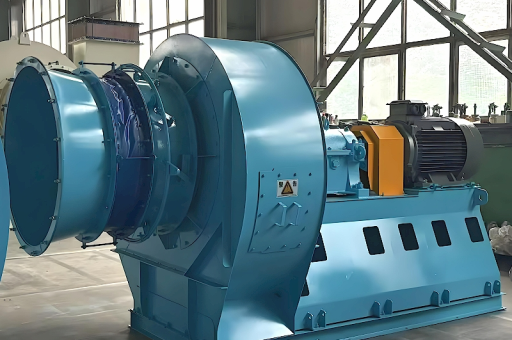
A backward fan (also called backward‑curved or backward‑inclined blade fan) has blades that curve away from the direction of rotation. This design offers several advantages in boiler and smelting applications:
- Higher efficiency: Backward‑curved blades achieve static efficiencies of 75–85 %, compared to 60–70 % for forward‑curved blades.
- Non‑overloading power curve: As flow increases, power consumption plateaus and then drops, preventing motor overload.
- Stable operation: Less prone to surge when duct resistance changes.
When this fan is installed in a boiler downstream of a smelting furnace, it must resist thermal expansion, dust erosion, and occasional chemical attack. A stainless steel blower construction (for fan casing and impeller) is often chosen to handle corrosive condensates (e.g., hydrochloric acid from chlorides in scrap).
Practical example: A secondary aluminum smelter replaced a forward‑curved fan with a stainless steel backward boiler fan. The friction loss in the boiler declined by 12 %, and annual electricity savings exceeded $18,000.
Stainless Steel Blowers: Corrosion Resistance and Longevity
Stainless steel blowers refer to fans whose impeller, shaft, and housing—or at least the gas‑wetted parts—are made from stainless steel grades such as 304, 316, or duplex alloys.
Why stainless steel for smelting furnace exhaust applications?
| Factor | Carbon Steel | Stainless Steel (316) |
|---|---|---|
| Corrosion rate in acidic condensate | 5–1.2 mm/year | < 0.05 mm/year |
| Maximum continuous temperature | 400 °C | 600 °C |
| Weld repair frequency | Every 6 months | Every 3–4 years |
By using a stainless steel blower in the backward boiler fan position, operators avoid frequent shutdowns for blade replacement. This directly contributes to energy saving because a clean, erosion‑free impeller maintains aerodynamic efficiency over its lifetime.
Energy‑saving tip: Specifying a stainless steel blower with a high‑efficiency impeller (e.g., with a 10 ° blade trailing‑edge profile) can reduce power draw by 5–8 % compared to a standard design, even before accounting for repair downtime.
Energy Saving Mechanisms: Fan Curve Optimization and Variable Speed Drives
The largest energy‑saving opportunities for smelting furnace backward boiler fan and stainless steel blower systems come from:
1. System Curve Matching
The fan’s operating point must lie within 10 % of its BEP. If the system resistance (ductwork, boiler tubes, dampers) changes due to fouling, the fan curve will shift away from BEP. Regular cleaning and pressure monitoring keep the system curve stable.
2. Variable Frequency Drives (VFDs)
Installing a VFD on the backward boiler fan motor allows the fan speed to follow the furnace load. For a 50 % reduction in flow, fan power drops to (0.5)^3 = 12.5 % of full‑load power—a theoretical saving of 87.5 %. In practice, with motor and drive losses, savings of 60–70 % are achievable during low‑load periods.
3. Inlet Guide Vanes vs. Dampers
Instead of throttling with dampers (which wastes energy), modern backward fans use inlet guide vanes that pre‑swirl the incoming air, reducing power consumption by up to 20 % at partial flows.
Case study: A copper smelter in Chile retrofitted its boiler induced‑draft fan—a 250 kW stainless steel blower—with a VFD and cleaned the inlet screens monthly. The energy consumption dropped from 2,160 MWh/year to 1,280 MWh/year, a 40 % reduction.
Synergy Between Smelting Furnace, Boiler Fan, and Blower Systems
The three components—smelting furnace, backward boiler fan, and stainless steel blower—form a tightly coupled thermal‑mechanical system:
- The furnace sets the gas flow and temperature.
- The backward boiler fan controls the draft through the boiler.
- The stainless steel blower ensures reliability in corrosive conditions.
If any one component is mismatched, the others lose efficiency. For example, a furnace that operates with a high excess‑air ratio forces the boiler fan to move more gas than necessary, increasing fan power. Conversely, if the boiler fan is too small, furnace pressure rises, slowing the smelting reaction and reducing throughput.
Energy saving is maximized when the entire system is designed together. Engineers should perform a system‑level simulation using fan performance curves, boiler heat‑transfer data, and furnace mass‑balance equations before purchasing equipment.
Common Questions (Q&A)
Q1: Why is a backward fan better than a forward fan for a boiler handling smelting furnace exhaust?
A: Backward fans have a non‑overloading power curve, higher efficiency (75–85 %), and better resistance to dust buildup. Forward fans can overload the motor at low flow, causing tripping.
Q2: When should I specify a stainless steel blower instead of carbon steel with a coating?
A: If the exhaust gas contains chlorides, fluorides, or sulfur compounds that form acids below the dew point, stainless steel (316L or duplex) will last 3–5 times longer than coated carbon steel. Coatings can chip and expose the base metal.
Q3: Can I retrofit a VFD to an existing backward boiler fan?
A: Yes, provided the motor is inverter‑duty rated. Check the fan’s minimum speed to avoid resonance. A VFD retrofit typically pays back within 12–18 months.
Q4: How do I measure the energy saving from my fan system?
A: Install a power meter on the fan motor and a flow meter on the duct. Calculate specific energy (kWh per ton of furnace material). Compare monthly averages before and after changes.
Conclusion: Future Trends in Energy‑Efficient Smelting
The combination of a smelting furnace, a backward boiler fan, and a stainless steel blower is not merely a mechanical arrangement—it is a platform for energy saving. As global smelters face stricter emission regulations and rising electricity costs, the industry is moving toward:
- Digital twin simulation to optimize fan selection before installation.
- High‑temperature magnetic bearings that eliminate oil‑lubrication losses.
- Smart VFD controls that predict system fouling and adjust fan speed proactively.
Investing in a high‑efficiency backward boiler fan made of stainless steel is one of the highest‑return upgrades a smelting plant can make. It reduces electricity consumption by up to 30 %, extends equipment life, and improves furnace stability. For any plant that wants to stay competitive in the energy‑constrained future, this fan technology is not optional—it is essential.
For more information on fan selection for your specific smelting furnace setup, refer to engineering standards such as AMCA 801 and ISO 13349, or consult with a fan manufacturer that specializes in high‑temperature, corrosive‑gas applications.





