
This article's table of contents introduction:
- Table of Contents
- Introduction: The Backbone of Coal-Fired Boiler Operations
- What Is a Coal Fired Boiler Fan?
- Understanding the Single Suction Centrifugal Fan Design
- The Function of an Exhaust Fan Blower in Boiler Systems
- Key Performance Factors: Pressure, Flow, and Temperature
- Common Applications Across Industries
- Frequently Asked Questions (FAQ)
- Maintenance and Safety Best Practices
- Conclusion: Why the Right Fan Choice Matters
Article Title:
Optimizing Industrial Efficiency: The Role of Coal Fired Boiler Fan, Single Suction Centrifugal Fan, and Exhaust Fan Blower Systems
Table of Contents
- Introduction: The Backbone of Coal-Fired Boiler Operations
- What Is a Coal Fired Boiler Fan?
- Understanding the Single Suction Centrifugal Fan Design
- The Function of an Exhaust Fan Blower in Boiler Systems
- Key Performance Factors: Pressure, Flow, and Temperature
- Common Applications Across Industries
- Frequently Asked Questions (FAQ)
- Maintenance and Safety Best Practices
- Conclusion: Why the Right Fan Choice Matters
Introduction: The Backbone of Coal-Fired Boiler Operations
In the modern energy and industrial landscape, coal-fired boilers remain a critical source of steam generation for power plants, chemical processing, and manufacturing facilities. At the heart of every high-efficiency boiler system lies a specialized set of fans and blowers. This article explores three interconnected equipment types: the coal fired boiler fan, the single suction centrifugal fan, and the exhaust fan blower. Each plays a distinct role in maintaining combustion air flow, removing flue gases, and optimizing thermal efficiency. Understanding these components is essential for plant engineers, procurement managers, and maintenance teams aiming to reduce energy costs and comply with emission regulations.
What Is a Coal Fired Boiler Fan?
A coal fired boiler fan is a heavy-duty industrial fan specifically designed to supply air for combustion and to extract flue gases from the boiler furnace. These fans must withstand high temperatures, abrasive fly ash, and continuous operation. There are two primary types:
- Forced Draft (FD) Fan: Pushes air into the furnace to support coal combustion.
- Induced Draft (ID) Fan: Draws exhaust gases out of the boiler and sends them to the chimney or pollution control system.
Both functions rely on robust centrifugal fan designs. A well-calibrated coal fired boiler fan ensures optimal fuel-to-air ratio, which directly impacts combustion efficiency and reduces unburned carbon emissions.
Understanding the Single Suction Centrifugal Fan Design
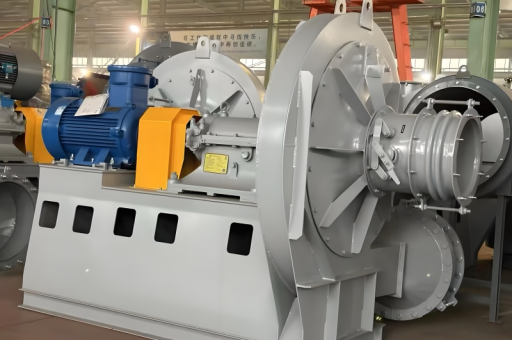
The single suction centrifugal fan is the most common configuration used in medium- to large-scale industrial boiler applications. In this design, air enters the impeller from only one side (single inlet), which simplifies ductwork and reduces space requirements.
Key design features include:
- Backward-curved or radial blades: Provide higher efficiency and lower noise compared to forward-curved alternatives.
- Robust housing: Made from wear-resistant steel or lined with ceramic to handle particulate-laden gas streams.
- Bearing and shaft assembly: Designed to handle radial and axial loads at elevated temperatures.
Compared to double-suction models, the single suction centrifugal fan offers easier maintenance access and lower initial cost, making it a preferred choice for coal fired boiler fan systems where space is constrained.
The Function of an Exhaust Fan Blower in Boiler Systems
The exhaust fan blower in a boiler system is typically the induced draft (ID) fan. Its primary job is to maintain slightly negative pressure inside the furnace, preventing hot gases from leaking into the boiler room. By extracting combustion products (CO₂, SOₓ, NOₓ, and fly ash), the exhaust fan blower ensures safe working conditions and allows downstream equipment—such as electrostatic precipitators or baghouses—to operate effectively.
Modern exhaust fan blowers often incorporate variable frequency drives (VFDs) to modulate speed based on boiler load. This reduces power consumption by 30–50% compared to constant-speed operation. Quiet, vibration-free operation is also critical, which explains why many facilities retrofit older fans with precision-balanced single suction centrifugal fan models.
Key Performance Factors: Pressure, Flow, and Temperature
When selecting a coal fired boiler fan or exhaust fan blower, engineers must evaluate three critical parameters:
- Static Pressure: The resistance the fan must overcome (ductwork, burner, heat exchanger, filters). A single suction centrifugal fan typically delivers 200–800 mmWG (millimeters of water gauge).
- Airflow Rate: Measured in cubic meters per hour (m³/h) or cubic feet per minute (CFM). For large utility boilers, flow can exceed 500,000 m³/h.
- Temperature: Flue gas temperature at the ID fan inlet can range from 140°C to 200°C in dry-bottom boilers. Fans must have heat-resistant bearings and shaft cooling.
Matching these parameters not only ensures reliable operation but also prevents cavitation, vibration, and premature bearing failure.
Common Applications Across Industries
While coal-fired power plants are the most obvious user, these fans are also found in:
- Cement kilns: Supplying combustion air and exhausting hot gases.
- Steel mills: For blast furnace boiler systems and sinter plant exhaust.
- Chemical processing: Steam boilers used in distillation and reaction vessels.
- District heating plants: Large hot-water boilers using pulverized coal.
In each case, the single suction centrifugal fan proves its versatility due to its ability to handle both clean and dusty air streams with minimal efficiency drop.
Frequently Asked Questions (FAQ)
Q1: What is the difference between a single suction and double suction centrifugal fan?
A: A single suction centrifugal fan draws air from one side, making it simpler and more compact. Double suction fans draw from both sides, doubling capacity for a given diameter but requiring more complex duct connections.
Q2: Can an exhaust fan blower be used for forced draft in a coal fired boiler fan system?
A: Yes, but it is not recommended. Exhaust fan blowers are designed for higher temperatures and particulate loads, while forced draft fans handle clean, cool air. Using an exhaust fan for forced air would be inefficient and increase power consumption.
Q3: How often should I inspect the impeller of a single suction centrifugal fan?
A: For continuous-duty coal fired boiler fans, inspect the impeller every 3–6 months. Look for erosion, cracks, or imbalance caused by ash buildup. Replace or repair worn blades immediately.
Q4: What causes vibration in a coal fired boiler fan?
A: Common causes include uneven ash deposition on blades, bearing wear, loose foundation bolts, or aerodynamic stall at low flow. Regular vibration monitoring is advised.
Q5: Is a VFD always necessary for an exhaust fan blower?
A: Not always, but highly recommended. VFDs reduce wear, lower energy bills, and allow precise pressure control, especially during boiler startup and load changes.
Maintenance and Safety Best Practices
Proper maintenance extends the life of a coal fired boiler fan and its associated exhaust fan blower:
- Clean the impeller regularly: Ash buildup causes imbalance and reduces flow.
- Check bearing lubrication: Use high-temperature grease and monitor oil levels in forced-feed systems.
- Inspect duct connections: Leaks reduce pressure and waste energy.
- Monitor temperature: Overheating of bearing housings indicates cooling system failure.
- Balance the rotor: An unbalanced single suction centrifugal fan will fail prematurely.
Safety protocols include: lockout/tagout before any access, using explosion-proof motors in gas-rich environments, and installing vibration sensors with automatic shutdown thresholds.
Conclusion: Why the Right Fan Choice Matters
The performance of a coal-fired boiler is directly tied to the efficiency of its air-moving equipment. A correctly specified coal fired boiler fan, integrated with a robust single suction centrifugal fan design and a reliable exhaust fan blower, can reduce fuel consumption by 5–15%, lower particulate emissions, and extend equipment life by years. Whether you are retrofitting an existing plant or designing a new facility, investing in premium fan technology pays dividends in operational reliability and regulatory compliance. For technical specifications and custom sizing, always consult with a fan manufacturer experienced in high-temperature, abrasive-duty applications.





