
This article's table of contents introduction:
- The Components of the Phrase
- The Most Likely Meaning
- Why This Fan is Crucial for This Application
- The "Snail" Design in Detail
- Possible Confusion / Translation Errors
- Summary
This is a highly specific term that appears to combine a few distinct pieces of industrial equipment and a potential translation error (likely from a manufacturing context in China or India).
Let's break down the phrase to understand what it likely refers to.
The Components of the Phrase
- Metallurgy Calcining Kilns: This is the application. In metallurgy, a calcining kiln (often a rotary kiln) is used to heat ore or concentrates to a temperature below their melting point. This removes volatile impurities (e.g., water, CO2) or causes a chemical change (e.g., oxidation).
- Draught Fan: This is the function. A "draught" (or draft) fan is used to create a flow of air or gas.
- Induced Draught (ID) Fan: This is a specific type of fan located after the kiln (at the "cold end" or exhaust). It pulls gas through the kiln, creating negative pressure inside. This is the most likely meaning here.
- Forced Draught (FD) Fan: This pushes air into the kiln.
- Blower: This is a general term for a fan that moves air against a resistance (high pressure, low volume). It's often used interchangeably with "fan."
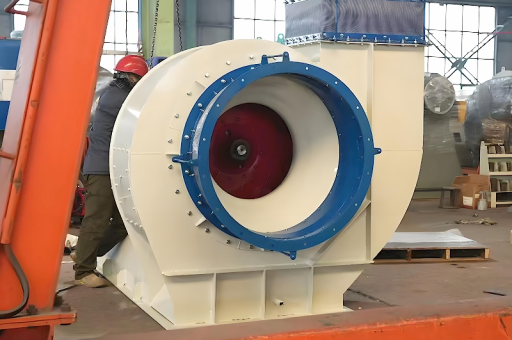
- Snail: This is the key descriptive term. A "Snail Blower" or "Snail Fan" is a nickname for a Centrifugal Fan.
Why "Snail"? Look at a centrifugal fan from the side. The spiral housing that wraps around the impeller looks exactly like a snail shell.
The Most Likely Meaning
The phrase "Metallurgy Calcining Kilns Snail Induced Draught Fan Blower" almost certainly refers to a heavy-duty, centrifugal (snail-type) Induced Draft (ID) fan used specifically to pull hot, dusty, and corrosive exhaust gases through a calcining kiln in a metallurgical plant.
It is a technical description for a specific piece of equipment, likely used in a purchase order, repair manual, or plant equipment list.
Why This Fan is Crucial for This Application
Using a Snail (Centrifugal) ID Fan for a calcining kiln is a specific engineering choice. Here’s why:
| Feature | Why it's needed for a Calcining Kiln |
|---|---|
| High Static Pressure | The ID fan must overcome the resistance of the long kiln, ductwork, and pollution control equipment (baghouse, scrubber). Centrifugal fans excel at this. |
| Handling Hot Gases | Calcining kilns exhaust gases can be 200°C - 400°C+. The fan (often made of special alloys, with water-cooled bearings) must withstand this heat without failing. |
| Handling Particulate (Dust) | The gas stream is laden with abrasive dust. The "snail" housing is robust and designed to be fitted with wear-resistant liners. |
| Variable Speed Control | The calcination process requires precise control of the airflow (and thus the temperature profile in the kiln). The ID fan usually has a VFD (Variable Frequency Drive). |
| Creating Negative Pressure | The ID fan creates a slight vacuum inside the kiln. This prevents hot, toxic gases from leaking out of the kiln's seals and into the plant environment, improving safety. |
The "Snail" Design in Detail
The "snail" or volute is crucial to the fan's function.
- Inlet: Air enters the center of the impeller axially (straight in).
- Impeller: The rotating wheel (blades) flings the air outward by centrifugal force.
- Snail Housing (Volute): The spiral shape of the housing collects the high-velocity air from the impeller. As the spiral gets wider, it converts the high velocity (kinetic energy) into high pressure (potential energy). This is why a centrifugal fan is a "blower."
Possible Confusion / Translation Errors
- "Snail" might be a brand name? Unlikely. There is no major global fan manufacturer with that name. It's almost universally a descriptive shape.
- "Draught" vs. "Draft": This is simply a British/Commonwealth English spelling ("draught") vs. American English ("draft").
- "Fan Blower": This is redundant in technical English (it's one or the other), but it's a very common construction in technical translations (e.g., Chinese 风机 fēngjī can mean both "fan" and "blower").
Summary
The term describes a Centrifugal (Snail-Type) Induced Draft Fan used to exhaust hot gases from a metallurgical calcining kiln.
- Primary Use: To pull the hot, dust-laden flue gas from the kiln exit, through the pollution control system, and to the stack.
- Key Characteristics: High pressure, high temperature tolerance, abrasive resistance, robust construction.
- Key Differentiator: The "snail" refers to the spiral volute casing of the centrifugal fan.





