
This article's table of contents introduction:
- What is an Induced Draft (ID) Fan?
- Critical Functions in a Boiler System
- Key Design & Operational Challenges
- Common Types of ID Fans
- Key Components of a Heavy-Duty ID Fan
- Drive & Control Systems
- Selection & Sizing Criteria
- Maintenance & Common Failure Modes
- Summary Table: ID Fan vs. FD Fan
- Conclusion
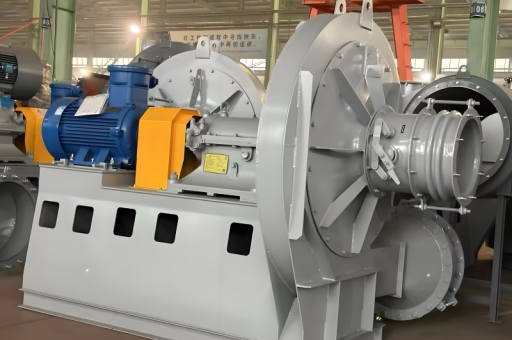
This is a comprehensive breakdown of the Heavy Duty Industrial Boiler Induced Draft (ID) Fan. This type of fan is a critical component in the boiler's flue gas system, ensuring safe and efficient operation.
What is an Induced Draft (ID) Fan?
An Induced Draft (ID) fan is located after the boiler, economizer, air preheater, and particulate control devices (like baghouses or electrostatic precipitators). Its primary function is to pull (induce) the hot flue gases through the boiler system and exhaust them safely up the chimney (stack).
Contrast with Forced Draft (FD) Fan:
- FD Fan: Pushes ambient air into the boiler furnace.
- ID Fan: Pulls flue gases out of the boiler, creating a slight negative pressure (draft) inside the furnace.
Critical Functions in a Boiler System
- Maintain Negative Furnace Pressure: This is the most critical safety function. If the furnace becomes positive (pressurized), hot gases and flames could be forced out of boiler openings, posing a severe safety and fire hazard. The ID fan maintains a slight vacuum (e.g., -0.5 to -2 inches of water column).
- Remove Combustion Products: It efficiently removes hot flue gases (CO2, N2, H2O, SOx, NOx, fly ash) from the boiler passes, economizer, and air heater.
- Overcome System Resistance: The fan must have enough power to overcome the high pressure drop across the entire flue gas path, including:
- Tubes and ducts
- Air preheater
- Baghouse or Electrostatic Precipitator (ESP)
- Wet Flue Gas Desulfurization (FGD) scrubber (if present)
- Stack
Key Design & Operational Challenges
The environment an ID fan operates in is extremely harsh. Fan designs must address these specific issues:
| Challenge | Cause | Consequence & Solution |
|---|---|---|
| High Temperature | Gases directly exiting the boiler (can be 300°F to 800°F+). | Consequence: Metal fatigue, warping, bearing failure. Solution: Water-cooled bearings, high-temperature alloys (like Corten or stainless steel), shaft cooling fans. |
| Abrasive Erosion | Fly ash and unburned carbon particles traveling at high velocity. | Consequence: Severe wear on impeller blades and housing, causing imbalance and vibration. Solution: Hard-faced blades (e.g., Stellite or tungsten carbide coatings), replaceable wear liners, thick-section impellers. |
| Corrosion | Acidic gases (SO2, SO3 forming H2SO4) condensing on fan surfaces, especially at startup or low load. | Consequence: Pitting and thinning of metal. Solution: Corrosion-resistant alloys, fiberglass reinforced plastic (FRP) for some components, or keeping gas temperatures above the acid dew point. |
| Fouling & Dust Build-up | Sticky or wet fly ash deposits on the impeller. | Consequence: Imbalance, severe vibration, and reduced efficiency. Solution: Inlet guide vanes (IGVs) to reduce turndown fouling, blade cleaning ports, smooth/self-cleaning blade profiles. |
| Large Size & Power | Handling millions of cubic feet per minute (CFM) of gas. | Consequence: Massive structural loads, high electrical consumption. Solution: Heavy-duty foundations, large electric motors (up to several MW), Variable Frequency Drives (VFDs) for energy savings. |
Common Types of ID Fans
-
Radial (or Radial-Tipped) Fans:
- Blade Shape: Straight, radial blades.
- Pros: Extremely rugged, excellent for highly abrasive dust-laden gases. Relatively simple and robust.
- Cons: Lower efficiency compared to other designs. Higher noise levels.
- Best For: High-dust applications like coal-fired boilers.
-
Backward-Curved (or Backward-Inclined) Fans:
- Blade Shape: Blades curve away from the direction of rotation.
- Pros: Higher efficiency, non-overloading power characteristic (power consumption peaks at a designed flow rate and drops off if flow increases further). Generally quieter.
- Cons: More susceptible to blade wear from erosion.
- Best For: Cleaner fuel applications (natural gas, oil) or when downstream particulate control (ESP/baghouse) is very efficient.
-
Airfoil (Backward-Curved Airfoil) Fans:
- Blade Shape: Hollow, airfoil-shaped blades.
- Pros: Highest efficiency of all centrifugal fan types. Quietest operation.
- Cons: Most complex and expensive to manufacture. Blades are vulnerable to erosion and dust build-up. Hollow blades can fill with dust causing imbalance.
- Best For: Large, modern power plants with very efficient upstream particulate removal.
Key Components of a Heavy-Duty ID Fan
- Impeller (Rotor): The rotating assembly with the blades. The most critical component.
- Housing (Casing): A heavy-gauge steel scroll that collects and directs the gas to the outlet.
- Shaft: Transmits power from the motor/coupling to the impeller. Often large diameter and forged.
- Bearings: Typically spherical roller bearings (self-aligning), mounted in sturdy bearing housings. Must handle both radial (weight) and axial (thrust) loads.
- Coupling: Connects the motor shaft to the fan shaft. Can be rigid, flexible (gear or grid), or a variable-speed fluid coupling.
- Inlet Box: A transition piece that smooths airflow into the fan eye. Often includes Inlet Guide Vanes (IGVs) for flow control.
- Inlet Guide Vanes (IGVs): Movable vanes that change the airflow direction entering the impeller. This is the most efficient way to modulate fan flow and pressure (more efficient than dampers).
Drive & Control Systems
- Motor: Large, high-voltage (e.g., 6.6kV, 11kV) squirrel-cage induction motors are standard.
- Speed Control:
- Variable Frequency Drive (VFD): The gold standard for energy efficiency. Precisely controls motor speed to match boiler demand.
- Fluid Coupling: A hydraulic coupling between motor and fan that allows variable speed.
- Inlet Guide Vanes (IGV): A mechanical method of flow control, less efficient than VFD but lower initial cost.
Selection & Sizing Criteria
Engineers select an ID fan based on:
- Gas Volume Flow Rate (CFM or m³/hr): At the actual operating temperature and pressure.
- Total Static Pressure (TSP): The resistance the fan must overcome (in inches of water gauge or Pascal).
- Gas Temperature: Both normal and maximum (upset) conditions.
- Gas Composition & Dust Loading: Corrosive, abrasive, or sticky components.
- Regulatory Requirements: Low noise, vibration limits, efficiency standards.
- Maintenance Accessibility: For a component that will require periodic blade inspection and repair.
Maintenance & Common Failure Modes
- Vibration: The #1 indicator of problems. Caused by:
- Imbalance: Blade erosion or dust build-up.
- Bearing failure: Worn bearings due to heat, contamination, or lack of lubrication.
- Foundation/structural issues: Loosening of anchor bolts or cracks in concrete.
- Shaft misalignment.
- Blade Wear: Uneven erosion is common, leading to imbalance.
- Bearing Overheating: Loss of cooling (water or air), incorrect lubricant, or high vibration.
- Blade Failure: Fatigue cracking from high vibration or thermal stress. Catastrophic failure can destroy the fan housing.
Summary Table: ID Fan vs. FD Fan
| Feature | Induced Draft (ID) Fan | Forced Draft (FD) Fan |
|---|---|---|
| Location | After boiler, in flue gas stream | Before boiler, in ambient air |
| Fluid Handled | Hot, dirty, corrosive flue gas | Clean, ambient air |
| Pressure | Low negative pressure (suction) | Moderate positive pressure |
| Temperature | High (200°F - 800°F+) | Ambient (50°F - 100°F) |
| Material Concerns | Erosion, corrosion, thermal stress | Minimal wear |
| Bearing Design | Water or fan-cooled, external lube | Standard, often simpler |
| Primary Risk | Furnace pressurization, blade erosion | Pulsation, motor overload |
Conclusion
The Heavy Duty Industrial Boiler ID Fan is not just a simple fan; it is a highly engineered machine designed to survive the most punishing environment in a power plant or industrial facility. Proper selection, material specification, vibration monitoring, and a robust maintenance program are essential to ensure the safe, reliable, and efficient operation of the entire boiler system. A failure of the ID fan typically forces an immediate boiler trip to prevent a dangerous furnace implosion or pressurization event.





