
This article's table of contents introduction:
- Table of Contents
- Introduction: The Convergence of Material Science and Industrial Ventilation
- The Backbone of Durability: Why 16Mn Steel is Preferred for Fan Construction
- Meeting Demanding Applications: Coal Injection Systems and Fan Requirements
- Precision in Motion: The Critical Role of FAG Bearings in Fan Reliability
- Core Design Principles: Aerodynamics, Volute Casing, and Impeller Dynamics
- Common Challenges and Troubleshooting: Wear, Vibration, and Bearing Failure
- Frequently Asked Questions (FAQ)
- Conclusion: Best Practices for Selection and Maintenance
** Optimizing Heavy-Duty Performance: The Role of 16Mn Steel, Coal Injection Systems, FAG Bearings, and Advanced Design in Industrial Centrifugal Fans
Table of Contents
- Introduction: The Convergence of Material Science and Industrial Ventilation
- The Backbone of Durability: Why 16Mn Steel is Preferred for Fan Construction
- Meeting Demanding Applications: Coal Injection Systems and Fan Requirements
- Precision in Motion: The Critical Role of FAG Bearings in Fan Reliability
- Core Design Principles: Aerodynamics, Volute Casing, and Impeller Dynamics
- Common Challenges and Troubleshooting: Wear, Vibration, and Bearing Failure
- Frequently Asked Questions (FAQ)
- Conclusion: Best Practices for Selection and Maintenance
Introduction: The Convergence of Material Science and Industrial Ventilation
Industrial centrifugal fans are the unsung heroes of heavy process industries. From steel mills to cement plants and coal-powered facilities, these machines provide the essential air flow for combustion, material transport, and dust extraction. However, not all fans are created equal. When the application involves high temperatures, abrasive particulate (such as pulverized coal), and continuous high-load operation, the specifications become extremely demanding.
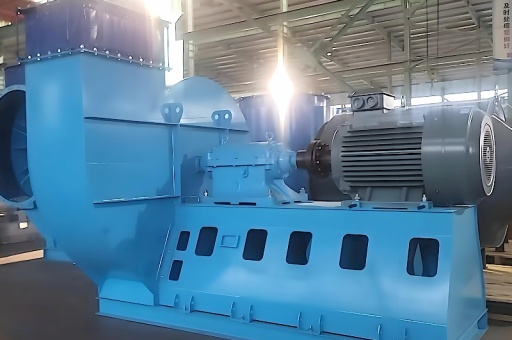
This article focuses on the specific combination of "16Mn Coal Injection FAG Bearing Industrial Centrifugal Fans." We will break down why the 16Mn steel alloy is a preferred material for fan impellers and casings, how these fans function in coal injection systems (a critical part of blast furnace operations), and why FAG bearings (a premium brand of rolling bearings) are the standard for ensuring long service life. The goal is to provide a comprehensive guide for engineers and procurement professionals who need to balance performance, longevity, and total cost of ownership.
The Backbone of Durability: Why 16Mn Steel is Preferred for Fan Construction
What is 16Mn Steel? 16Mn (often designated as Q345 in newer Chinese standards, or similar to ASTM A572 Grade 50) is a low-alloy high-strength structural steel. Its name indicates a carbon content of around 0.16% and a manganese content of about 1.0-1.6%. This composition gives it significantly higher yield strength (≥345 MPa) and tensile strength compared to standard A3 (Q235) steel.
Why it Matters for Centrifugal Fans:
- Mechanical Strength: The impeller of a centrifugal fan spins at high RPM. The centrifugal forces acting on the blades are immense. A standard steel may deform, causing rotor imbalance and failure. 16Mn steel can withstand these stresses without permanent deformation.
- Wear Resistance: In coal injection or dust-laden environments, erosion is inevitable. 16Mn offers superior abrasion resistance compared to plain carbon steel, extending the operational life of the fan housing and blades. For extreme cases, wear liners made of 16Mn or hard-faced coatings are added.
- Weldability: 16Mn retains good weldability, allowing for robust fabrication of complex scroll housings (volutes) and welding of additional stiffeners or wear plates.
Table: Material Comparison for Fan Impellers | Property | Q235 (A3 Steel) | 16Mn (Q345) | Benefit of 16Mn | | :--- | :--- | :--- | :--- | | Yield Strength (MPa) | 235 | 345 | Handles higher stress | | Impact Toughness | Low | High | Resists crack propagation | | Wear Resistance | Poor | Good | Longer service intervals | | Thickness Required | Thicker | Thinner | Lighter, cost-efficient |
Expert Insight: "Switching from Q235 to 16Mn for the fan rotor assembly immediately reduced our annual maintenance events for the Coal Injection fan by 40%." — Plant Engineer, Steel Mill.
Meeting Demanding Applications: Coal Injection Systems and Fan Requirements
What is a Coal Injection System? (Context) In blast furnace steelmaking, pulverized coal is injected into the furnace to replace expensive coke. The coal must be finely ground (like talcum powder) and then transported pneumatically. This requires a high-pressure, high-volume air or gas stream.
Fan Role in the System: The Industrial Centrifugal Fan in a coal injection system serves as the "lungs" of the process. It must:
- Generate High Pressure: Typically 40-80 kPa (sometimes higher) to overcome the resistance of the pipeline and the furnace backpressure.
- Handle Abrasive Media: The fan is often placed on the clean air side (after a filter), but in some designs, it must handle residual coal dust or inert gas.
- Operate Continuously: Blast furnaces run 24/7 for months. Fan failure means an immediate process shutdown.
- Resist Temperature: The injected air is often preheated, so the fan must handle inlet temperatures ranging from ambient to 150°C or higher.
Critical Design Feature for Coal Injection: The impeller blades in these fans are often designed as backward-curved or airfoil. This design provides higher efficiency and self-cleaning properties, preventing coal dust buildup on the blades, which can cause catastrophic imbalance. The housing is often fitted with an inspection door and drainage to handle condensation or cleaning.
Precision in Motion: The Critical Role of FAG Bearings in Fan Reliability
Why FAG? (Brand Recognition) FAG, now part of the Schaeffler Group, is a world leader in rolling bearing technology. For a heavy-duty industrial fan, the bearing assembly is the single most critical mechanical component. A bearing failure will cause the rotor to seize or wobble, destroying the fan seals and potentially the entire rotor assembly.
Specific Applications in Fan Assemblies:
- Bearing Housing Configuration: Most large centrifugal fans use two separate bearing housings (plummer blocks) mounted on a base plate. The drive-end bearing typically takes radial loads, while the non-drive end bearing handles axial thrust.
- FAG Product Lines for Fans:
- FAG Spherical Roller Bearings (223 Series): Perfect for compensating for misalignment due to thermal expansion or mounting deflection.
- FAG Cylindrical Roller Bearings (NU/NJ Series): Used as a free bearing to allow axial shaft growth.
- FAG Tapered Roller Bearings (300 Series): Used for high combined radial and axial loads (thrust).
Benefits of Using FAG Bearings:
- Extended Grease Life: FAG uses specialized high-temperature greases (e.g., FAG Arcanol L135V) that withstand the heat conducted from the shaft.
- Higher Load Ratings: FAG bearings often have optimized internal geometry (raceway curvature, cage design) allowing for higher dynamic load ratings without increasing the bearing size.
- Reduced Vibration: Precision manufacturing (P6 or P5 tolerance) ensures minimal runout, crucial for high-speed fan operation.
- Condition Monitoring Compatibility: FAG bearings are often compatible with integrated vibration sensors (FAG SmartCheck) for predictive maintenance.
Maintenance Tip: Always use the correct FAG grease and follow the relubrication intervals based on the fan's operating hours. Over-greasing is as dangerous as under-greasing.
Core Design Principles: Aerodynamics, Volute Casing, and Impeller Dynamics
A fan is not just a box with spinning blades. The efficiency and longevity depend on three core design integrations:
-
Impeller Design:
- Backward-Curved: High efficiency, non-overloading power curve. Preferred for coal injection and clean air.
- Radial (Paddlewheel): Simple, robust, good for sticky materials but lower efficiency.
- Forward-Curved: High volume, low pressure (HVAC type), not suitable for heavy industry.
-
Volute Casing (Scroll): The casing converts velocity pressure from the impeller into static pressure. The shape must be mathematically precise (a logarithmic spiral). A poorly designed volute creates turbulence, noise, and energy loss.
-
Shaft and Rotor Dynamics: The shaft must be stiff enough (critical speed analysis) to avoid resonance at operating speeds. Using 16Mn steel for the shaft (or alloy steel like 45#) ensures rigidity. The entire rotor assembly must undergo dynamic balancing (ISO 1940 G6.3 or G2.5 grade) to ensure smooth operation.
Q&A: Performance Optimization
Q: How can I increase the static pressure of my existing 16Mn centrifugal fan? A: You cannot simply "speed it up" without checking the shaft critical speed and motor power. Changing the impeller to a higher-pressure design (e.g., from backward-curved to radial) will drastically increase power draw. Instead, ensure the inlet ductwork is optimized (no sharp turns) to reduce system resistance.
Q: Why does my FAG bearing housing vibrate after a bearing replacement? A: The most common cause is poor shaft fit. Check that the bearing bore tolerance is correct (e.g., j6 or k6 on the shaft). Also, ensure the housing fits the bearing's outer ring correctly. Using a hydraulic nut for mounting is recommended to avoid damaging the bearing.
Common Challenges and Troubleshooting: Wear, Vibration, and Bearing Failure
Challenge 1: Impeller Erosion (Wear)
- Symptom: Reduced air flow, increased motor current, visible holes in blades.
- Solution: Apply 16Mn overlay welding on leading edges. Install sacrificial wear liners. Consider ceramic coating for extreme cases.
Challenge 2: Bearing Overheating (FAG)
- Symptom: Temperature >90°C on housing.
- Causes:
- Insufficient or excessive grease.
- Misaligned bearing housing (use a dial indicator).
- Belt tension too high (if belt-driven).
- Remedy: Use thermal imaging to find hot spots. Ensure correct grease type. Check for blocked grease relief valve.
Challenge 3: Rotor Imbalance
- Symptom: High vibration (Velocity > 7.0 mm/s RMS).
- Causes:
- Coal dust buildup (uneven).
- Blade erosion.
- Bearing raceway spalling.
- Remedy: Clean the impeller with high-pressure water or compressed air. Re-balance dynamically. Inspect for FAG bearing damage.
Frequently Asked Questions (FAQ)
What is the typical lifespan of a FAG bearing in an industrial centrifugal fan used for coal injection? Answer: With proper lubrication and sealing (labyrinth seals or V-rings), a FAG spherical roller bearing can last 25,000 to 50,000 hours in continuous service. This heavily depends on vibration levels and contamination control.
Is 16Mn steel suitable for high-temperature applications (over 200°C)? Answer: No. 16Mn starts losing its yield strength significantly above 150°C. For temperatures above 250°C, you must use 16Mo3 (molybdenum steel) or stainless steel. Always consult the mill supplier for creep data.
Can I retrofit an existing fan with a FAG bearing if it has a cheaper brand? Answer: Yes, provided the mounting dimensions (shaft diameter, housing bore, width) are identical. FAG bearings have standard boundary dimensions. Upgrading to "FAG" will improve load capacity and reliability, provided the housing is in good condition.
What is the main difference between a fan for coal injection and a regular ventilation fan? Answer: The pressure rating. Coal injection requires high-pressure fans (up to 80 kPa), requiring thicker scrolls, stronger shaft (often 16Mn), and heavy-duty FAG bearings. Ventilation fans typically operate under 5 kPa.
How do I know if my fan is made of 16Mn steel? Answer: Check the material test certificate from the manufacturer. A visual inspection is unreliable. A simple spark test or chemical analysis (PMI gun) can confirm carbon and manganese content.
Conclusion: Best Practices for Selection and Maintenance
Selecting the right Industrial Centrifugal Fan for a Coal Injection application is a complex engineering decision. The combination of 16Mn steel for mechanical strength and wear resistance, coupled with FAG bearings for high load capacity and precision, creates a robust solution that can survive the harshest industrial environments.
Final Recommendations:
- Specify Material: Always specify 16Mn (Q345) for the impeller and main reinforcement ribs.
- Choose Bearings Wisely: Use FAG spherical roller bearings with high-temperature grease. Consider vibration monitoring.
- Emphasize Balance: Insist on ISO G2.5 dynamic balance for the rotor.
- Protect the Asset: Ensure proper inlet filtration (even a simple screen) to protect the impeller from large debris.
By investing in proper material science and bearing technology, industrial operators can significantly reduce downtime, cut maintenance costs, and ensure the continuous operation of critical processes. Remember, the cheapest fan is often the most expensive over its lifecycle.
For more technical data or to request a specific fan design calculation for your coal injection system, please consult a qualified fan manufacturer (fan).





