
This article's table of contents introduction:
- What is "Coupling Driven"?
- The 10 kV Motor Factor
- The Application: Boiler Exhaust Fan Blower
- Potential Problems with this System
- Key Maintenance Checks
- Summary Table for Your System
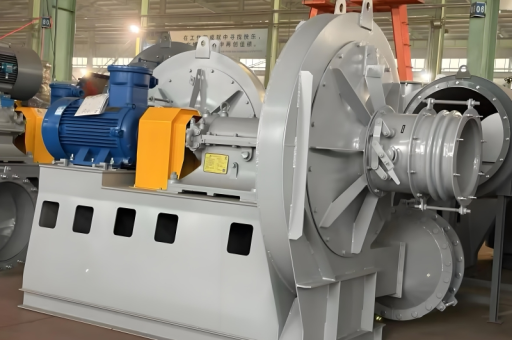
It appears you are referring to an industrial fan system, specifically a 10 kV (10,000 Volt) boiler fan exhaust blower that is "coupling driven."
This is a standard configuration in large thermal power plants, industrial boilers, or cement plants. Here is a breakdown of what this means, its components, and common operational concerns.
What is "Coupling Driven"?
In this context, "coupling driven" means the motor and the fan impeller are not directly mounted on the same shaft (direct drive) or connected by a belt. Instead, they are connected via a mechanical coupling.
- The Setup:
- Prime Mover: A 10 kV electric motor.
- Connector: A coupling (e.g., flexible, gear, or fluid coupling).
- Load: The exhaust blower (fan).
- Why use a coupling?
- Misalignment Tolerance: It allows for minor shaft misalignment between the motor and fan.
- Vibration Dampening: It reduces transmission of vibration from the motor to the fan (or vice versa).
- Ease of Maintenance: You can replace the motor or fan without dismantling the other component.
- Torque Transmission: Gear couplings transmit high torque efficiently.
- Speed Control (Fluid Coupling): In many high-power applications (like boiler fans), a fluid coupling (scoop coupling) is used. This allows the fan speed to be varied while the 10 kV motor runs at a constant speed, which is the most efficient way to control boiler draft.
The 10 kV Motor Factor
A 10 kV motor is a Medium Voltage (MV) motor.
- Power Range: These motors typically range from ~200 kW to several MW (Megawatts).
- Starting: 10 kV motors draw very high inrush current (6-8 times full load current). To avoid voltage dips and stress, starting is often done via:
- Star-Delta (less common at 10 kV)
- VFD (Variable Frequency Drive): Modern systems use a VFD to soft-start and control speed.
- LRS (Liquid Resistance Starter): Often used for large fan loads like induced draft (ID) or forced draft (FD) fans.
The Application: Boiler Exhaust Fan Blower
- Role: It pulls hot flue gas (exhaust) from the boiler furnace, through the economizer, electrostatic precipitator (ESP), and out the chimney.
- Key Challenges:
- High Temperature: The gas can be 140°C – 180°C (up to 400°C in some bypass ducts). The fan must be designed for thermal expansion.
- Abrasion: Fly ash in the exhaust gas erodes the fan blades (especially ID fans).
- Corrosion: Sulfur and moisture in the flue gas can cause acid corrosion below the dew point.
Potential Problems with this System
If you are troubleshooting or installing this system, watch for these common issues:
| Issue | Cause | Symptom |
|---|---|---|
| Coupling Failure | Misalignment, worn elastomeric elements (flex couplings), or lack of lubrication (gear couplings). | High motor or fan vibration. |
| Vibration | Unbalance due to fly ash buildup on blades, thermal distortion, or coupling misalignment. | Bearing failure, structural damage. |
| Overload / High Current | Damper stuck closed, duct blockage, or fan running in wrong direction. | Motor trips on overcurrent relay. |
| Shaft Alignment Drift | Thermal expansion of the fan casing (casing grows more than motor base). The "cold alignment" must be set to "hot alignment" targets. | Coupling hub wear, high vibration after startup. |
| Fluid Coupling Slippage (if applicable) | Low oil level, overheating, or worn scoop tube. | Fan runs slow or overheats. |
Key Maintenance Checks
- Alignment: Perform Laser Alignment when the system is cold and hot (locked rotor condition). For a boiler fan, the motor is often set lower than the fan (offset) to compensate for thermal rise.
- Lubrication:
- Gear Coupling: Requires specific high-viscosity grease.
- Motor Bearings: 10 kV motors typically use oil-ring or forced lube bearings.
- Fan Bearings: Usually spherical roller bearings with grease nipples or oil baths.
- Blade Inspection: Check for erosion, cracking (weldment), or fly ash buildup. Imbalance can destroy bearings.
- Motor Insulation: High voltage (10 kV) motors are sensitive to moisture and dust. Megger testing (Insulation Resistance) is critical before startup.
Summary Table for Your System
| Parameter | Typical Value / Component |
|---|---|
| Voltage | 10 kV |
| Motor Type | Squirrel cage induction |
| Coupling Type | Flexible (Elastomeric, Gear) or Fluid (Scoop) |
| Fan Type | Centrifugal (Radial, Backward Curved, or Airfoil) |
| Function | Create negative draft in boiler furnace |
| Control | Inlet vane, outlet damper, or VFD/fluid coupling |
If you have a specific problem (e.g., "The coupling is failing every month" or "The motor trips on earth fault"), please provide the exact symptom and I can give you a targeted diagnosis.





