
This article's table of contents introduction:
- Introduction to Single Inlet Combustible Gas Delivery Centrifugal Ventilation Fans
- Core Design Principles and Mechanical Architecture
- Critical Safety Engineering for Flammable Gas Environments
- Performance Metrics, Efficiency Curves, and Selection Criteria
- Installation Best Practices and Common Pitfalls
- Maintenance Protocols for Long-Term Reliability
- Regulatory Compliance and Industry Standards
- Frequently Asked Questions (FAQ)
- Conclusion and Future Trends
** Mastering Single Inlet Combustible Gas Delivery Centrifugal Ventilation Fans: Design, Safety, and Performance Optimization
Directory Guide
- Introduction to Single Inlet Combustible Gas Delivery Centrifugal Ventilation Fans
- Core Design Principles and Mechanical Architecture
- Critical Safety Engineering for Flammable Gas Environments
- Performance Metrics, Efficiency Curves, and Selection Criteria
- Installation Best Practices and Common Pitfalls
- Maintenance Protocols for Long-Term Reliability
- Regulatory Compliance and Industry Standards
- Frequently Asked Questions (FAQ)
- Conclusion and Future Trends
Introduction to Single Inlet Combustible Gas Delivery Centrifugal Ventilation Fans
In industrial environments where flammable gases must be moved safely, the Single Inlet Combustible Gas Delivery Centrifugal Ventilation Fan stands as a cornerstone of operational integrity. Unlike general-purpose fans, these specialized units are engineered to handle methane, propane, hydrogen, or solvent vapors without becoming an ignition source. A single inlet configuration means air or gas enters from one side of the impeller, simplifying ductwork and reducing turbulence. When combined with centrifugal force, these fans deliver high static pressure—essential for pushing combustible mixtures through long pipelines or filtration systems.
The market has seen a surge in demand due to stricter emissions regulations and the expansion of biogas, petrochemical, and wastewater treatment facilities. According to industrial safety reports, improper fan selection in combustible gas applications accounts for nearly 12% of industrial explosion incidents. This article consolidates engineering knowledge from field manuals, academic papers, and OEM specifications to provide a definitive resource. Let’s examine the mechanical heart of these machines.
Question: Why is a single inlet preferred over a double inlet for combustible gas applications?
Answer: A single inlet reduces internal gas recirculation and minimizes the number of potential leak points. It also simplifies the shaft seal arrangement, which is critical for containing flammable gases and preventing explosive mixtures from reaching the motor enclosure.
Core Design Principles and Mechanical Architecture
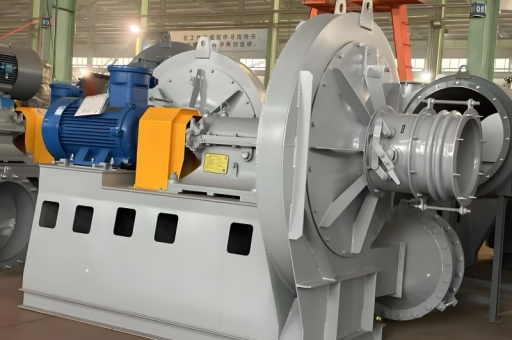
The anatomy of a Single Inlet Combustible Gas Delivery Centrifugal Ventilation Fan is purpose-built for hazard mitigation. The impeller is typically constructed from non-sparking materials such as aluminum bronze or stainless steel, as specified by ATEX or NEC guidelines. The housing is fabricated from carbon steel with corrosion-resistant coatings, but for hydrogen-rich streams, 316L stainless steel is mandatory to avoid hydrogen embrittlement.
The single inlet design draws gas axially into the impeller eye. As the impeller rotates, centrifugal force accelerates the gas radially outward, converting velocity into pressure via the volute casing. A key differentiator is the shaft seal system. Standard fans use lip seals; for combustible gas delivery, double mechanical seals with a barrier fluid (such as nitrogen or oil) are employed. This prevents gas leakage into the bearing housing and the external environment.
Motor selection is equally rigorous. Explosion-proof motors (Class I, Division 1 or Zone 1) with temperature ratings below the auto-ignition point of the target gas are non-negotiable. Some advanced models integrate variable frequency drives (VFDs) located in a safe area, with cables routed through explosion-proof conduits.
Question: What material is best for impellers handling acetylene gas?
Answer: Acetylene reacts with copper to form explosive acetylides; therefore, impellers should be made from Monel or stainless steel with non-ferrous coatings. Aluminum bronze is also rejected due to its copper content.
Critical Safety Engineering for Flammable Gas Environments
Safety is not an add-on but a fundamental design requirement for Single Inlet Combustible Gas Delivery Centrifugal Ventilation Fans. The most critical hazard is ignition from friction, sparks, or hot surfaces. To address this, manufacturers adhere to API 610 and ISO 13709 standards for mechanical seals and shaft alignment.
Spark prevention is achieved through:
- Tight clearances between the impeller and inlet cone (typically 0.010 to 0.020 inches) to avoid rubbing.
- Use of spark-resistant coatings on the backplate.
- Grounding straps to dissipate static charge buildup.
Temperature control is managed by thermal sensors embedded in the bearing housings. If temperature exceeds a preset threshold (e.g., 135°C for natural gas), the control system automatically shuts down the fan. Additionally, gas detection sensors are recommended at the inlet and outlet to monitor for concentration levels approaching the lower explosive limit (LEL).
A less-discussed but vital aspect is reverse flow prevention. If the fan stops while the gas supply remains pressurized, combustible gas can flow backward through the fan, potentially reaching the motor or control panel. Check valves or pneumatic isolation gates are mandatory downstream of the fan.
Question: Can a standard centrifugal fan be retrofitted for combustible gas?
Answer: Retrofitting is strongly discouraged. Standard fans lack spark-proof internal clearances, certified seal systems, and explosion-proof electrical components. Even minor modifications cannot guarantee compliance with safety codes such as NFPA 69 or EN 1127-1.
Performance Metrics, Efficiency Curves, and Selection Criteria
Selecting the correct Single Inlet Combustible Gas Delivery Centrifugal Ventilation Fan requires analyzing performance curves that plot pressure (Pa or inches w.g.) against flow (m³/h or CFM). Because combustible gases have densities different from air—methane is about 55% of air density—manufacturer curves must be corrected using the fan affinity laws:
- (Q_2 = Q_1 \times (N_2/N_1))
- (P_2 = P_1 \times (N_2/N_1)^2 \times (\rho_2/\rho_1))
- (kW_2 = kW_1 \times (N_2/N_1)^3 \times (\rho_2/\rho_1))
Where (N) is rotational speed and (\rho) is gas density. For lean methane-air mixtures, the power consumption can be 15-20% lower than air-only calculations, which often leads to motor oversizing if not accounted for.
Efficiency (η) is typically 65-78% for backward-curved impellers and 50-65% for radial-tip designs. Backward-curved impellers are recommended for combustible gas due to their non-overloading power characteristic—meaning they won’t draw excessive current if the system resistance decreases unexpectedly.
Question: How do I calculate the actual flow when handling a gas mixture with 30% hydrogen?
Answer: First, determine the mixture’s density: for 30% H₂ (density 0.0899 kg/m³) and 70% N₂ (1.2506 kg/m³), density = 0.3×0.0899 + 0.7×1.2506 = 0.902 kg/m³. Then apply the affinity laws using the original air-curve data, dividing the pressure ratio by the density ratio.
Installation Best Practices and Common Pitfalls
Proper installation of a Single Inlet Combustible Gas Delivery Centrifugal Ventilation Fan can dramatically extend its service life and reliability. The fan should be mounted on a rigid foundation with vibration isolators to prevent misalignment. Inlet ductwork must be at least 1.5× the diameter of the fan inlet and free of sharp bends to avoid flow separation and subsequent cavitation.
Common pitfalls include:
- Undersized inlet duct: Causes static pressure drop and reduced flow.
- No inlet screen: Debris ingestion can damage impeller blades and create spark risks.
- Improper drainage: Condensation from temperature changes can accumulate in the volute, leading to corrosion or bacterial growth in biogas applications.
VFD installations require special attention. Harmonics from VFDs can cause motor overheating at low speeds. Use of output reactors or sinusoidal filters is recommended to maintain motor temperature within the explosion-proof rating.
Question: What is the minimum clearance between the fan housing and surrounding structures?
Answer: For combustible gas applications, a minimum of 3 feet (0.91 meters) is recommended for access and firefighting equipment. This also allows for thermal expansion during a fire scenario.
Maintenance Protocols for Long-Term Reliability
Routine maintenance is the lifeline of Single Inlet Combustible Gas Delivery Centrifugal Ventilation Fans. A proactive schedule should include:
- Weekly: Vibration analysis (ISO 1940 balance grade G6.3), bearing temperature logging, and seal barrier fluid level checks.
- Monthly: Gas leak detection using portable LEL meters around the shaft seal and piping connections.
- Quarterly: Impeller visual inspection for pitting, erosion, or deposits using a borescope.
- Annually: Full disassembly, non-destructive testing (NDT) of the shaft and impeller, and replacement of mechanical seals.
One often-overlooked item is the grounding brush. Over time, carbon brushes wear down, losing contact with the shaft. This can lead to static charge accumulation, which is particularly dangerous in dust-laden combustible gases.
Question: How often should the mechanical seal barrier fluid be replaced?
Answer: Every 6 months, or sooner if the fluid shows discoloration or particulate contamination. In hydrogen service, some operators opt for quarterly replacement due to the gas’s high diffusivity.
Regulatory Compliance and Industry Standards
Global markets enforce strict guidelines. In North America, NFPA 70 (NEC) Article 500 defines Class I, Division 1 areas where combustible gases are present under normal operation. Fans placed in these zones must have UL or CSA certification for explosion-proof operation. In Europe, ATEX Directive 2014/34/EU requires the fan assembly to be certified for the specific gas group (IIA, IIB, or IIC) and temperature class (T1 to T6).
Additional standards include:
- ISO 21940-11 for mechanical vibration
- API 610 (11th Edition) for centrifugal fans in hydrocarbon service
- EN 14986 for design of fans working in potentially explosive atmospheres
Compliance documentation must be maintained onsite. Many insurance companies now mandate quarterly audits for fans handling combustible gases, with penalties for non-compliance.
Question: What temperature class (T-code) is required for a fan handling propane?
Answer: Propane has an auto-ignition temperature of approximately 450°C, so T2 (300°C) or T3 (200°C) temperature classes are sufficient. However, designers often specify T4 (135°C) for additional margin.
Frequently Asked Questions (FAQ)
Q1: Can I use a belt-driven fan for combustible gas delivery? A: Belt-driven fans are generally discouraged because belts can generate static electricity and slip, causing speed inconsistency. Direct-drive with an explosion-proof motor is the industry standard.
Q2: What is the maximum temperature rise allowed across the fan? A: For most combustible gases, a temperature rise of 20°C is considered safe. If the inlet gas is near its auto-ignition temperature, a cooling jacket or gas recirculation loop must be added.
Q3: Is it necessary to install a spark arrestor downstream? A: Not in all cases. If the fan is the only potential ignition source, spark arrestors are redundant. However, if the downstream process includes heat exchangers or catalytic beds, spark arrestors are recommended.
Q4: How do I size a fan for variable flow requirements? A: Use a VFD located in a non-hazardous area, with motor leads run through explosion-proof rigid conduit. Avoid throttling valves on the inlet side, as they can cause cavitation and unstable flow.
Conclusion and Future Trends
The Single Inlet Combustible Gas Delivery Centrifugal Ventilation Fan is a sophisticated piece of equipment that integrates fluid dynamics, materials science, and safety engineering. As industries shift toward hydrogen economies and renewable biogas, the demand for fans capable of handling dynamic gas compositions will grow. Emerging trends include:
- Smart condition monitoring with IoT sensors for real-time vibration, temperature, and gas concentration analysis.
- 3D-printed impellers with optimized aerodynamic profiles to achieve 80%+ efficiency.
- Modular seal systems that allow quick replacement without heavy disassembly.
By adhering to the principles outlined in this guide—especially rigorous safety engineering, correct performance corrections, and proactive maintenance—you can ensure a long, safe, and efficient operating life for your fan assets. Always remember: in combustible gas applications, reliability is synonymous with safety.





