
This article's table of contents introduction:
- Breakdown of the Terms
- Typical Applications (Where you'd find these fans)
- Key Technical Specifications (What to look for)
- Important Considerations
- Summary
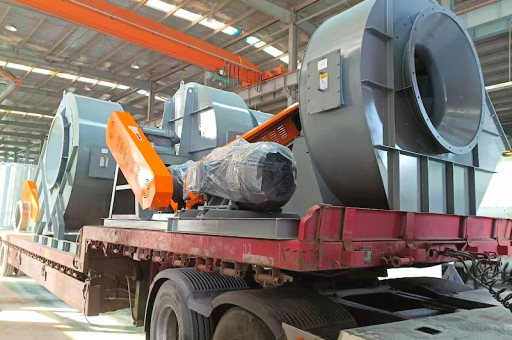
It appears you are describing a high-performance industrial centrifugal fan, likely used in applications requiring:
- High Air Flow (large volume of air movement)
- Backward Curved / Inclined Blades (efficiency, non-overloading power curve)
- Antiwear / Abrasion Resistance (handling particulate-laden or harsh gases)
- Gas Delivery (moving process gases, combustion air, or exhaust)
This is a specific subset of Centrifugal Ventilation Fans, often classified under Dust Loading / Industrial Process Fans.
Here is a breakdown of what that description means, typical applications, and key technical specifications to look for.
Breakdown of the Terms
- High Air Flow: The fan is designed for a high volumetric flow rate (CFM or m³/h), typically at medium to high pressure. This usually implies a larger housing, impeller, and motor size.
- Backward (Backward-Curved/Backward-Inclined):
- Wheel Type: The blades curve away from the direction of rotation.
- Advantages:
- High Efficiency (best among centrifugal designs for clean air).
- Non-Overloading Power Curve (motor will not burn out if duct pressure drops).
- Quieter operation compared to forward-curved.
- Stable pressure/flow characteristics.
- Antiwear: The fan is constructed to resist erosion from solid particles (dust, ash, debris). This implies:
- Thicker Impeller Blades (e.g., 10mm+ AR400 or Hardox steel).
- Replaceable Wear Liners inside the housing (usually on the volute tongue and cut-off).
- Shaft Seals to prevent dust ingress.
- Material: Often carbon steel, stainless steel, or abrasion-resistant steel (AR).
- Gas Delivery: The fan is moving a gas (air, fumes, hydrogen, biogas, or flue gas) rather than just fresh air. This may imply:
- Sparking / ATEX / Explosion-Proof construction.
- Gas-Tight Housing to prevent leaks.
- High Temperature rating (e.g., up to 400°C / 750°F).
- Special Coatings (e.g., epoxy, PTFE, or zinc for corrosive gases).
- Centrifugal Ventilation Fan: The fan uses centrifugal force (air enters axially, exits radially) to generate pressure.
Typical Applications (Where you'd find these fans)
- Cement Plants: Induced Draft (ID) fans moving hot gas with dust; Raw Mill fans.
- Steel Mills: Sinter plant fans, converter gas fans, blast furnace gas fans.
- Glass Industry: Glass furnace combustion air or exhaust fans.
- Chemical Processing: Moving reactive or corrosive gases (e.g., chlorine, SO₂).
- Power Generation: Flue gas desulfurization (FGD) fans, boiler forced draft (FD) or induced draft (ID) fans.
- Wood / Biomass / Pellet Mills: Pneumatic conveying of sawdust, hog fuel, or pellets.
Key Technical Specifications (What to look for)
When sourcing or specifying this fan, you need to define:
| Parameter | Unit (Imperial) | Unit (Metric) | Typical Range for "High Air Flow" |
|---|---|---|---|
| Airflow (Volume) | CFM (Cubic Feet per Minute) | m³/h | > 50,000 CFM (>> 85,000 m³/h) |
| Pressure | in. w.g. (Inches of Water Gauge) | Pa / kPa | 10 - 60 in. w.g. (2.5 - 15 kPa) |
| Temperature | °F | °C | Ambient to 800°F (425°C) |
| Wheel Diameter | Inches | mm | 40 - 120 inches (1 m - 3 m) |
| Motor Power | HP | kW | 100 HP - 2000+ HP (75 kW - 1500+ kW) |
| Material | - | - | AR400, Stainless S.S. 316L, Corten |
| Speed | RPM | RPM | 500 - 1800 RPM (often with VFD) |
Important Considerations
- Wheel Design: For high wear, a Radial Flat Blade (or Radial Tip) is more resistant to wear than a Backward-Curved blade, but it is less efficient and louder. A "Backward Antiwear" design is a compromise (e.g., Single-Thickness Backward-Inclined blades with heavy leading edges).
- Seals & Bearings: For gas delivery, you must specify shaft seals (carbon rings, labyrinth, or purge air seals) to prevent gas leakage into the room.
- Vibration Monitoring: Due to potential unbalance from wear, industrial fans often come with accelerometers on the bearing housings.
- Drive System: Most high-power fans use a V-belt or direct drive with a Variable Frequency Drive (VFD) for flow control.
Summary
If you are looking for a manufacturer or a quote, you need to phrase your request as:
"I am looking for a centrifugal fan with a high flow, backward curved impeller, for harsh/abrasive gas service (e.g., dust-laden air). The housing and wheel must be anti-wear constructed."
Would you like me to help you refine specific requirements (e.g., temperature, dust concentration, or required material) to match a specific industrial fan line (e.g., from brands like New York Blower, Cincinnati Fan, Howden, TLTC, or Zibo)?





