
This article's table of contents introduction:
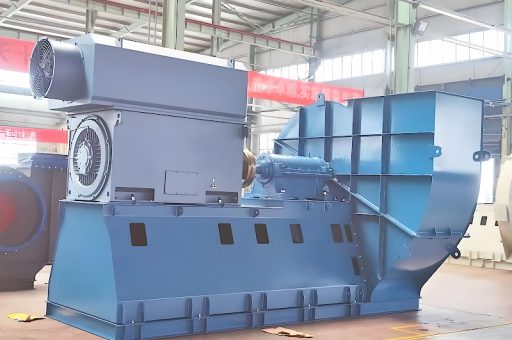
- "16Mn" (Material)
- "V-Belt Driven"
- "Backward Cement Kiln"
- "Cement Kiln High Pressure Blower Fan"
- Why this specific combination is used in Cement Plants:
- Potential Issues & Maintenance Concerns:
- In a typical industrial catalog or inquiry, this would be specified as:
It appears you are describing a very specific piece of heavy industrial equipment. Let's break down the components of that description to understand exactly what this machine is and where it is used.
Summary: This is a large, specialized centrifugal fan designed to provide high-pressure combustion air to a cement kiln (specifically a "backward" or counter-flow type). It is driven by an electric motor via V-belts and the fan impeller is made from 16Mn steel.
Here is a detailed analysis of each component:
"16Mn" (Material)
- What it is: This is a Chinese standard designation for a low-alloy, high-strength structural steel. It is approximately equivalent to Q345B (China) or A572 Grade 50 (USA) / S355JR (EU).
- Why it's used: 16Mn offers a good balance of strength (yield strength ~345 MPa) and weldability. For a high-pressure fan impeller (the spinning part), this material is necessary to withstand the centrifugal stresses of high-speed rotation and the pressure differential. It is more durable than standard carbon steel but less expensive than stainless steel, which is ideal for the high-volume, semi-clean air found in a cement kiln blower.
"V-Belt Driven"
- What it means: The fan is not directly connected to the motor shaft. Instead, pulleys on the motor and fan are connected by V-belts.
- Why it's used:
- Speed Control: It allows the fan to run at a different speed than the motor. In high-pressure fans, the optimal fan speed (RPM) is often lower than a standard motor's speed. The pulley ratio determines the final speed.
- Torque Transfer: V-belts are effective at transmitting high torque.
- Safety & Maintenance: The belts act as a mechanical fuse. If the fan jams, the belts can slip or break, protecting the motor from overload. It also allows for slight misalignment between the motor and fan shaft.
- Cost: Pulley and belt systems are generally less expensive than a direct-coupled gearbox for this power range.
"Backward Cement Kiln"
- What it means: This is the most critical process term. In a cement plant, the kiln is a rotating, slightly inclined cylinder where raw meal is heated to over 1400°C to form clinker.
- Backward (Counter-Current): The fan is likely part of the Preheater system. In a modern preheater tower, hot gases from the kiln flow upward through a series of cyclones. The raw meal moves downward (backward) against the gas flow to be preheated. This fan is the Induced Draft (ID) Fan or Kiln Exhaust Fan, which pulls hot gases from the kiln through the preheater and into the pollution control system.
- Alternative: It could be a Primary Air Fan blowing air into the kiln burner pipe, but "backward" more strongly suggests the gas flow direction in the preheater.
"Cement Kiln High Pressure Blower Fan"
- What it means: This is the functional description.
- High Pressure: This fan must overcome significant resistance (static pressure) from the preheater cyclones, ductwork, and the kiln flame. "High pressure" in this context typically means 6,000 to 10,000 Pa (Pascals) or higher. It is not a low-pressure ventilation fan.
- Blower Fan: This is a specific type of centrifugal fan design. It typically has a radial or backward-curved blade design to generate high pressure efficiently.
- Role: It is the prime mover for the kiln's combustion air supply and gas exhaust system.
Why this specific combination is used in Cement Plants:
- Process Requirement: Cement kilns need a massive, consistent, and high-pressure flow of air to maintain the flame temperature and push gases through the restrictive preheater tower.
- Reliability: The fan must run for months at a time (cement plants run continuously). The 16Mn steel provides fatigue resistance. The V-belt drive allows for quick belt replacement (hours) instead of a motor or gearbox rebuild (days).
- Efficiency: A correctly designed backward-curved (or airfoil) fan blade is highly efficient for this pressure range, reducing electricity costs.
- Temperature Tolerance: Depending on its exact location (e.g., ID fan vs. cooling fan), this fan may handle hot, dusty gases. The material choice helps manage thermal stress.
Potential Issues & Maintenance Concerns:
- Abrasion: If the fan is handling raw gas (before a baghouse), the dust is highly abrasive. The impeller blades and housing will wear down over time, requiring hard-facing or replacement.
- Vibration: High-speed, high-pressure fans are sensitive to imbalance. Any material buildup (dust caking) on the blades or uneven wear causes severe vibration, damaging bearings and the V-belt drive.
- Belt Tension: The V-belts must be tensioned correctly. Too loose, they slip and fail. Too tight, they overload the motor and fan bearings.
- High Temperature: If the fan is for hot gas, the shaft can conduct heat to the bearings. Special cooling fins, heat slingers, or even forced-air cooling are needed to prevent bearing failure.
In a typical industrial catalog or inquiry, this would be specified as:
"Centrifugal Fan, Double Inlet, Single Width (DIDW), 16Mn Impeller, Backward-Curved Blades, V-Belt Drive, 100,000 m³/hr, 8500 Pa, 250°C."
Conclusion: You have described a high-reliability, high-cost, critical-path piece of equipment in a cement plant. Its failure (e.g., a destroyed bearing or a cracked 16Mn impeller) would shut down the entire kiln line for days, costing tens of thousands of dollars per day. Maintenance and balancing are paramount.





