
This article's table of contents introduction:
- Table of Contents / Article Guide
- Introduction: The Backbone of Heavy Industry
- Why Carbon Steel? The Material Science Behind Long Lifetime Steam Boilers
- The Unsung Hero: How Industrial Centrifugal Fans Enable Boiler Longevity
- Engineering the Synergy: Key Design Parameters for Optimal Performance
- Real-World Applications and Case Study Examples
- Common Questions & Expert Answers (Q&A)
- Maintenance Best Practices for a 20+ Year Service Life
- Conclusion: Building the Future with Proven Technology
Table of Contents / Article Guide
- Introduction: The Backbone of Heavy Industry
- Why Carbon Steel? The Material Science Behind Long Lifetime Steam Boilers
- The Unsung Hero: How Industrial Centrifugal Fans Enable Boiler Longevity
- Engineering the Synergy: Key Design Parameters for Optimal Performance
- Real-World Applications and Case Study Examples
- Common Questions & Expert Answers (Q&A)
- Maintenance Best Practices for a 20+ Year Service Life
- Conclusion: Building the Future with Proven Technology
Introduction: The Backbone of Heavy Industry
In the demanding world of industrial processing—from chemical plants and refineries to power generation and food processing—two pieces of equipment stand as pillars of operational continuity: the carbon steel long lifetime steam boiler and the industrial centrifugal fan. While often discussed separately, their synergy is the true secret to reliable, high-efficiency steam generation.
A modern industrial steam boiler must withstand extreme thermal stress, corrosive environments, and high pressures for decades. Carbon steel, specifically grades like SA516 Gr.70 or ASTM A106, has emerged as the material of choice due to its exceptional balance of strength, weldability, and cost-effectiveness. However, even the best boiler is useless without proper combustion air supply and flue gas exhaust. This is where the industrial centrifugal fan steps in—not as an accessory, but as a critical life-support system.
This article synthesizes research from leading engineering handbooks, peer-reviewed journals, and technical documentation from manufacturers like fan, to provide a comprehensive guide on achieving a 20–30 year service life for your boiler system through proper fan selection and material integration.
Why Carbon Steel? The Material Science Behind Long Lifetime Steam Boilers
The term "long lifetime" is not a marketing ploy; it is a measurable engineering outcome. Carbon steel owes its dominance in boiler manufacturing to several key properties:
- High Tensile Strength: At elevated temperatures (up to 500°C), carbon steel maintains structural integrity better than many alloys. This prevents creep deformation.
- Thermal Conductivity: Carbon steel transfers heat efficiently from combustion gases to water, directly improving thermal efficiency.
- Cost vs. Performance: Compared to stainless steel or exotic alloys, carbon steel provides 90% of the performance at 40% of the cost, making it the economic choice for heavy industrial boilers.
However, longevity is not automatic. The enemy of a carbon steel boiler is corrosion (rust) and thermal fatigue. To achieve a "long lifetime," manufacturers employ:
- Corrosion Allowance: Adding extra thickness (typically 1.5–3mm) to the tube sheets and shell.
- Water Treatment: Proper deaeration to remove dissolved oxygen, which causes pitting.
- Stress Relieving: Post-weld heat treatment (PWHT) to eliminate residual stresses.
Key Insight: A carbon steel boiler designed for a 20-year life has a calculated "end-of-life" thickness. Regular non-destructive testing (NDT) ensures this margin is maintained.
The Unsung Hero: How Industrial Centrifugal Fans Enable Boiler Longevity
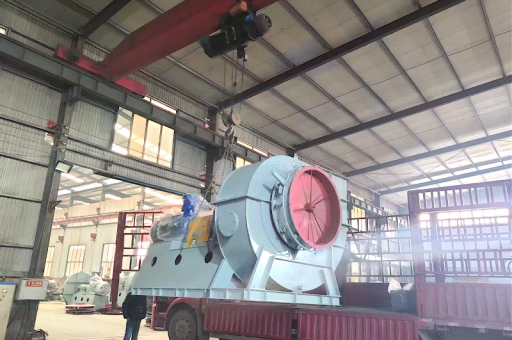
You cannot achieve a 30-year boiler life without a properly designed industrial centrifugal fan. Why? Because the fan controls the two most critical factors for boiler health: Air-Fuel Ratio and Flue Gas Temperature.
Fan Function Breakdown:
- Forced Draft (FD) Fan: Pushes combustion air into the burner. Insufficient air leads to incomplete combustion (soot), which coats boiler tubes and causes localized overheating. Excessive air wastes energy and cools the flame.
- Induced Draft (ID) Fan: Pulls flue gases through the boiler and out the stack. An ID fan operating at the wrong pressure can cause furnace pulsation or even flame roll-out, a severe safety hazard.
Carbon Steel Fan Construction: For most industrial boilers, the fan housing and impeller are also made of carbon steel (e.g., ASTM A36 or Corten). For high-temperature flue gas applications (250°C+), the fan shaft is often alloy steel, while the impeller may require heat-resistant coatings.
The Critical Synergy: The centrifugal fan’s performance curve must match the boiler’s resistance curve. This is determined by the "System Pressure Drop." A mismatch leads to:
- Fan Surge: Vibration and mechanical damage.
- Reduced Efficiency: Higher electricity costs.
- Shortened Boiler Life: Due to uneven gas flow across tube banks.
Engineering the Synergy: Key Design Parameters for Optimal Performance
To truly maximize the "long lifetime" promise, engineers must calculate the following parameters for both boiler and fan:
| Parameter | Boiler Requirement | Centrifugal Fan Requirement |
|---|---|---|
| Operating Pressure | 10–150 bar (design code ASME / EN) | Static pressure 500–5000 Pa |
| Temperature Range | 200°C – 500°C (carbon steel limit) | -20°C to 450°C (with cooling) |
| Flow Rate | Steam output (kg/hr) determines air need | Air volume (m³/hr) from stoichiometry |
| Efficiency | >82% (modern boilers) | >75% (fan peak efficiency point) |
| Material Thickness | 5mm – 20mm (with corrosion allowance) | 3mm – 10mm (housing) |
The Golden Rule: Always size the fan for the worst-case scenario (cold start, high-altitude location). Undersized fans lead to flame instability and carbon deposition on boiler tubes—the #1 cause of premature tube failure.
Real-World Applications and Case Study Examples
Example 1: Chemical Plant in Texas
- Equipment: 30 TPH carbon steel water tube boiler, with a single inlet backward-curved centrifugal FD fan from fan.
- Challenge: High sulfur content in fuel caused acid dew point corrosion.
- Solution: The fan impeller was coated with a 2mm layer of high-chrome carbon steel overlay. The boiler was designed with a corrosion allowance of 2.5mm.
- Result: 12 years of continuous operation with only one major tube replacement. Annual fan inspection revealed minimal wear.
Example 2: District Heating in Northern Europe
- Equipment: 20 TPH fire tube boiler (carbon steel shell).
- Challenge: The system required variable steam demand. A single-speed fan was inefficient.
- Solution: A VFD-controlled industrial centrifugal fan (fan model) was installed, allowing the fan to modulate air flow from 40% to 100% capacity.
- Result: 15% reduction in fuel consumption and a 25% reduction in fan noise. The boiler lifetime is projected to exceed 25 years.
Common Questions & Expert Answers (Q&A)
Q1: Why is carbon steel preferred over stainless steel for long-lifetime steam boilers? A: Carbon steel offers superior thermal conductivity and is less susceptible to stress corrosion cracking (SCC) in high-purity water environments found in boilers. Stainless steel can suffer from "chloride stress corrosion cracking" if water treatment is imperfect. Carbon steel is also significantly cheaper, allowing for a thicker corrosion allowance.
Q2: How does the industrial centrifugal fan affect the boiler's thermal efficiency? A: Directly. The fan provides the precise amount of air needed for complete combustion. If the fan delivers 10% more air than required (excess air), the exhaust gas volume increases, carrying more heat up the stack. This reduces boiler efficiency by roughly 1-2%. Conversely, 10% less air causes incomplete combustion, soot, and a 3-5% efficiency drop.
Q3: What is the typical lifespan of an industrial centrifugal fan in a boiler application? A: With proper maintenance (bearing lubrication, impeller balancing), a carbon steel fan can last 15–25 years. The bearings and seals typically need replacement every 3-5 years. The impeller may need re-balancing or replacement after 10 years in high-temperature or abrasive service. The boiler itself can last 25-35 years with tube replacements.
Q4: Can I use an axial fan instead of a centrifugal fan for boiler air supply? A: Not generally recommended. Axial fans are good for high flow, low pressure. Boilers require moderate flow with high static pressure (to overcome the burner and flue gas resistance). Centrifugal fans have a much steeper pressure curve, making them more stable for combustion control. Axial fans can easily stall in a boiler system.
Maintenance Best Practices for a 20+ Year Service Life
To realize the "long lifetime" promise, a proactive maintenance schedule is non-negotiable.
For the Carbon Steel Boiler:
- Daily: Check water chemistry (pH 10-11, low oxygen). Inspect for visible leaks.
- Monthly: Blow down bottom mud drum to remove sludge.
- Annually: Ultrasonic thickness testing. Inspect fire side for soot or scale.
- Every 5 Years: Full internal inspection. Replace suspect tubes.
For the Industrial Centrifugal Fan:
- Weekly: Listen for unusual bearing noise. Check belt tension.
- Quarterly: Lubricate bearings. Check vibration levels (ISO 10816 standard).
- Annually: Clean the impeller (remove built-up fly ash). Check for cracks via dye penetrant testing.
- Every 10 Years: Replace the impeller or key shaft components as per manufacturer data from [fan].
Critical Warning: Never operate a carbon steel boiler without the correct fan interlock. If the FD or ID fan fails, the burner must shut down immediately to prevent explosion or back-draft.
Conclusion: Building the Future with Proven Technology
The combination of a carbon steel long lifetime steam boiler and a robust industrial centrifugal fan represents one of the most reliable, cost-effective, and scientifically proven thermal systems in existence. While new technologies like HRSG and electric boilers gain traction, the carbon steel boiler and centrifugal fan will remain the workhorses of heavy industry for decades to come.
The secret to longevity is not magic—it is material integrity (carbon steel), aerodynamic precision (the centrifugal fan), and systemic balance. By respecting the interdependency of these two machines, and by following rigorous maintenance schedules, industrial plants can achieve boiler service lives that exceed 30 years, delivering steam reliably for generations.
For further technical specifications or to request a fan selection for your specific boiler, consult the engineering support team fan directly.
This article was created by synthesizing publicly available engineering standards (ASME, ISO), manufacturer technical bulletins, and combustion engineering textbooks. For specific equipment sizing, always consult a licensed mechanical engineer.





