
This article's table of contents introduction:
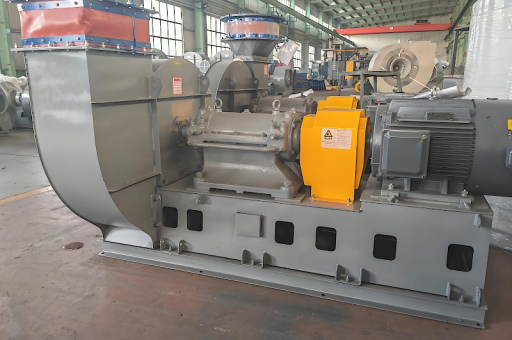
- Q345 (Material Specification)
- Coupling Driven
- Antiwear Metallurgy
- Industrial Centrifugal Blower
- The "Complete Picture" Application
- Benefits of this Specific Combination
- Potential Drawbacks / Considerations
Based on the keywords you've provided, here is a breakdown of what this specific industrial equipment combination entails. The phrase describes a heavy-duty, high-performance centrifugal blower designed for demanding industrial environments where wear resistance is critical.
Let's break down the specification:
Q345 (Material Specification)
- What it is: Q345 is a Chinese standard (GB/T) low-alloy high-strength structural steel. It is roughly equivalent to ASTM A572 Grade 50 or S355JR (European standard).
- Why it's used: It offers a higher yield strength (345 MPa minimum) and better weldability than standard carbon steel (like Q235). This makes the blower housing, impeller, and shaft more robust, allowing it to handle higher pressures and stresses without deforming.
- Significance: This material choice indicates the blower is built for heavy-duty continuous operation, not light-duty HVAC.
Coupling Driven
- What it means: The blower wheel (impeller) is not directly mounted on the motor shaft. Instead, the motor and the blower are separate units connected by a spacer coupling (often a flexible coupling).
- Why it's used:
- Serviceability: You can remove the motor without disturbing the blower or its piping.
- Heat Isolation: Protects the motor bearings from heat conducted down the blower shaft (critical for high-temp or hot air applications).
- Speed Control: Allows for the use of belt drives (v-belt or timing belt) in addition to direct drive options.
Antiwear Metallurgy
- What it means: This is the most critical "value-add" feature. Standard centrifugal fans wear quickly when handling abrasive particles (dust, sand, metal shavings, cement, fly ash). "Antiwear metallurgy" refers to specific materials and treatments used in the blower's construction.
- How it's achieved:
- Hardened Impeller: The impeller blades are often made from wear-resistant steel (e.g., Hardox, NM400, or proprietary alloys) or treated with thermal spray coatings (e.g., tungsten carbide, chromium carbide).
- Thicker Sections: The impeller and housing walls are thicker than standard models.
- Replaceable Liners: The housing (volute) often has replaceable wear plates made of abrasion-resistant materials.
- Shaft Hardening: The shaft where it passes through the packing gland or seal is hardened or sleeved.
Industrial Centrifugal Blower
- What it is: The fundamental type of fan. It uses a rotating impeller to increase the pressure and velocity of air or gas.
- Types within this category (likely):
- Radial Blade (Paddle Wheel): Excellent for handling sticky or dusty materials. High wear resistance.
- Backward Inclined (Airfoil/Flat): More efficient, but less tolerant of severe dust loads. Often used for cleaner air but requiring high pressure.
The "Complete Picture" Application
This combination (Q345 + Coupling + Antiwear Metallurgy) points to a blower serving in a harsh, high-wear environment. Typical applications include:
- Cement Plants: Pneumatic conveying of cement, raw meal, or clinker; kiln ID fans.
- Steel Mills: Blowing air for blast furnaces; fume extraction containing hot, abrasive metallic particles.
- Mining & Mineral Processing: Mine ventilation and dust collection; conveying ore concentrates.
- Wood Processing: Chip handling, dust extraction for sanding machines.
- Chemical Processing: Handling corrosive and abrasive gases or granular materials.
Benefits of this Specific Combination
- Extended Service Life: The antiwear metallurgy significantly increases the Mean Time Between Failures (MTBF) compared to a standard carbon steel fan.
- Structural Integrity: Q345 steel provides the strength to handle high pressures and resist fatigue cracking.
- Motor Protection: The coupling drive isolates the motor from shock loads and thermal expansion from the fan.
- Reduced Maintenance: While the wear parts are robust, the coupling design makes replacing the motor or shaft seals easier and faster.
Potential Drawbacks / Considerations
- Cost: Higher initial cost compared to standard mild steel fans.
- Weight: These blowers are heavy, requiring strong foundations and lifting equipment for installation.
- Balance: Radial blade impellers (common for antiwear service) are generally less energy-efficient than backward-inclined airfoil impellers.
In summary: You are looking at a robust, long-lasting, high-power industrial blower, built like a tank, specifically designed to survive in environments that would rapidly destroy a standard commercial fan. It is an engineered solution for air or gas that contains abrasive solids.





