
This article's table of contents introduction:
- Understanding the Application: Smoke Exhaust
- The AC Motor: Types and Efficiency
- Energy Efficiency: Where the Savings Are
- Key Components of an Industrial Centrifugal Smoke Exhaust Fan
- Selection Criteria (Checklist)
- Energy Efficiency Summary (Compared to Standard Fans)
- Real-World Example
- Recommendation
It appears you are looking for information on industrial centrifugal smoke exhaust fans, specifically those driven by AC motors with a focus on energy efficiency.
This is a critical application in fire safety, HVAC, and industrial ventilation. Below is a comprehensive breakdown covering how these fans work, the key components that define their energy efficiency, and what to look for when selecting one.
Understanding the Application: Smoke Exhaust
The primary difference between a standard fan and a smoke exhaust fan is its High Temperature Rating. These fans must operate reliably at extreme temperatures (typically 300°C for 2 hours or 400°C for 2 hours, per standards like UL 762 or EN 12101-3).
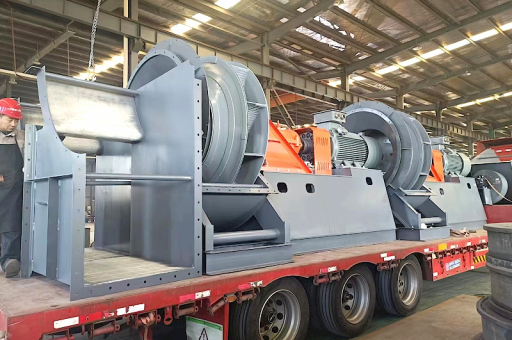
Crucial requirement: The motor must be out of the airstream (belt-driven or direct-drive with a heat shield) to prevent overheating and failure during a fire. A standard motor in the airstream would seize up.
The AC Motor: Types and Efficiency
While EC (Electronically Commutated) motors are gaining popularity for their efficiency at variable speeds, AC motors remain the standard for industrial, high-reliability smoke exhaust due to their robustness and lower initial cost.
- IE3 (Premium Efficiency) & IE4 (Super Premium Efficiency) Motors: These are the standard for new industrial installations. They use higher-grade steel and copper to reduce electrical losses.
- Single-Speed vs. Multi-Speed: Most smoke exhaust fans use a single-speed AC motor (2-pole for ~2900 RPM or 4-pole for ~1450 RPM).
- Variable Frequency Drives (VFDs): While AC motors are inherently fixed-speed, pairing them with a VFD allows for variable airflow. This is the single biggest contributor to energy efficiency in a system.
Energy Efficiency: Where the Savings Are
Energy efficiency for a centrifugal fan is not just about the motor; it is about the system's efficiency (Fan + Motor + Control).
A. Fan Impeller Design (The Air Mover)
- Backward-Curved (BC) / Airfoil: Most efficient for high-pressure, high-volume smoke exhaust. Designed to run at high speeds without overloading the motor.
- Radial / Paddle Wheel: Less efficient (lower static efficiency), but self-cleaning and better for dirty, particulate-laden exhaust.
- Forward-Curved (Squirrel Cage): Moderate efficiency but prone to overheating motors in smoke applications if not properly matched.
Efficiency Tip: For energy efficiency, Backward-Curved (BC) impellers are the gold standard.
B. Motor Efficiency
- IE4 Motors can be 2-4% more efficient than IE2 motors. Over a 100 HP fan running 8,000 hours a year, this is significant.
- Motor Cooling: In a smoke exhaust fan, the motor is typically in a cool air environment (outside the duct or on a belt-driven base). This allows it to maintain its rated efficiency without thermal derating.
C. System Control (VFD)
- The Law of Affinity: Fan power is proportional to the cube of the speed. Reducing fan speed by 20% reduces energy consumption by almost 50%.
- Duty Cycle: Smoke exhaust fans are typically for emergency use (S2 duty). However, many are used for dual-purpose (daily ventilation + smoke exhaust). For daily ventilation, a VFD is essential to match airflow to demand, saving massive amounts of energy.
Key Components of an Industrial Centrifugal Smoke Exhaust Fan
| Component | Standard Requirement | Energy Efficient Feature |
|---|---|---|
| Impeller | Steel, corrosion-resistant | Backward-curved or Airfoil design (High static efficiency) |
| Motor | TEFC (Totally Enclosed Fan Cooled) | IE4 (Super Premium) efficiency class |
| Drive | Belt or Direct | Premium V-belts (less slip) or Direct Drive (no belt loss) |
| Drive Control | Across-the-line starter | VFD (for variable volume / dual-duty operation) |
| Casing & Inlet | Steel cone | Inlet cone (smooth air entry reduces turbulence & noise) |
| Dampers | Motorized shutters | Low-leakage, low-pressure drop dampers |
Selection Criteria (Checklist)
When specifying a AC Motor Energy Efficient Smoke Exhaust Centrifugal Fan, ensure you have the following:
- Certifications:
- UL 762 (USA) or EN 12101-3 (EU) for smoke & heat control.
- ISO 5801 for fan performance testing.
- Temperature Class:
- F300 (300°C for 2 hours)
- F400 (400°C for 2 hours)
- Motor Efficiency:
- Specify IE4 (IEC) or NEMA Premium (NEMA).
- Application:
- Duty: S2 (Emergency) or S1 (Continuous).
- Particles: Clean, dusty, or sticky.
Energy Efficiency Summary (Compared to Standard Fans)
| Feature | Standard Fan | Energy Efficient Fan | Typical Savings |
|---|---|---|---|
| Motor | IE2 (Standard) | IE4 (Premium) | 15-20% reduction in motor losses |
| Impeller | Forward-Curved | Backward-Curved | 10-15% higher fan static efficiency |
| Speed Control | Across-the-line | VFD + BC Impeller | 30-50% (if used for daily ventilation) |
| Drive Belts | Standard V-Belt | Cogged / Synchronous Belt | 2-5% reduction in drive losses |
Real-World Example
- Scenario: A factory needs to exhaust 50,000 CFM of hot smoke.
- Standard Fan: 75 HP AC motor, IE2, Forward-Curved impeller.
- Efficient Fan: 60 HP AC motor, IE4, Backward-Curved impeller, VFD for daily low-speed operation.
- Annual Energy (Daily Use): The efficient fan would use ~40% less electricity for the same airflow during normal ventilation mode.
Recommendation
For a high-performance, energy-efficient smoke exhaust system, choose:
- Fan Type: Centrifugal, Backward-Curved.
- Motor: IE4 (Super Premium) AC motor, TEFC, mounted out of the airstream.
- Drive: Belt-driven with cogged V-belts or a synchronous belt.
- Control: VFD (if a dual-purpose fan) or standard start (if emergency only).
Would you like specific brand recommendations (e.g., Greenheck, Twin City, Howden, New York Blower) or help calculating the total cost of ownership for a specific project?





