
This article's table of contents introduction:
- Deconstructing the Terminology
- Common Applications
- Critical Engineering Features
- Key Performance Parameters to Specify
- Leading Manufacturers
- Summary
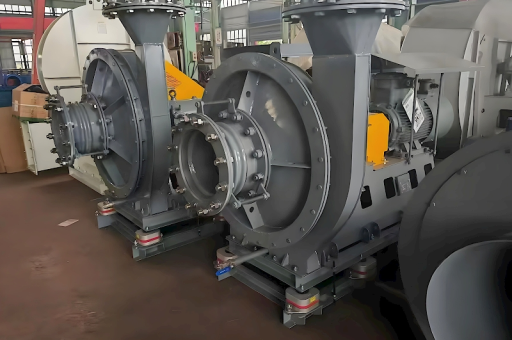
Based on your keywords, you are describing a specialized industrial fan designed for harsh, dangerous, and high-temperature environments. This is a niche but critical piece of equipment often found in power plants, chemical processing, steel mills, and cement plants.
Here is a detailed breakdown of what these terms mean individually and collectively, along with key specifications you should look for.
Deconstructing the Terminology
- High Temp Flue Gas Fan: This fan handles exhaust gases from combustion processes (boilers, furnaces, incinerators). These gases are typically hot (200°C to 600°C+), corrosive (containing sulfur, chlorine), and abrasive (containing fly ash). The fan must be built with materials that resist thermal expansion and corrosion.
- High Pressure Centrifugal Blower: "Centrifugal" means air enters axially and is expelled radially by a rotating impeller. "High Pressure" means the fan is designed to overcome significant system resistance (ductwork, scrubbers, baghouses). These are typically radial-bladed or backward-inclined fans with heavy-duty shafts and bearings.
- Explosion Proof: This is a safety certification, not a performance spec. It means the fan is designed and built to contain an internal explosion without igniting the surrounding atmosphere. This is crucial when handling flammable gases (e.g., CO, methane, hydrogen) or combustible dusts (e.g., coal dust, carbon black).
Common Applications
This combination of features is mandatory in:
- Thermal Power Plants: Induced Draft (ID) fans pulling hot, dusty flue gas from boilers.
- Cement Plants: Exhaust fans for rotary kilns handling hot, abrasive gases.
- Chemical/Petrochemical: Handling process off-gases, vapors from reactors, or air from hazardous areas (Class I, Division 1 or 2).
- Waste-to-Energy (Incineration): Moving corrosive, high-temperature combustion gases.
- Steel Mills: Furnace exhaust and fume extraction.
Critical Engineering Features
When specifying or designing such a fan, key features include:
| Feature | Why it matters for your keyword |
|---|---|
| Impeller Design | Radial-tipped or Flat-bladed impellers are best for high temperatures and abrasive dust. Backward-inclined for higher efficiency but less tolerance for heavy dust. |
| Material | Carbon Steel for low temps. Corten/Weathering Steel for corrosion. Stainless Steel (304/316L) for high corrosion/temps. Hastelloy/Inconel for extreme temp + corrosion. |
| Shaft Sealing | Air or Purge Seals to prevent hot, flammable gas from leaking out of the shaft opening (a common ignition source). |
| Bearing Cooling | Water-cooled or oil-cooled bearing housings are often required for flue gas temps above 200°C to prevent lubricant failure. |
| Drive System | Direct drive (shaft-mounted motor) for low maintenance. V-belt drive for speed/torque flexibility (but belts can generate static and require explosion-proof conduit). Variable Frequency Drive (VFD) for energy savings. |
| Explosion Proof Enclosure | Motor must be ATEX/IECEx or UL/CSA rated for the specific gas/dust group (e.g., IIB for ethylene, IIC for hydrogen/acetylene). Fan housing must be pressure-rated and have a shaft grounding brush to prevent sparking. |
| Vibration Monitoring | Essential for predictive maintenance on high-speed/high-temp fans. Accelerometers on bearing housings. |
Key Performance Parameters to Specify
To get a correct quote, you must provide these to a manufacturer:
- Gas Flow Rate: (e.g., 50,000 m³/h or 30,000 CFM)
- Static Pressure: (e.g., 5,000 Pa or 20 in. w.g.)
- Gas Temperature: Normal and Maximum (e.g., 250°C normal, 350°C peak).
- Gas Composition: % of O2, CO, H2, SO2, dust content, moisture.
- Ambient Conditions: Site altitude and temperature.
- Explosion Proof Classification: (e.g., ATEX II 2G Ex d IIC T4 or Class I, Div 1, Group D)
- Material of Construction: (e.g., SS304L for impeller and casing).
Leading Manufacturers
Companies that specialize in this tough market sector:
- Howden (now part of Chart Industries)
- Robinson Fans
- New York Blower (NYB)
- Cincinnati Fan
- Chicago Blower
- Twin City Fan
- Ziehl-Abegg (European)
Summary
A High Temp Flue Gas Fan High Pressure Centrifugal Blower Explosion Proof is a purpose-built, rugged machine. It is not a standard HVAC fan. It requires careful engineering for thermal expansion, material corrosion, bearing cooling, and hazardous area compliance. Do not attempt to use a standard fan for this application – the risk of catastrophic failure (fire, explosion, bearing seizure) is very high.





