
This article's table of contents introduction:
- Introduction: The Evolution of Induced Draft Fans
- What Is a High Strength Steel Induced Draft Fan?
- The Flat Performance Curve: Why It Matters
- Material Advantages: High Strength Steel vs. Traditional Options
- Key Industrial Applications
- Design and Engineering Considerations
- Frequently Asked Questions (FAQ)
- Conclusion: Future Trends and Selection Tips
High Strength Steel Induced Draft Fan With Flat Performance Curve: Design, Benefits, and Industrial Applications**
Table of Contents
- Introduction: The Evolution of Induced Draft Fans
- What Is a High Strength Steel Induced Draft Fan?
- The Flat Performance Curve: Why It Matters
- Material Advantages: High Strength Steel vs. Traditional Options
- Key Industrial Applications
- Design and Engineering Considerations
- Frequently Asked Questions (FAQ)
- Conclusion: Future Trends and Selection Tips
Introduction: The Evolution of Induced Draft Fans
Induced draft (ID) fans are critical components in power plants, cement kilns, steel mills, and chemical processing facilities. Their primary role is to pull flue gases, hot air, or process exhaust through a system and expel them into the atmosphere or downstream treatment units. Traditionally, ID fans faced challenges such as corrosion, vibration, and performance instability under variable load conditions. The introduction of high strength steel induced draft fans with a flat performance curve has revolutionized this field. By combining advanced metallurgy with aerodynamic optimization, these fans deliver consistent flow, reduced energy consumption, and longer service life. This article explores their design, advantages, and real-world applications, while answering the most common questions from engineers and procurement professionals.
What Is a High Strength Steel Induced Draft Fan?
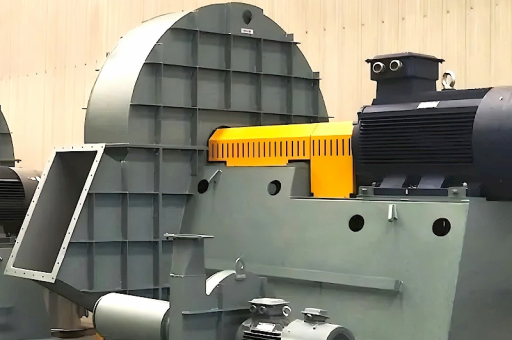
A high strength steel induced draft fan is a heavy-duty centrifugal or axial fan constructed from advanced high-strength low-alloy (HSLA) or quenched-and-tempered steel. These materials offer significantly higher yield strength and toughness compared to conventional carbon steel, allowing for thinner, lighter impellers and housing without sacrificing structural integrity. The fan is specifically designed to operate in the induced draft position (i.e., after the heat source or process equipment), handling hot, abrasive, and often corrosive gas streams.
Key characteristics include:
- Impeller and housing made from abrasion-resistant high strength steel
- Reinforced shaft and bearing assemblies for high torque and dynamic loads
- Optional wear liners and coatings for extended life in harsh environments
- A flat performance curve, meaning that the pressure rise remains nearly constant over a wide range of flow rates
This combination of material and aerodynamic design makes the fan highly reliable for applications with fluctuating process demands.
The Flat Performance Curve: Why It Matters
A flat performance curve (also called a stable or droop-free curve) means that as the system resistance changes—due to filter loading, damper adjustments, or temperature variations—the fan maintains a nearly constant pressure differential. This is in contrast to steep-curve fans, where a small change in flow can cause large pressure swings, leading to instability, surging, or mechanical stress.
Benefits of a flat performance curve include:
- Predictable operation: System designers can easily match fan output to process requirements without complex controls
- Energy efficiency: The fan operates closer to its best efficiency point (BEP) over a wider range of conditions
- Reduced maintenance: Less vibration and fewer transient loads extend bearing, seal, and impeller life
- Simpler control strategy: Variable frequency drives (VFDs) or inlet vanes can modulate flow with greater precision
This characteristic is especially valuable in induced draft applications where gas density, temperature, and particulate loading vary continuously.
Material Advantages: High Strength Steel vs. Traditional Options
| Material | Yield Strength (MPa) | Abrasion Resistance | Weight Savings | Cost |
|---|---|---|---|---|
| Carbon Steel (A36) | 250 | Low | Baseline | Low |
| Stainless Steel (304) | 205 | Medium | Similar | High |
| High Strength Steel (e.g., Hardox, T-1) | 700–1200 | High | 15–30% lighter | Moderate |
Critical benefits of high strength steel:
- Thinner sections reduce weight, lowering the load on foundations and drive trains
- Higher fatigue life under cyclic loading from start‑stop and variable flow
- Better impact resistance against flying debris and scale buildup
- Weldability and formability allow complex aerodynamic shapes without cracks
These properties directly contribute to the flat performance curve because the impeller maintains its aerodynamic profile under stress, preventing deflection that would alter airfoil shape.
Key Industrial Applications
Power Generation
- Boiler induced draft fans handling flue gas at 150–400°C
- High strength steel prevents creep deformation and corrosion from sulfur compounds
- Flat curve ensures stable draft during load changes from 30% to 100% capacity
Cement & Mineral Processing
- Kiln exhaust fans moving hot, dust-laden gas
- Abrasion-resistant steel extends impeller life by 2–3 times vs. standard steel
- Stable pressure allows precise baghouse or ESP operation
Steel Mills
- Fume exhaust systems for electric arc furnaces (EAF) or basic oxygen furnaces (BOF)
- High strength steel withstands thermal shock and mechanical vibration
- Flat curve maintains consistent capture velocity at hoods
Chemical & Petrochemical
- Process gas recirculation and vent gas handling
- Corrosion-resistant coatings on high strength substrate reduce downtime
Design and Engineering Considerations
To maximize the benefits of a high strength steel induced draft fan with a flat performance curve, engineers should consider:
- Aerodynamic profiling: Forward-curved or backward-inclined blades are designed for specific flow coefficients to achieve a flat curve.
- Structural analysis: Finite element analysis (FEA) ensures impeller and shaft stiffness to avoid resonance.
- Sealing and bearings: High-temperature shaft seals and oversized bearings handle thermal expansion and dust intrusion.
- Drive system: Direct coupling or belt drive selection must account for torque spikes during cold starts.
- Testing & certification: Performance curves should be verified per AMCA or ISO standards before installation.
Frequently Asked Questions (FAQ)
Q1: How does a flat performance curve improve fan reliability?
A1: It eliminates the risk of surging (flow reversal) during pressure fluctuations. The fan can operate safely at partial load without entering unstable zones, reducing mechanical stress on bearings, shafts, and blades.
Q2: Can a high strength steel ID fan handle corrosive gases?
A2: Yes. High strength steel can be combined with specialized coatings (e.g., epoxy, ceramic, or rubber lining) or used with corrosion-resistant alloys in critical areas. Regular inspection of protective layers is recommended.
Q3: Is the initial cost higher than a standard fan?
A3: The material cost is moderate, but total lifecycle cost is often lower due to reduced maintenance, longer intervals between overhauls, and energy savings from stable operation.
Q4: What maintenance is required for high strength steel impellers?
A4: Periodic visual inspection for cracks or erosion, balancing checks, and cleaning of blade surfaces. Hardness testing can detect fatigue. Typical overhaul intervals range from 3 to 6 years.
Q5: Can this fan be retrofitted into an existing system?
A5: Yes. Many manufacturers offer drop-in replacements with matched mounting dimensions and motor ratings. The flat curve often allows the same motor to handle broader flow ranges without overloading.
Q6: How do I select the correct size and speed?
A6: You need system resistance curves at normal and extreme conditions. A flat-curve fan with a specific speed (Ns) between 800 and 1500 is typical for induced draft. Consult the manufacturer’s selection software or expert.
Q7: Does high strength steel affect noise levels?
A7: The flat curve itself does not reduce noise, but the stiffer impeller reduces vibration-induced noise. Silencers and acoustic enclosures are still recommended for audible frequencies.
Conclusion: Future Trends and Selection Tips
The high strength steel induced draft fan with a flat performance curve is no longer a niche product—it is becoming the standard for demanding industrial processes. As environmental regulations tighten and energy costs rise, facilities are seeking equipment that offers both operational flexibility and longevity. The combination of high strength steel (for durability) and a flat performance curve (for stability) directly addresses these needs.
Selection tips:
- Always request certified performance curves for your operating range
- Consider total cost of ownership (purchase + installation + energy + maintenance) rather than upfront price
- Verify the manufacturer’s experience with your specific gas composition and temperature
- Plan for future capacity increases—the flat curve allows the same fan to handle broader conditions
By investing in this technology, industries achieve lower downtime, predictable performance, and significant energy savings. For customized solutions, consult with a fan engineering specialist who can model your system and recommend the optimal high strength steel fan configuration.
This article is based on technical literature, industry standards (AMCA, ISO, DIN), and field experience from power generation, cement, metallurgy, and chemical process sectors.





