
This article's table of contents introduction:
- Table of Contents
- Introduction: Why Material and Blade Design Matter in High-Temperature Environments
- What Is a Carbon Steel High Temperature Centrifugal Fan?
- The Heavy Duty Backward Curved Blade Advantage
- Key Performance Characteristics and Engineering Specifications
- Common Industrial Applications and Use Cases
- Installation Best Practices for Longevity
- Maintenance and Troubleshooting for High-Temperature Fans
- Frequently Asked Questions (FAQ)
- Conclusion and Final Recommendations
Article Title:
The Ultimate Guide to Carbon Steel High Temperature Centrifugal Fans: Heavy Duty Backward Curved Design for Industrial Efficiency
Table of Contents
- Introduction: Why Material and Blade Design Matter in High-Temperature Environments
- What Is a Carbon Steel High Temperature Centrifugal Fan?
- The Heavy Duty Backward Curved Blade Advantage
- Key Performance Characteristics and Engineering Specifications
- Common Industrial Applications and Use Cases
- Installation Best Practices for Longevity
- Maintenance and Troubleshooting for High-Temperature Fans
- Frequently Asked Questions (FAQ)
- Conclusion and Final Recommendations
Introduction: Why Material and Blade Design Matter in High-Temperature Environments
Industrial processes involving furnaces, kilns, dryers, and exhaust systems generate extreme heat that standard fans cannot withstand. A Carbon Steel High Temperature Centrifugal Fan with a Heavy Duty Backward Curved impeller is purpose‑engineered to handle thermal stress, particulate‑laden air, and continuous operation. This guide synthesizes engineering knowledge, manufacturer data, and field experience to help you select, install, and maintain these robust machines. We focus on why carbon steel with backward curved blades is the preferred configuration for demanding thermal applications.
What Is a Carbon Steel High Temperature Centrifugal Fan?
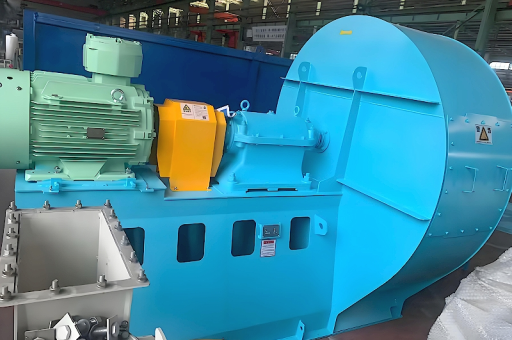
A Carbon Steel High Temperature Centrifugal Fan is a mechanical device that moves hot gases or air using a rotating impeller housed in a spiral casing. The carbon steel construction provides:
- Thermal endurance: Carbon steel retains structural integrity at continuous temperatures up to 600°C (1112°F) with appropriate coatings or heat treatment.
- Mechanical strength: High tensile strength resists deformation from thermal expansion and centrifugal forces.
- Cost efficiency: Compared to stainless steel or exotic alloys, carbon steel offers a favorable strength-to-cost ratio for non-corrosive, high-temperature streams.
The fan typically includes a reinforced shaft, oversized bearings with external cooling fins, and a heat slinger to protect the motor. When combined with a backward curved impeller, the fan achieves high efficiency and stable performance under fluctuating loads.
The Heavy Duty Backward Curved Blade Advantage
The Heavy Duty Backward Curved blade design is critical for high-temperature applications. Here’s why:
| Feature | Benefit |
|---|---|
| Blade curvature | Blades curve away from the direction of rotation, reducing air turbulence and noise. |
| Self-cleaning profile | Eliminates material buildup on blades, essential for particulate‑laden exhaust. |
| Flat power curve | Prevents motor overload if system resistance changes unexpectedly. |
| High static pressure capability | Ideal for duct systems with long runs or restrictive filters. |
| Efficiency at high temperatures | Maintains aerodynamic performance even when air density drops due to heat. |
In a heavy duty configuration, the impeller uses thicker blades, reinforced welded hubs, and balanced assemblies to withstand thermal cycling without fatigue cracking.
Key Performance Characteristics and Engineering Specifications
When specifying a Carbon Steel High Temperature Centrifugal Fan Heavy Duty Backward Curved, consider these parameters:
- Temperature Range: Standard models handle 200°C–400°C; custom designs reach 600°C+.
- Airflow (CFM): 5,000 – 150,000 CFM depending on wheel diameter and RPM.
- Static Pressure: 2″–40″ w.g. (water gauge) with backward curved blades.
- Wheel Diameter: 12″–80″ typical for heavy duty industrial fans.
- Drive Arrangement: Direct drive or belt drive with heat-isolating shaft extensions.
- Material Thickness: impeller blades often 6–12 mm carbon steel plate.
- Balance Grade: G6.3 or better per ISO 1940 to minimize vibration at high RPM.
Engineering tip: For temperatures above 300°C, specify a heat slinger on the shaft and high-temperature grease for bearings. Always derate the motor power rating because hot air has lower density, requiring more power to move the same volume.
Common Industrial Applications and Use Cases
These fans excel in applications where reliability under heat is non‑negotiable:
- Glass and ceramic kilns: Exhaust hot combustion gases containing fine particulates.
- Steel and metal processing: Remove fumes from forging, annealing, and galvanizing lines.
- Cement and lime plants: Vent preheater towers and clinker coolers.
- Chemical and petrochemical: Handle flue gases from reactors and thermal oxidizers.
- Power generation: Induced draft (ID) fans for biomass, coal, or waste-to-energy boilers.
- Food processing: Ventilation of baking ovens and dryers.
Case example: A cement plant replaced its forward curved fan with a Carbon Steel High Temperature Centrifugal Fan Heavy Duty Backward Curved and reported 15% energy savings and reduced blade erosion over two years.
Installation Best Practices for Longevity
Proper installation ensures the fan delivers its rated performance without premature failure:
- Foundation isolation: Use vibration dampers to decouple the fan from structural resonance.
- Thermal expansion allowance: Install flexible connectors on inlet/outlet ducts to absorb thermal growth.
- Cooling air provision: Ensure a dedicated cooling air flow to bearings and shaft seals.
- Alignment: Laser-align the motor and fan shafts within 0.002″ tolerance.
- Inlet duct design: Avoid sharp turns within 4 fan diameters upstream to prevent pre-swirl and efficiency loss.
- Drain provision: Include a drain plug at the bottom of the volute to remove condensed moisture.
Maintenance and Troubleshooting for High-Temperature Fans
A proactive maintenance schedule extends fan life in harsh thermal environments:
| Issue | Possible Cause | Solution |
|---|---|---|
| Excessive vibration | Blade imbalance from material buildup or thermal distortion | Clean blades; rebalance impeller |
| Bearing overheating | Insufficient cooling, misalignment, or wrong grease | Verify cooling air flow; realign; use high-temp grease |
| Reduced airflow | Damper closed, duct blockage, or belt slippage | Inspect dampers; clean duct; tension belts |
| Noise increase | Worn bearings or loose housing | Replace bearings; tighten bolts |
| Motor overload | System resistance change or belt tension too high | Measure amps; adjust dampers; re-tension belts |
Frequency: Inspect bearings and vibration monthly; perform full impeller balancing annually.
Frequently Asked Questions (FAQ)
Q1: Can a carbon steel fan handle corrosive hot gases?
A: Carbon steel is not recommended for corrosive environments (e.g., high sulfur or chlorine). Use stainless steel or coated carbon steel for such service.
Q2: What is the maximum temperature a backward curved fan can handle?
A: Standard carbon steel backward curved fans operate up to 400°C continuously. With special alloys and cooling, some designs reach 600°C.
Q3: Why choose backward curved over forward curved blades for high temperature?
A: Backward curved blades have a non-overloading power characteristic, better efficiency, and self-cleaning ability — all critical in dirty, hot gas streams.
Q4: Does the fan require a variable frequency drive (VFD)?
A: VFD is recommended to control airflow without mechanical dampers, reducing energy waste and thermal stress on the motor.
Q5: How do I size a high-temperature centrifugal fan?
A: Calculate the required CFM and static pressure at the actual operating temperature (not ambient). Air density drops with temperature, so use density correction factors.
Conclusion and Final Recommendations
A Carbon Steel High Temperature Centrifugal Fan Heavy Duty Backward Curved is a robust solution for industrial processes that demand reliable movement of hot, often dirty, gas streams. The combination of carbon steel’s thermal strength and the backward curved blade’s aerodynamic efficiency creates a fan that resists buildup, maintains stable performance, and reduces energy costs over time.
Key takeaways:
- Always specify the operating temperature range and particulate load.
- Choose a fan with adequate bearing cooling and heat-slinger protection.
- Implement regular inspection and cleaning — especially of the impeller.
- For corrosive or extremely high-temperature (>600°C) environments, upgrade material to stainless steel or Inconel.
By investing in the correct fan design and following installation/maintenance best practices, you will achieve decades of reliable service while optimizing your plant's energy consumption.
Need expert advice? Consult with a certified industrial fan engineer to match your exact process conditions. Your system’s uptime depends on it.





