
This article's table of contents introduction:
- Why "High Temperature" is a Critical Specification
- Key Applications & Specific Fan Types
- Critical Design Features for High-Temperature Operation
- Common Failure Modes & Maintenance
- Example: Selecting an ID Fan
- Top Manufacturers for High-Temp Power Plant Fans
- Summary: The Critical Rule for High-Temp Fans
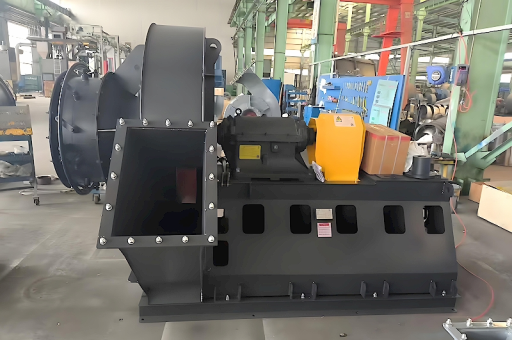
Here is a comprehensive breakdown of High Temperature Industrial Air Blower Machines and Fans used in Power Plants, focusing on their specific roles, types, and critical design features for handling extreme heat.
Why "High Temperature" is a Critical Specification
In a power plant (coal, gas, biomass, or nuclear), air is not just for ventilation. It is a process gas. It must be moved at high pressure and volume, often after being pre-heated or in direct contact with combustion byproducts.
"High Temperature" in this context typically means operating continuously at 200°C (392°F) to 400°C (752°F), with peak survival temperatures up to 700°C (1292°F) . Standard industrial fans would fail instantly under these conditions due to thermal expansion, material softening, and bearing failure.
Key Applications & Specific Fan Types
| Application | Fan Type | Air Temp Range | Key Function |
|---|---|---|---|
| Forced Draft (FD) Fan | Centrifugal (Airfoil or Backward Curved) | Ambient to ~30°C | Pushes ambient air into the boiler furnace or air heater. Rarely high-temp on its own, unless after an air heater. |
| Induced Draft (ID) Fan | Centrifugal (Radial or Paddle Wheel) | 140°C to 180°C (high temp) | Pulls hot flue gas through the boiler, economizer, and scrubber. Must handle corrosive, abrasive gas. |
| Primary Air (PA) Fan | Centrifugal (Backward Curved) | Ambient to ~30°C (for drying/pulverizing) | Provides high-pressure air to transport coal dust from the mill to the burner. |
| Secondary Air (SA) Fan | Axial or Centrifugal | Ambient (often pre-heated to ~300°C) | Provides additional combustion air for complete burnout of fuel. |
| Overfire Air (OFA) Fan | Axial or Centrifugal | Ambient or Mildly Heated (~150°C) | Aids in pollution control (NOx reduction) by injecting air above the main combustion zone. |
| Flue Gas Recirculation (FGR) Fan | Centrifugal (Radial) | 300°C to 400°C (Extreme High Temp) | Recirculates hot flue gas back into the combustion zone for temperature control and NOx reduction. |
Critical Design Features for High-Temperature Operation
To survive and perform reliably, these fans are engineered differently from standard industrial fans:
Impeller Design & Materials
- Material: High-strength, heat-resistant alloys like Inconel, Hastelloy, or stainless steel (310S, 253MA) are used instead of standard carbon steel.
- Wheel Type: Radial (Paddle Wheel) impellers are preferred for high-temperature, abrasive flue gas. They are robust, self-cleaning, and less prone to distortion.
- Thicker Blades: Blades are thicker and have reinforced leading edges to resist erosion from fly ash (SiO2, Al2O3 particles).
Shaft & Bearing Cooling
- Shaft Cooling: A heat barrier is critical.
- Heat Shroud: A metal guard around the shaft between the housing and bearing block dissipates heat.
- Air or Water Cooling:
- Air Cooling: A small fan (or the process air) blows over the shaft.
- Water Jacket: Cooling water circulates through a jacket around the bearing housing to keep the oil below 80°C.
- Labyrinth Seals: Special seals prevent hot gas from leaking along the shaft towards the bearings (which would cause catastrophic failure).
Casing & Expansion
- Insulated Casing: The fan housing is often lined with internal or external insulation to protect the structural steel and reduce heat loss.
- Expansion Joints: The inlet and outlet ductwork must have flexible joints (bellows) to allow for thermal expansion of the fan casing.
- Centerline Mounting: The fan is supported at the centerline of the shaft, allowing the casing to expand evenly in all directions without misaligning the rotor.
Drive System
- Variable Frequency Drives (VFDs): Mandatory for modern plants. They allow precise control of fan speed (RPM) to match boiler load, saving massive amounts of energy and reducing wear.
- Hydraulic Couplings: An alternative to VFDs for large fans, allowing speed control by varying the oil fill level.
Common Failure Modes & Maintenance
| Failure Mode | Cause | Solution |
|---|---|---|
| Impeller Blade Erosion | Fly ash particles impacting blades at high velocity. | Use hard-facing (Stellite, Tungsten Carbide) on blades. Repair via welding. |
| Impeller Creep & Distortion | Prolonged exposure to temperatures exceeding material limits (e.g., >500°C). | Material upgrade (e.g., to Inconel). Monitor gas temps. |
| Bearing Failure | Overheating due to poor cooling, lubricant breakdown, or hot gas ingress. | Check cooling water flow. Inspect oil condition. Replace seals. |
| Rotor Imbalance / Vibration | Uneven buildup of dust/ash on blades (deposits). Alternating blade erosion. | Regular cleaning (sootblowers on ID fans). Dynamic balancing. |
| Hot Gas Corrosion | Sulfuric acid condensation (when flue gas cools below acid dew point ~120°C). | Maintain operating temp above acid dew point. Use corrosion-resistant materials (Corten steel). |
Example: Selecting an ID Fan
A typical Induced Draft Fan for a 500MW coal plant might have these specifications:
- Type: Centrifugal, single or double inlet, radial blade.
- Flow: ~1,000,000 CFM (cubic feet per minute).
- Pressure: ~30 to 50 inches w.g. (water gauge).
- Temperature: 145°C (continuous).
- Impeller Material: 310S Stainless Steel, with 12mm thick blades.
- Motor: 5,000 HP, 890 RPM, with a VFD.
- Cooling: Water-cooled bearing housings.
Top Manufacturers for High-Temp Power Plant Fans
- Howden (Global leader, UK/USA)
- TLT-Turbo (Germany)
- ABB / FläktGroup (Sweden/Germany)
- Robinson Fans (USA)
- Zibo Decent Machinery (China, for cost-effective options)
- Johnson Industries (USA, for heavy-duty)
Summary: The Critical Rule for High-Temp Fans
"Never let the fan temperature exceed the material's creep limit for more than a few seconds."
Modern power plants rely on condition monitoring (vibration, bearing temperature, motor current) and automatic control systems (DCS) that will trip the fan or reduce load if temperatures spike, preventing a catastrophic and expensive impeller failure.
Do you need specific fan sizing calculations, or are you troubleshooting a specific issue (e.g., vibration at startup, overheating bearings)?





