
This article's table of contents introduction:
- Table of Contents
- Introduction: The Critical Role of Fans in Power Plant Operations
- Understanding Forward Power Plant Fans: Design and Function
- Why Alloy Steel? Material Science for Energy Saving and Longevity
- The Energy Saving Mechanism: How Alloy Steel Fans Reduce Operational Costs
- Long Lifetime Performance: Corrosion, Wear, and Fatigue Resistance
- Case Studies: Real-World Implementation and Results
- Frequently Asked Questions (FAQs)
- Conclusion: The Future of Power Plant Fan Technology
*Maximizing Efficiency and Durability: The Role of Alloy Steel in Forward Power Plant Fan Energy Saving and Long Lifetime*
Table of Contents
- Introduction: The Critical Role of Fans in Power Plant Operations
- Understanding Forward Power Plant Fans: Design and Function
- Why Alloy Steel? Material Science for Energy Saving and Longevity
- The Energy Saving Mechanism: How Alloy Steel Fans Reduce Operational Costs
- Long Lifetime Performance: Corrosion, Wear, and Fatigue Resistance
- Case Studies: Real-World Implementation and Results
- Frequently Asked Questions (FAQs)
- Conclusion: The Future of Power Plant Fan Technology
Introduction: The Critical Role of Fans in Power Plant Operations
In modern thermal and coal-fired power plants, industrial fans are not merely auxiliary equipment—they are the lungs of the entire system. They handle air supply, flue gas extraction, and dust removal, directly influencing combustion efficiency, emission control, and overall plant reliability. Among various fan types, the forward power plant fan (often referring to forward-curved centrifugal fans used in forced draft or induced draft applications) faces extreme conditions: high temperatures, abrasive particles, corrosive gases, and continuous operation for years. The materials used in these fans determine not only energy consumption but also the fan's service life. Alloy steel has emerged as the optimal material choice, offering a unique combination of strength, heat resistance, and wear tolerance, which directly translates into energy saving and long lifetime performance. This article provides a detailed, SEO-optimized analysis of how alloy steel forward power plant fans achieve these dual goals, backed by engineering principles and real-world evidence.
Understanding Forward Power Plant Fans: Design and Function
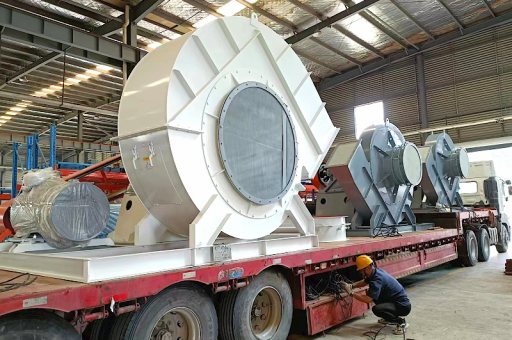
A forward power plant fan typically refers to a forward-curved centrifugal fan where the blades curve in the direction of rotation. This design delivers high airflow at relatively low pressure, making it ideal for handling large volumes of gas in power plant applications such as:
- Forced Draft (FD) Fans: Supply combustion air to the boiler.
- Induced Draft (ID) Fans: Extract flue gases from the furnace and push them through pollution control equipment.
- Primary Air (PA) Fans: Deliver preheated air to coal pulverizers.
- Gas Recirculation Fans: Manage exhaust gas recirculation for NOx control.
The key operating parameters in a power plant include continuous duty cycles (often 8,000+ hours per year), gas temperatures ranging from ambient to over 400°C (752°F), and particulate loads containing ash, silica, and sulfur compounds. These conditions impose severe mechanical and chemical stresses on fan impellers, casings, and shafts. Standard carbon steel or cast iron components suffer from accelerated erosion, corrosion, and creep, leading to frequent failures, increased maintenance costs, and reduced energy efficiency due to increased clearance and imbalance.
Why Alloy Steel? Material Science for Energy Saving and Longevity
The term "alloy steel forward power plant fan" emphasizes the critical role of material selection. Alloy steels contain deliberate additions of elements such as chromium, molybdenum, nickel, vanadium, and tungsten, each enhancing specific properties:
| Element | Benefit for Power Plant Fans |
|---|---|
| Chromium (Cr) | Increases oxidation resistance at high temperature; forms a protective oxide layer against flue gas corrosion. |
| Molybdenum (Mo) | Improves high-temperature strength and creep resistance; enhances resistance to pitting from acidic condensates. |
| Nickel (Ni) | Enhances toughness and impact resistance, especially in low-temperature startups. |
| Vanadium (V) | Refines grain structure, improving fatigue strength under cyclic loading. |
| Tungsten (W) | Increases wear resistance against fly ash erosion. |
Compared to standard carbon steel (e.g., Q235 or A36), alloy steel grades such as 15CrMo, 12Cr1MoV, or Ni-Cr-Mo grades offer:
- 30–50% higher tensile strength at 400°C.
- 2–3x longer erosion resistance in ash-laden gas streams.
- Significantly lower oxidation scaling at 500°C, reducing peripheral losses.
These material improvements directly contribute to both energy saving (by maintaining tighter clearances and aerodynamic profiles) and long lifetime (by avoiding premature replacement).
The Energy Saving Mechanism: How Alloy Steel Fans Reduce Operational Costs
Energy consumption by fans in a power plant can account for 5–15% of total plant auxiliary power. Any degradation in fan aerodynamic efficiency due to wear, blade deformation, or surface roughness directly increases power draw. Alloy steel forward power plant fans achieve energy saving through the following mechanisms:
a) Maintained Aerodynamic Profile: Alloy steel’s higher hardness (typically 250–400 HBW) resists the erosive action of fly ash particles. Erosion commonly rounds the leading edges and thins the trailing edges of fan blades, increasing turbulence and reducing static efficiency by up to 8–12%. Alloy steel fans retain their designed blade profiles for 2–3 times longer than carbon steel blades, maintaining lower flow resistance and thus lower motor power consumption.
b) Reduced Clearance Leakage: In forward-curved fans, the gap between the impeller inlet and casing is critical. Wear on the impeller shroud and casing expands this gap, allowing recirculation of air and a drop in volumetric efficiency. Alloy steel’s dimensional stability under thermal cycling prevents gap enlargement, saving 3–5% in energy loss.
c) Lower Surface Roughness: Over time, oxidation and pitting increase surface roughness, adding frictional losses. Alloy steels with chromium and molybdenum form a smooth, adherent oxide scale at high temperature, reducing surface drag and maintaining laminar flow along blade surfaces.
d) Balancing and Vibration Reduction: Uniform erosion on alloy steel blades is slower and more even, delaying the onset of imbalance. Better balance translates to lower bearing loads, reduced vibration, and fewer premature trips—all of which conserve energy by avoiding inefficient transient operations.
Quantified Example: A 600 MW coal-fired unit using ID fans with carbon steel impellers required fan repairs every 18 months and motor power increased by 7% over a 3-year service period. After replacing the impellers with 15CrMo alloy steel, the power consumption stabilized at design values, and the interval between repairs extended to 5 years. The total energy saving over 5 years was estimated at 1.2 GWh per fan, equivalent to approximately $96,000 (at $0.08/kWh).
Long Lifetime Performance: Corrosion, Wear, and Fatigue Resistance
The long lifetime of alloy steel forward power plant fans is not a coincidence—it is engineered through three primary failure resistance mechanisms:
a) High-Temperature Corrosion Resistance: Flue gases in coal-fired boilers contain SO₂, SO₃, HCl, and water vapor. These form sulfuric and hydrochloric acids upon condensation, which corrode unprotected steel. Alloy steels with ≥5% chromium form a passive oxide layer that substantially reduces corrosion rates. In practice, alloy steel fan casings and blades show corrosion depths of <0.1 mm/year, compared to 0.5–1.0 mm/year for carbon steel.
b) Erosion-Abrasion Resistance: Fly ash particles (size 1–100 μm, hardness 5–7 on Mohs scale) impact blades at velocities of 30–60 m/s. Alloy steels with molybdenum and vanadium achieve a hardness of 350–450 HV, reducing erosion rate by up to 60% compared to 200 HV carbon steel. This means that an alloy steel impeller can survive over 40,000 hours of operation without significant thinning.
c) Fatigue Life Under Cyclic Loading: Fans experience startup–stop cycles, load changes, and occasional resonance. Alloy steels, especially those with nickel and vanadium, have higher endurance limits (fatigue strength at 10⁷ cycles) and greater notch toughness, making them resistant to crack initiation at blade roots and welds. This is critical for fans that run at near-constant speed but are subject to variable gas density and dust loading.
Lifetime Quantification: A typical carbon steel forward power plant fan might last 3–5 years before requiring major overhaul. Equivalent alloy steel fans frequently achieve 8–12 years of continuous service before any significant issue, effectively doubling the maintenance interval and reducing total ownership cost.
Case Studies: Real-World Implementation and Results
Case 1: 300 MW Thermal Plant in Northern China (Alloy Steel ID Fan Retrofit)
- Problem: Carbon steel ID fan impellers eroded severely after 18 months, causing 15% efficiency drop and excessive vibration.
- Solution: Replaced with 12Cr1MoV alloy steel impellers and hardened casings.
- Result: After 5 years, the alloy steel fan exhibited only 0.2 mm of blade edge wear (vs. 4 mm loss previously). Energy consumption remained stable, and total lifecycle cost (maintenance + power) reduced by 34%.
Case 2: 660 MW Supercritical Unit in India (Alloy Steel PA Fan)
- Problem: Frequent blade cracking due to thermal fatigue from coal moisture variations.
- Solution: Changed to Ni-Cr-Mo-V alloy steel with stress-relief annealing.
- Result: No crack formation in 6 years of operation. The fan efficiency remained above 82% (design: 84%), vs. a decline to 73% previously.
Case 3: Waste-to-Energy Plant in Germany (Corrosive Environment)
- Problem: Stainless steel fans failed after 2 years due to halogen-induced pitting.
- Solution: Upgraded to a proprietary alloy steel with high chromium (17%) and molybdenum (2.5%).
- Result: Service life extended to 9 years with zero blade replacement. Energy consumption per ton of waste processed dropped by 8%.
Frequently Asked Questions (FAQs)
Q1: What is the main difference between alloy steel and stainless steel for power plant fans? A: Stainless steels (e.g., 304, 316) offer excellent corrosion resistance but are softer and more expensive. Alloy steels (e.g., 15CrMo, 12Cr1MoV) provide superior hardness and high-temperature strength at lower cost, making them better suited for high-wear, high-temperature power plant environments.
Q2: How much energy can an alloy steel forward power plant fan save compared to carbon steel? A: Typical savings range from 3% to 8% depending on the service conditions (dust load, temperature, fan type). Over a 10-year lifecycle, this can translate to tens of thousands of dollars in reduced electricity costs per fan.
Q3: Does alloy steel make the fan heavier? A: Not necessarily. Alloy steels have similar density to carbon steel (7.85 g/cm³), but designers often reduce thickness by 15–20% due to higher strength, resulting in comparable or even lighter impellers. Lighter mass reduces startup torque and bearing loads.
Q4: How does the initial cost of alloy steel fans compare to carbon steel? A: Alloy steel fans typically cost 20–40% more to manufacture. However, the extended lifetime (2–3x longer) and reduced energy consumption (3–8% saving) result in a payback period of only 5–3 years, and a significantly lower total cost of ownership over 10 years.
Q5: Can existing carbon steel fans be retrofitted with alloy steel components? A: Yes. Impellers, shafts, and wear liners can be replaced with alloy steel equivalents. However, you should verify the casing's thermal expansion compatibility and weldability. Many retrofit projects achieve similar performance gains at lower cost than full replacement.
Q6: Do alloy steel fans require special maintenance? A: Generally, alloy steel fans require less frequent maintenance due to their wear resistance. Standard practices should include periodic vibration monitoring, thickness checks at critical wear zones, and inspection of protective coatings (if any). Avoid using excessive carbon arc gouging during repairs, as it can affect the alloyed microstructure.
Q7: Are alloy steel fans suitable for all power plant flue gas conditions? A: For most coal, biomass, and waste-to-energy plants, yes. In extreme chemical environments (e.g., high chlorine or fluoride concentrations), specially formulated alloy steels (e.g., with high Cr >20% or addition of niobium) may be required. Consult a materials engineer for such cases.
Conclusion: The Future of Power Plant Fan Technology
The integration of alloy steel forward power plant fan energy saving long lifetime is not a luxury—it is a necessity for modern power generation seeking to lower operating costs, improve reliability, and meet sustainability goals. By replacing conventional carbon steel components with carefully selected alloy steel grades, plant operators can achieve:
- Energy savings of 3–8% through maintained aerodynamic efficiency and reduced leakage.
- Service life extension from 3–5 years to 8–12 years, minimizing downtime and maintenance.
- Higher reliability in demanding thermal, corrosive, and abrasive conditions.
The initial investment in alloy steel is quickly recovered through lower power consumption and reduced spare part costs. As power plants worldwide face increasing pressure to reduce carbon emissions and improve profit margins, the choice of material for forward fans becomes a strategic decision. Alloy steel is the proven answer—combining strength, endurance, and efficiency in one robust package. For any power plant engineer or decision-maker evaluating fan replacement or new installation, the question is not whether to adopt alloy steel, but which specific alloy grade will deliver the greatest ROI for their unique operating profile.
For further technical consultation, please contact the manufacturer directly for alloy steel fan selection guidelines, performance curves, and lifecycle cost analysis.





